
DART Asteroid Mission, Rescue Robots, Raccoon Vaccination, Medical Marijuana and Workplace Rules, Lanternfly Signals. Sept 30, 2022, Part 2
Science Friday30 Sep 2022

DART Asteroid Mission, Rescue Robots, Raccoon Vaccination, Medical Marijuana and Workplace Rules, Lanternfly Signals. Sept 30, 2022, Part 2

After Hurricane Ian, Robots To The Rescue

Hurricane Ian made landfall in southwest Florida Wednesday, with winds over 150 miles per hour, high storm surge and heavy rains. As the storm, now weaker, is projected to move northward, search and rescue operations are setting out to assess the damage – with help from robots, both flying and swimming.

Producer Christie Taylor talks with David Merrick, who is leading the emergency management team responsible for flying drones over areas hit by disasters like Ian, about what it takes to use robots in these contexts and how they help speed up response and recovery efforts.

Vague Medical Marijuana Rules Leave Workers and Employers in the Dark

Vague legal safeguards for medical marijuana users in Pennsylvania are forcing patients to choose between their job and a drug they say has changed their life, and leaving skittish employers vulnerable to lawsuits, according to a three-month Spotlight PA investigation.

While state law protects workers from being fired or denied a job just for having a doctor’s permission to use marijuana, those protections become opaque when people actually take the drug — regardless of whether they do it in their personal time.

“It essentially makes no sense,” Pittsburgh attorney John McCreary Jr., who represents employers, told Spotlight PA.

Some jobs are specifically regulated by state and federal drug testing rules, but most fall into a gray area that leaves the interpretation of the rules up to employers and the courts. That leads to inconsistency and what employers see as a lose-lose scenario: Either risk a wrongful termination suit, or potentially allow an unsafe work environment.

Read the rest of the article at sciencefriday.com.

The DART Asteroid Impact Mission: It’s A Cosmic Smash

This week, a small spacecraft slammed into an asteroid—on purpose. The mission, known as DART (for ‘Double Asteroid Redirection Test’) was an effort to try out a potential means of planetary defense. NASA wanted to discover: Is it possible to change the path of an approaching asteroid by slamming something into it?

On Monday evening, the DART spacecraft slammed into the small asteroid moonlet Dimorphos, which orbits a slightly larger asteroid called Didymos. Pictures taken from onboard the spacecraft showed the rocky, rubbly terrain of Dimorphos approaching closer and closer, then disappearing, while telescopes observing the impact and cameras on a neighboring Italian Space Agency CubeSat showed a plume of debris ejected from the asteroid.

Dr. Nancy Chabot, the DART coordination lead and a planetary scientist at Johns Hopkins Applied Physics Laboratory, which built the spacecraft and is managing the mission for NASA’s Planetary Defense Coordination Office, joins host John Dankosky. They talk about the impact, and what scientists hope to learn about asteroids and planetary defense from the crash.

High-Flying Trick-Or-Treat Delivers Rabies Vaccines For Raccoons

Rabies is one of the deadliest diseases in the world. It’s fatal in 99% of cases. Because of that, rabies prevention has been one of the most important—and successful—public health initiatives in the US.

To contain rabies outbreaks, the USDA leads a mass vaccination effort from August to October to keep the disease from being carried by critters. It’s an action-packed adventure involving raccoons, helicopters, and fish-flavored candy.

SciFri’s director of news and audio, John Dankosky, speaks with Jordona Kirby, the rabies field coordinator for the USDA’s National Rabies Management Program. She’s based in Milton, Florida.

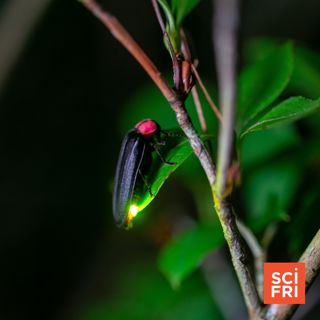
Can Lanternflies’ Excretions Be Used To Quell Their Spread?

As the invasive spotted lanternfly continues to spread west in the United States, researchers are trying to better understand—and perhaps find a way to control —the behavior of the pretty, but ravenous, insects. Important agricultural crops, including grapes, peaches, and apples are especially at risk from the spreading infestation.

As the lanternflies feed on tree sap, they excrete a sweet-smelling liquid known as honeydew. That liquid can attract other insects, and can also allow fungus to grow on affected trees. Writing in the journal Frontiers In Insect Science this week, researchers from the USDA’s Animal and Plant Health Inspection Service report that chemicals in the honeydew may act as a signaling agent among the lanternflies—in some cases attracting others of the species. The finding may help explain the way in which the insects can infest a given tree in huge numbers, while leaving neighboring trees largely alone.

John Dankosky talks with the paper’s lead author, Dr. Miriam Cooperband of USDA APHIS, about her research, and whether the finding may lead to a way to bait or repel the invasive insects.

Transcripts for each segment will be available the week after the show airs on sciencefriday.com.

Subscribe to this podcast. Follow our show on Instagram, TikTok, Facebook, and Bluesky @scifri and sign up for our newsletters. Got a science question that’s keeping you up at night? Call us: 877-472-4374


Hosted by Simplecast, an AdsWizz company. See pcm.adswizz.com for information about our collection and use of personal data for advertising.

Denne episoden er hentet fra en åpen RSS-feed og er ikke publisert av Podme. Den kan derfor inneholde annonser.

Episoder(1340)

Can you learn to love the scorpion?

Can you learn to love the scorpion?

If you have arachnophobia, consider this your opportunity to try exposure therapy: A new study suggests that 415 million years ago, in modern-day England and Wales, a scorpion the length of a golden r...

23 Jun 18min

FDA approves a well-known sunscreen ingredient—finally

FDA approves a well-known sunscreen ingredient—finally

The FDA recently approved a sunscreen ingredient called bemotrizinol, or BEMT, that’s been used in Europe and Asia for years. This is the first new sunscreen ingredient approved in the United States i...

22 Jun 12min

Why do sports announcers talk like that?

Why do sports announcers talk like that?

If you watch sports, whether the recent NBA finals or the ongoing World Cup matches, you may have noticed that the athletes aren’t the only ones putting on a show. The announcers seem to be playing a ...

19 Jun 13min

Swords, cannibalism, poison: inside the world of killer microbes

Swords, cannibalism, poison: inside the world of killer microbes

There is a murderous crime spree happening right under—and perhaps inside—our noses. Killer microbes armed with weapons are eviscerating, assassinating, and detonating their fellow microbes. And the n...

18 Jun 21min

When music transports you to a different place

When music transports you to a different place

Do you ever hear a song that transports you to a specific place and time? This auditory wormhole has a name: musical daydreams. Music cognition expert Elizabeth Margulis studies why they happen, and w...

17 Jun 18min

A vast whale graveyard + Zombie sea cucumbers

A vast whale graveyard + Zombie sea cucumbers

Researchers just published details of a massive undersea graveyard of whales deep in the Indian Ocean. Spanning about 1,200 kilometers (745 miles), it contains whale remains dating back more than 5 mi...

16 Jun 18min

Should we bring mountain lions back to the Northeast?

Should we bring mountain lions back to the Northeast?

Big cats used to roam the entire United States. You might know them as mountain lions, pumas, cougars, or catamounts. Though they go by many names, they're actually all the same species.  Their curren...

15 Jun 12min

Blue Origin explosion hits NASA timeline + Artemis III crew

Blue Origin explosion hits NASA timeline + Artemis III crew

When Blue Origin’s New Glenn spacecraft exploded in an enormous fireball during a ground test a couple weeks ago, it sent shockwaves not only through the air, but through NASA’s timeline for the upcom...

12 Jun 12min

Populært innen Vitenskap

fastlegen
jss
tingenes-tilstand
forskningno
liberal-halvtime
rss-nysgjerrige-norge
rekommandert
sinnsyn
tomprat-med-gunnar-tjomlid
villmarksliv
rss-paradigmepodden
dekodet-2
rss-overskuddsliv
rss-inn-til-kjernen-med-sunniva-rose
rss-ingeniorpodden
hva-er-greia-med
fjellsportpodden
nevropodden
rss-rekommandert
rss-lundqvist-podden