Vision and the Brain, Jellypalooza. Sept 29, 2023, Part 1
Science Friday29 Sep 2023

Vision and the Brain, Jellypalooza. Sept 29, 2023, Part 1

After 7 Years, NASA Gets Its Asteroid Sample

About a week ago, space nerds got the delivery of a lifetime: a sample from Bennu, an asteroid soaring through the galaxy, currently about 200 million miles away. The capsule of rocks and dust came courtesy of NASA’s OSIRIS-REx, the first U.S. mission to collect a sample from an asteroid.

Scientists hope it’ll help unveil some of the mysteries of our universe, like how the sun and planets came to exist or how life began. Guest host and musician Dessa talks with Sophie Bushwick, technology editor at Scientific American, about this week in science. They also chat about how antimatter interacts with gravity, the new RSV vaccine for pregnant people, why LED streetlights are turning purple, and how beetles came to dominate all other species, especially ants.

How You See With Your Brain

Ever try to take a picture of a spectacular moon that looks like it fills up half the sky? And then you look at the photo, and the moon looks like a tiny dumb ping-pong ball? And you want to march into the Apple store and demand to know why this pocket-size device fails to capture the wonder of the cosmos properly?

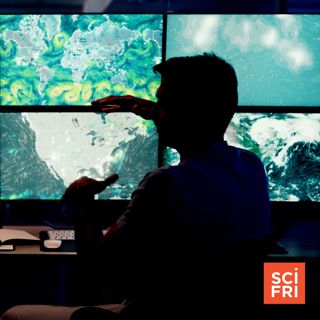
The majesty of that supermoon you saw might be in your head as much as it is in the sky—your brain does a lot more than just receive data reports from your eyes. Vision is complicated. Seeing involves a lot of interpretation, of which you’re usually unaware.

Guest host and musician Dessa talks with neuroscientist Dr. Cheryl Olman, associate professor in the University of Minnesota’s psychology department, about her work to better understand how the brain processes visual information using sophisticated fMRI techniques, including studying the brains of people with schizophrenia.

Are Jellyfish Smarter Than We Think?

Jellyfish are known for their graceful, hypnotic movement through the water—and for occasionally stinging swimmers. One thing they’re not known for, however, is intelligence. A study published in the journal Current Biology, however, challenges the idea of the ‘brainless’ jellyfish by showing that at least one species of jelly may be capable of associative learning.

The scientists were studying the Caribbean box jellyfish, which normally lives amongst a forest of tangled mangrove tree roots. In the lab, they painted false roots on the walls of the jellyfish’s tank, and watched to see what happened. At first, the jellies judged the low-contrast gray roots to be far away, and tried to swim through them. After a few collisions with the tank, however, the jellies learned that the false roots were closer than they appeared, and learned to keep their distance.

Dr. Anders Garm, an associate professor of marine biology at the University of Copenhagen in Denmark, joins guest host Dessa to explain the experiment, and what it tells researchers about the connection between the behavior of small groups of neurons and the process of learning.

The Mysteries Of Freshwater Jellyfish

In 1933, a high schooler fishing along the Huron River in Ann Arbor, Michigan looked into the water and saw something weird. It turned out to be a freshwater jellyfish – the first ever discovered in the Great Lakes region. Later that year, there was another sighting in Lake Erie.

Researchers think the species hitched a ride here on aquatic plants shipped from China, then spread. But there’s no evidence they harm the lake ecosystems they now call home.

Since then, the jellyfish have spread across the Upper Midwest, loitering mostly in inland lakes, rivers, and streams. But we still don’t know all that much about them.

A biology professor and her field research class at Eastern Michigan University are hoping to change that. Every week, they slap on masks, snorkels, and floaties, and wade out into a southeast Michigan lake on the lookout for jellyfish.

Read the rest at sciencefriday.com.

To stay updated on all-things-science, sign up for Science Friday's newsletters.

Transcripts for each segment will be available the week after the show airs on sciencefriday.com.

Subscribe to this podcast. Follow our show on Instagram, TikTok, Facebook, and Bluesky @scifri and sign up for our newsletters. Got a science question that’s keeping you up at night? Call us: 877-472-4374


Hosted by Simplecast, an AdsWizz company. See pcm.adswizz.com for information about our collection and use of personal data for advertising.

Denne episoden er hentet fra en åpen RSS-feed og er ikke publisert av Podme. Den kan derfor inneholde annonser.

Episoder(1342)

That chlorine smell at the pool? It’s pee

That chlorine smell at the pool? It’s pee

On a hot summer day, there’s nothing better than a dip in a cold pool. But you know who can ruin that for you? A scientist who studies pool chemistry. What chemical reactions are happening in that swi...

25 Jun 12min

Under proposed rule, science funding must pass political review

Under proposed rule, science funding must pass political review

The federal Office of Management and Budget (OMB) has proposed rule changes that would bring a major shift in how scientific grants are awarded by U.S. government agencies. Under the current process, ...

24 Jun 12min

Can you learn to love the scorpion?

Can you learn to love the scorpion?

If you have arachnophobia, consider this your opportunity to try exposure therapy: A new study suggests that 415 million years ago, in modern-day England and Wales, a scorpion the length of a golden r...

23 Jun 18min

FDA approves a well-known sunscreen ingredient—finally

FDA approves a well-known sunscreen ingredient—finally

The FDA recently approved a sunscreen ingredient called bemotrizinol, or BEMT, that’s been used in Europe and Asia for years. This is the first new sunscreen ingredient approved in the United States i...

22 Jun 12min

Why do sports announcers talk like that?

Why do sports announcers talk like that?

If you watch sports, whether the recent NBA finals or the ongoing World Cup matches, you may have noticed that the athletes aren’t the only ones putting on a show. The announcers seem to be playing a ...

19 Jun 13min

Swords, cannibalism, poison: inside the world of killer microbes

Swords, cannibalism, poison: inside the world of killer microbes

There is a murderous crime spree happening right under—and perhaps inside—our noses. Killer microbes armed with weapons are eviscerating, assassinating, and detonating their fellow microbes. And the n...

18 Jun 21min

When music transports you to a different place

When music transports you to a different place

Do you ever hear a song that transports you to a specific place and time? This auditory wormhole has a name: musical daydreams. Music cognition expert Elizabeth Margulis studies why they happen, and w...

17 Jun 18min

A vast whale graveyard + Zombie sea cucumbers

A vast whale graveyard + Zombie sea cucumbers

Researchers just published details of a massive undersea graveyard of whales deep in the Indian Ocean. Spanning about 1,200 kilometers (745 miles), it contains whale remains dating back more than 5 mi...

16 Jun 18min

Populært innen Vitenskap

fastlegen
tingenes-tilstand
jss
liberal-halvtime
forskningno
rekommandert
sinnsyn
tomprat-med-gunnar-tjomlid
villmarksliv
rss-nysgjerrige-norge
rss-overskuddsliv
rss-paradigmepodden
rss-inn-til-kjernen-med-sunniva-rose
dekodet-2
noen-har-snakket-sammen
nevropodden
rss-ingeniorpodden
vett-og-vitenskap-med-gaute-einevoll
utenrikshospitalet
hva-er-greia-med