Ancient Human Footprints & 'Ring Of Fire' Eclipse
Science Friday13 Okt 2023

Ancient Human Footprints & 'Ring Of Fire' Eclipse

A new analysis of ancient footprints in New Mexico adds to the debate about when humans arrived in North America. Plus, astronomer Dean Regas offers tips for safe viewing of Saturday’s eclipse.

New Data Support Human Arrival In North America 22,000 Years Ago

In 2021, scientists uncovered ancient human footprints in White Sands, New Mexico. Dating of the footprints suggested that people arrived in North America thousands of years earlier than anthropologists had thought. It sparked fierce debate among researchers, some of whom raised concerns about the radiocarbon dating process used in the original study. Now, a new study provides additional data supporting humans’ arrival in North America 22,000 years ago.

Ira talks with Maggie Koerth, editorial lead at Carbon Plan about the latest in this debate about the peopling of North America and other top science news of the week including how solar storms affect bird migration, why ants are getting ensnared in plastic, and how climate change is improving Bordeaux wine.

This Weekend’s ‘Ring Of Fire’ Eclipse

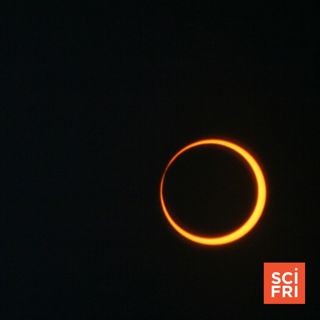
This Saturday, much of the continental United States will be treated to an astronomical event—an annular solar eclipse. In this type of eclipse, the apparent sizes of the moon and sun don’t align perfectly to Earth-bound viewers, resulting in a solar “ring of fire” shining around the edges of a moon nestled inside the boundaries of the sun.

The best viewing will come in a 125-mile-wide band known as the path of annularity, which will stretch from Eugene, Oregon to San Antonio, Texas, and then on into Mexico and Central America. Viewers outside that band will still be able to see some parts of the eclipse, with the percent coverage depending on how far they are from that central line.

Even though the sun will be partly covered, it is NOT safe to look directly at the sun without eclipse glasses. If you don’t have glasses, you can look at a projection of the sun through a pinhole onto the ground or another surface—but don’t look through the pinhole at the sun. Astronomer and author Dean Regas joins Ira for an eclipse preview, and to offer viewing tips on when, where, and how to best view the solar event.

To stay updated on all things science, sign up for Science Friday's newsletters.

Transcripts for each segment will be available the week after the show airs on sciencefriday.com.

Subscribe to this podcast. Follow our show on Instagram, TikTok, Facebook, and Bluesky @scifri and sign up for our newsletters. Got a science question that’s keeping you up at night? Call us: 877-472-4374


Hosted by Simplecast, an AdsWizz company. See pcm.adswizz.com for information about our collection and use of personal data for advertising.

Denne episoden er hentet fra en åpen RSS-feed og er ikke publisert av Podme. Den kan derfor inneholde annonser.

Episoder(1342)

That chlorine smell at the pool? It’s pee

That chlorine smell at the pool? It’s pee

On a hot summer day, there’s nothing better than a dip in a cold pool. But you know who can ruin that for you? A scientist who studies pool chemistry. What chemical reactions are happening in that swi...

25 Jun 12min

Under proposed rule, science funding must pass political review

Under proposed rule, science funding must pass political review

The federal Office of Management and Budget (OMB) has proposed rule changes that would bring a major shift in how scientific grants are awarded by U.S. government agencies. Under the current process, ...

24 Jun 12min

Can you learn to love the scorpion?

Can you learn to love the scorpion?

If you have arachnophobia, consider this your opportunity to try exposure therapy: A new study suggests that 415 million years ago, in modern-day England and Wales, a scorpion the length of a golden r...

23 Jun 18min

FDA approves a well-known sunscreen ingredient—finally

FDA approves a well-known sunscreen ingredient—finally

The FDA recently approved a sunscreen ingredient called bemotrizinol, or BEMT, that’s been used in Europe and Asia for years. This is the first new sunscreen ingredient approved in the United States i...

22 Jun 12min

Why do sports announcers talk like that?

Why do sports announcers talk like that?

If you watch sports, whether the recent NBA finals or the ongoing World Cup matches, you may have noticed that the athletes aren’t the only ones putting on a show. The announcers seem to be playing a ...

19 Jun 13min

Swords, cannibalism, poison: inside the world of killer microbes

Swords, cannibalism, poison: inside the world of killer microbes

There is a murderous crime spree happening right under—and perhaps inside—our noses. Killer microbes armed with weapons are eviscerating, assassinating, and detonating their fellow microbes. And the n...

18 Jun 21min

When music transports you to a different place

When music transports you to a different place

Do you ever hear a song that transports you to a specific place and time? This auditory wormhole has a name: musical daydreams. Music cognition expert Elizabeth Margulis studies why they happen, and w...

17 Jun 18min

A vast whale graveyard + Zombie sea cucumbers

A vast whale graveyard + Zombie sea cucumbers

Researchers just published details of a massive undersea graveyard of whales deep in the Indian Ocean. Spanning about 1,200 kilometers (745 miles), it contains whale remains dating back more than 5 mi...

16 Jun 18min

Populært innen Vitenskap

fastlegen
tingenes-tilstand
jss
liberal-halvtime
forskningno
rekommandert
sinnsyn
tomprat-med-gunnar-tjomlid
villmarksliv
rss-nysgjerrige-norge
rss-overskuddsliv
rss-paradigmepodden
rss-inn-til-kjernen-med-sunniva-rose
dekodet-2
noen-har-snakket-sammen
nevropodden
rss-ingeniorpodden
vett-og-vitenskap-med-gaute-einevoll
utenrikshospitalet
hva-er-greia-med