Flame Retardant From Cocoa Pod Husks | The Oozy Physics Of Oobleck
Science Friday20 Des 2023

Flame Retardant From Cocoa Pod Husks | The Oozy Physics Of Oobleck

Flame Retardant Could Be Made From Discarded Cocoa Husks

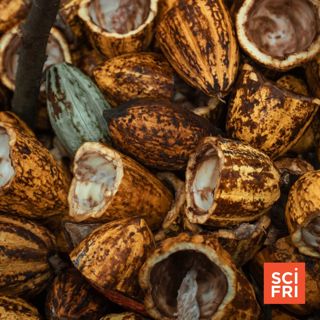
On cocoa farms around the world, cocoa beans are pulled from their pods, and the hard husks are discarded, leaving 20 million tons of plant waste to biodegrade and potentially harm future crops. These husks are a source of lignin, a substance that gives plants their rigidity. It’s extremely abundant—but often wasted.

A new study published in the journal ACS Sustainable Chemistry and Engineering found that the lignin processed from leftover cocoa pod husks could have a new use as an ingredient in flame retardant.

“Lignin is pretty special, as it is very soluble in organic solvents,” said study co-author Dr. Nicholas Westwood, a professor of chemistry and chemical biology at St. Andrews University in Scotland, in an email. This means lignin can be chemically manipulated to create a number of useful substances relatively easily.

Because of lignin’s malleability, Westwood and his coauthors were able to add a flame-retardant molecule to the processed substance, and found that the modification increased its already naturally high ability to smother flames.

That’s just one possible application. While lignin hasn’t found widespread industrial use yet, scientists hold hope for it to become a greener alternative for fuel and a biodegradable plastic instead of just being leftovers. Processing biomass for food or fuel also produces a massive amount of lignin as a byproduct, which has been converted to materials like activated charcoal or carbon foam. “There are endless possibilities,” Westwood said.

​​Joining Ira to talk about lignin and its potential uses is Dr. Rigoberto Advincula, a materials scientist with the Oak Ridge National Laboratory and the University of Tennessee in Knoxville.

The Oozy Physics Of Oobleck

You may be familiar with a common science demonstration done in classrooms: If you mix cornstarch and water together in the right proportions, you create a gooey material that seems to defy the rules of physics. It flows like a liquid, but when you try to handle it quickly, it stiffens up.

This kind of material is called an oobleck, and it’s a type of non-Newtonian fluid, meaning its viscosity changes under pressure or stress. Oobleck-like materials include human-made things like Silly Putty and paint, but are also found in nature; blood and quicksand are both non-Newtonian fluids.

For a long time, it’s been hard to prove exactly why these materials act the way they do. But recently, scientists developed a better understanding of the underlying physics. A new study conducted in collaboration between the James Franck Institute and Pritzker School of Molecular Engineering at the University of Chicago was able to demonstrate this mechanism.

“The findings from this study are important because they provide direct experimental evidence for one of the mechanisms proposed for strong shear thickening,” says Dr. Heinrich Jaeger, professor of physics at the University of Chicago. “Namely, frictional interactions as the particles in the liquid are sheared into contact.” Jaeger is a co-author of the study, which was led by postdoctoral researcher Dr. Hojin Kim.

Jaeger and Kim speculate that a better understanding of non-Newtonian fluids could help in the development of new, advanced materials. The potential ranges from flexible speed bumps to impact-resistant clothing. Jaeger joins Ira to talk about it.

Transcripts for each segment will be available after the show airs on sciencefriday.com.

Subscribe to this podcast. Follow our show on Instagram, TikTok, Facebook, and Bluesky @scifri and sign up for our newsletters. Got a science question that’s keeping you up at night? Call us: 877-472-4374


Hosted by Simplecast, an AdsWizz company. See pcm.adswizz.com for information about our collection and use of personal data for advertising.

Denne episoden er hentet fra en åpen RSS-feed og er ikke publisert av Podme. Den kan derfor inneholde annonser.

Episoder(1340)

Can you learn to love the scorpion?

Can you learn to love the scorpion?

If you have arachnophobia, consider this your opportunity to try exposure therapy: A new study suggests that 415 million years ago, in modern-day England and Wales, a scorpion the length of a golden r...

23 Jun 18min

FDA approves a well-known sunscreen ingredient—finally

FDA approves a well-known sunscreen ingredient—finally

The FDA recently approved a sunscreen ingredient called bemotrizinol, or BEMT, that’s been used in Europe and Asia for years. This is the first new sunscreen ingredient approved in the United States i...

22 Jun 12min

Why do sports announcers talk like that?

Why do sports announcers talk like that?

If you watch sports, whether the recent NBA finals or the ongoing World Cup matches, you may have noticed that the athletes aren’t the only ones putting on a show. The announcers seem to be playing a ...

19 Jun 13min

Swords, cannibalism, poison: inside the world of killer microbes

Swords, cannibalism, poison: inside the world of killer microbes

There is a murderous crime spree happening right under—and perhaps inside—our noses. Killer microbes armed with weapons are eviscerating, assassinating, and detonating their fellow microbes. And the n...

18 Jun 21min

When music transports you to a different place

When music transports you to a different place

Do you ever hear a song that transports you to a specific place and time? This auditory wormhole has a name: musical daydreams. Music cognition expert Elizabeth Margulis studies why they happen, and w...

17 Jun 18min

A vast whale graveyard + Zombie sea cucumbers

A vast whale graveyard + Zombie sea cucumbers

Researchers just published details of a massive undersea graveyard of whales deep in the Indian Ocean. Spanning about 1,200 kilometers (745 miles), it contains whale remains dating back more than 5 mi...

16 Jun 18min

Should we bring mountain lions back to the Northeast?

Should we bring mountain lions back to the Northeast?

Big cats used to roam the entire United States. You might know them as mountain lions, pumas, cougars, or catamounts. Though they go by many names, they're actually all the same species.  Their curren...

15 Jun 12min

Blue Origin explosion hits NASA timeline + Artemis III crew

Blue Origin explosion hits NASA timeline + Artemis III crew

When Blue Origin’s New Glenn spacecraft exploded in an enormous fireball during a ground test a couple weeks ago, it sent shockwaves not only through the air, but through NASA’s timeline for the upcom...

12 Jun 12min

Populært innen Vitenskap

fastlegen
jss
tingenes-tilstand
forskningno
liberal-halvtime
rss-nysgjerrige-norge
rekommandert
sinnsyn
tomprat-med-gunnar-tjomlid
villmarksliv
rss-paradigmepodden
dekodet-2
rss-overskuddsliv
rss-inn-til-kjernen-med-sunniva-rose
rss-ingeniorpodden
hva-er-greia-med
fjellsportpodden
nevropodden
rss-rekommandert
rss-lundqvist-podden