
Which Feathered Dinosaurs Could Fly? | Some French Cheeses At Risk Of Extinction
Science Friday20 Feb 2024

Which Feathered Dinosaurs Could Fly? | Some French Cheeses At Risk Of Extinction

How Do You Know If A Feathered Dinosaur Could Fly?

Not all birds can fly. Penguins, ostriches, and kiwis are some famous examples.

It’s pretty easy to figure out if a living bird can fly. But it’s a bit tricker when it comes to extinct birds or bird ancestors, like dinosaurs. Remember, all birds are dinosaurs, but not all dinosaurs evolved into birds.

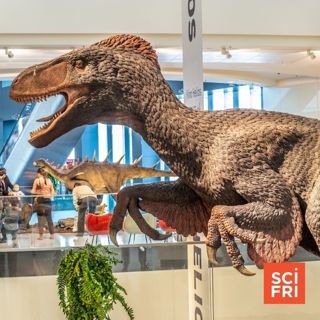
Scientists at Chicago’s Field Museum wanted to figure out if there was a way to tell if a dinosaur could fly or not. They found that the number and symmetry of flight feathers are reliable indicators of whether a bird or dinosaur could lift off the ground.

Ira talks with two of the study’s co-authors about their research and how it might help us understand how dinosaur flight evolved. Dr. Yosef Kiat is a postdoctoral researcher and Dr. Jingmai O’Connor is the associate curator of fossil reptiles at The Field Museum in Chicago.

Sacre Bleu! Some French Cheeses At Risk Of Extinction

There’s bad news for the Camembert and brie lovers out there: According to the French National Center for Scientific Research, some beloved soft cheeses are at risk of extinction. The culprit? A lack of microbial diversity in the mold strains used to make Camemberts and bries.

As with many foods, consumers expect the cheese they buy to be consistent over time. We want the brie we buy today to look and taste like the brie we bought three months ago. But there’s a downside to this uniformity—the strain of Penicillium microbes used to make these cheeses can’t reproduce sexually, meaning it must be cloned. That means these microbes are not resilient, and susceptible to errors in the genome. Over the years, P. camemberti has picked up mutations that make it much harder to clone, meaning it’s getting harder to create the bries we know and love.

Joining Ira to talk about this is Benji Jones, senior environmental reporter at Vox based in New York City.

Transcripts for each segment will be available the week after the show airs on sciencefriday.com

Subscribe to this podcast. Follow our show on Instagram, TikTok, Facebook, and Bluesky @scifri and sign up for our newsletters. Got a science question that’s keeping you up at night? Call us: 877-472-4374


Hosted by Simplecast, an AdsWizz company. See pcm.adswizz.com for information about our collection and use of personal data for advertising.

Denne episoden er hentet fra en åpen RSS-feed og er ikke publisert av Podme. Den kan derfor inneholde annonser.

Episoder(1340)

Can you learn to love the scorpion?

Can you learn to love the scorpion?

If you have arachnophobia, consider this your opportunity to try exposure therapy: A new study suggests that 415 million years ago, in modern-day England and Wales, a scorpion the length of a golden r...

23 Jun 18min

FDA approves a well-known sunscreen ingredient—finally

FDA approves a well-known sunscreen ingredient—finally

The FDA recently approved a sunscreen ingredient called bemotrizinol, or BEMT, that’s been used in Europe and Asia for years. This is the first new sunscreen ingredient approved in the United States i...

22 Jun 12min

Why do sports announcers talk like that?

Why do sports announcers talk like that?

If you watch sports, whether the recent NBA finals or the ongoing World Cup matches, you may have noticed that the athletes aren’t the only ones putting on a show. The announcers seem to be playing a ...

19 Jun 13min

Swords, cannibalism, poison: inside the world of killer microbes

Swords, cannibalism, poison: inside the world of killer microbes

There is a murderous crime spree happening right under—and perhaps inside—our noses. Killer microbes armed with weapons are eviscerating, assassinating, and detonating their fellow microbes. And the n...

18 Jun 21min

When music transports you to a different place

When music transports you to a different place

Do you ever hear a song that transports you to a specific place and time? This auditory wormhole has a name: musical daydreams. Music cognition expert Elizabeth Margulis studies why they happen, and w...

17 Jun 18min

A vast whale graveyard + Zombie sea cucumbers

A vast whale graveyard + Zombie sea cucumbers

Researchers just published details of a massive undersea graveyard of whales deep in the Indian Ocean. Spanning about 1,200 kilometers (745 miles), it contains whale remains dating back more than 5 mi...

16 Jun 18min

Should we bring mountain lions back to the Northeast?

Should we bring mountain lions back to the Northeast?

Big cats used to roam the entire United States. You might know them as mountain lions, pumas, cougars, or catamounts. Though they go by many names, they're actually all the same species.  Their curren...

15 Jun 12min

Blue Origin explosion hits NASA timeline + Artemis III crew

Blue Origin explosion hits NASA timeline + Artemis III crew

When Blue Origin’s New Glenn spacecraft exploded in an enormous fireball during a ground test a couple weeks ago, it sent shockwaves not only through the air, but through NASA’s timeline for the upcom...

12 Jun 12min

Populært innen Vitenskap

fastlegen
jss
tingenes-tilstand
forskningno
liberal-halvtime
rss-nysgjerrige-norge
rekommandert
sinnsyn
tomprat-med-gunnar-tjomlid
villmarksliv
rss-paradigmepodden
dekodet-2
rss-overskuddsliv
rss-inn-til-kjernen-med-sunniva-rose
rss-ingeniorpodden
hva-er-greia-med
fjellsportpodden
nevropodden
rss-rekommandert
rss-lundqvist-podden