Our Inevitable Cosmic Apocalypse
Science Friday4 Apr 2024

Our Inevitable Cosmic Apocalypse

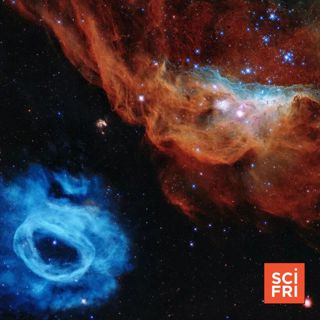
When it comes to the eventual end of our universe, cosmologists have a few classic theories: the Big Crunch, where the universe reverses its expansion and contracts again, setting the stars themselves on fire in the process. Or the Big Rip, where the universe expands forever—but in a fundamentally unstable way that tears matter itself apart. Or it might be heat death, in which matter and energy become equally distributed in a cold, eventless soup.

These theories have continued to evolve as we gain new understandings from particle accelerators and astronomical observations. As our understanding of fundamental physics advances, new ideas about the ending are joining the list. Take vacuum decay, a theory that’s been around since the 1970s, but which gained new support when CERN confirmed detection of the Higgs Boson particle. The nice thing about vacuum decay, writes cosmologist Dr. Katie Mack in her book The End of Everything: (Astrophysically Speaking), is that it could happen at any time, and would be almost instantaneous—painless, efficient.

The End Of Everything is our SciFri Book Club pick for April—you can join in on the community conversation and maybe even win a free book on our book club page. In this interview from 2020, Mack joins Ira to talk about the diversity of universe-ending theories, and how cosmologists like her think about the big questions, like where the universe started, how it might end, and what happens after it does.

Also, Nobel Prize-winning psychologist Dr. Daniel Kahneman died this week at the age of 90. His work turned many traditional ideas about economics upside-down, arguing that people often make bad decisions that go against their own self-interest. It’s something he continued to study throughout his career, and that he wrote about in the 2022 book Noise: A Flaw in Human Judgment. At the end of this segment, we revisit an interview from 2022 with Kahneman in remembrance of his long career studying cognitive biases.

Transcripts for each segment will be available after the show airs on sciencefriday.com.

Subscribe to this podcast. Follow our show on Instagram, TikTok, Facebook, and Bluesky @scifri and sign up for our newsletters. Got a science question that’s keeping you up at night? Call us: 877-472-4374


Hosted by Simplecast, an AdsWizz company. See pcm.adswizz.com for information about our collection and use of personal data for advertising.

Denne episoden er hentet fra en åpen RSS-feed og er ikke publisert av Podme. Den kan derfor inneholde annonser.

Episoder(1340)

Can you learn to love the scorpion?

Can you learn to love the scorpion?

If you have arachnophobia, consider this your opportunity to try exposure therapy: A new study suggests that 415 million years ago, in modern-day England and Wales, a scorpion the length of a golden r...

23 Jun 18min

FDA approves a well-known sunscreen ingredient—finally

FDA approves a well-known sunscreen ingredient—finally

The FDA recently approved a sunscreen ingredient called bemotrizinol, or BEMT, that’s been used in Europe and Asia for years. This is the first new sunscreen ingredient approved in the United States i...

22 Jun 12min

Why do sports announcers talk like that?

Why do sports announcers talk like that?

If you watch sports, whether the recent NBA finals or the ongoing World Cup matches, you may have noticed that the athletes aren’t the only ones putting on a show. The announcers seem to be playing a ...

19 Jun 13min

Swords, cannibalism, poison: inside the world of killer microbes

Swords, cannibalism, poison: inside the world of killer microbes

There is a murderous crime spree happening right under—and perhaps inside—our noses. Killer microbes armed with weapons are eviscerating, assassinating, and detonating their fellow microbes. And the n...

18 Jun 21min

When music transports you to a different place

When music transports you to a different place

Do you ever hear a song that transports you to a specific place and time? This auditory wormhole has a name: musical daydreams. Music cognition expert Elizabeth Margulis studies why they happen, and w...

17 Jun 18min

A vast whale graveyard + Zombie sea cucumbers

A vast whale graveyard + Zombie sea cucumbers

Researchers just published details of a massive undersea graveyard of whales deep in the Indian Ocean. Spanning about 1,200 kilometers (745 miles), it contains whale remains dating back more than 5 mi...

16 Jun 18min

Should we bring mountain lions back to the Northeast?

Should we bring mountain lions back to the Northeast?

Big cats used to roam the entire United States. You might know them as mountain lions, pumas, cougars, or catamounts. Though they go by many names, they're actually all the same species.  Their curren...

15 Jun 12min

Blue Origin explosion hits NASA timeline + Artemis III crew

Blue Origin explosion hits NASA timeline + Artemis III crew

When Blue Origin’s New Glenn spacecraft exploded in an enormous fireball during a ground test a couple weeks ago, it sent shockwaves not only through the air, but through NASA’s timeline for the upcom...

12 Jun 12min

Populært innen Vitenskap

fastlegen
jss
tingenes-tilstand
forskningno
liberal-halvtime
rss-nysgjerrige-norge
rekommandert
sinnsyn
tomprat-med-gunnar-tjomlid
villmarksliv
rss-paradigmepodden
dekodet-2
rss-overskuddsliv
rss-inn-til-kjernen-med-sunniva-rose
rss-ingeniorpodden
hva-er-greia-med
fjellsportpodden
nevropodden
rss-rekommandert
rss-lundqvist-podden