Zapping Nerves Into Regrowth | Celebrating the Maya Calendar In Guatemala’s Highlands
Science Friday24 Mai 2024

Zapping Nerves Into Regrowth | Celebrating the Maya Calendar In Guatemala’s Highlands

An early study found that electrical stimulation could improve hand and arm function in people with spinal cord injuries. Also, for thousands of years, Indigenous communities in Guatemala have used observations and mathematics to track astronomical events.

Zapping Nerves Into Regrowth

Results of an early trial published this week in the journal Nature Medicine found that people with cervical spinal cord damage showed some improvements both in strength and movement in arm and hand function after they received electrical stimulation near the site of their injury. The improved function persisted even after the stimulation stopped, indicating that the treatment may be inducing nerve cells to regrow in the damaged area.

Sophie Bushwick, senior news editor at New Scientist, joins Ira to talk about the work and what it could mean for people with severe spinal cord injuries. They also talk about other stories from the week in science, including creating the most powerful X-ray pulse ever reported, investigations into the microbiome of the scalp, and some epic cosplay—testing out the practicality of some ancient Greek armor in combat scenarios.

Celebrating the Maya Calendar In Guatemala’s Highlands

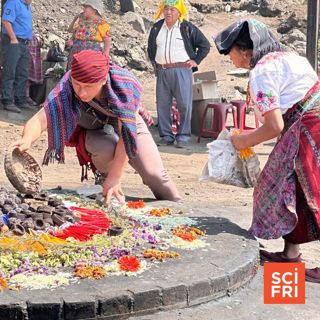
Every 260 days, Indigenous communities in the highlands of Guatemala celebrate a new cycle of the Maya calendar. This ceremony has persisted for thousands of years, from pre-Columbian times to today. The latest of these ceremonies happened in early May.

Joining Ira to talk about the importance of astronomical ceremony is Willy Barreno, a Maya calendar keeper based in Quetzaltenango, Guatemala, and Dr. Isabel Hawkins, astronomer and senior scientist at the Exploratorium in San Francisco, California.

Transcripts for each segment will be available after the show airs on sciencefriday.com.

Subscribe to this podcast. Follow our show on Instagram, TikTok, Facebook, and Bluesky @scifri and sign up for our newsletters. Got a science question that’s keeping you up at night? Call us: 877-472-4374


Hosted by Simplecast, an AdsWizz company. See pcm.adswizz.com for information about our collection and use of personal data for advertising.

Denne episoden er hentet fra en åpen RSS-feed og er ikke publisert av Podme. Den kan derfor inneholde annonser.

Episoder(1339)

FDA approves a well-known sunscreen ingredient—finally

FDA approves a well-known sunscreen ingredient—finally

The FDA recently approved a sunscreen ingredient called bemotrizinol, or BEMT, that’s been used in Europe and Asia for years. This is the first new sunscreen ingredient approved in the United States i...

22 Jun 12min

Why do sports announcers talk like that?

Why do sports announcers talk like that?

If you watch sports, whether the recent NBA finals or the ongoing World Cup matches, you may have noticed that the athletes aren’t the only ones putting on a show. The announcers seem to be playing a ...

19 Jun 13min

Swords, cannibalism, poison: inside the world of killer microbes

Swords, cannibalism, poison: inside the world of killer microbes

There is a murderous crime spree happening right under—and perhaps inside—our noses. Killer microbes armed with weapons are eviscerating, assassinating, and detonating their fellow microbes. And the n...

18 Jun 21min

When music transports you to a different place

When music transports you to a different place

Do you ever hear a song that transports you to a specific place and time? This auditory wormhole has a name: musical daydreams. Music cognition expert Elizabeth Margulis studies why they happen, and w...

17 Jun 18min

A vast whale graveyard + Zombie sea cucumbers

A vast whale graveyard + Zombie sea cucumbers

Researchers just published details of a massive undersea graveyard of whales deep in the Indian Ocean. Spanning about 1,200 kilometers (745 miles), it contains whale remains dating back more than 5 mi...

16 Jun 18min

Should we bring mountain lions back to the Northeast?

Should we bring mountain lions back to the Northeast?

Big cats used to roam the entire United States. You might know them as mountain lions, pumas, cougars, or catamounts. Though they go by many names, they're actually all the same species.  Their curren...

15 Jun 12min

Blue Origin explosion hits NASA timeline + Artemis III crew

Blue Origin explosion hits NASA timeline + Artemis III crew

When Blue Origin’s New Glenn spacecraft exploded in an enormous fireball during a ground test a couple weeks ago, it sent shockwaves not only through the air, but through NASA’s timeline for the upcom...

12 Jun 12min

Why can I handle tequila but not rum?

Why can I handle tequila but not rum?

‘Tis the season for porch beers and happy hours, and we’re taking on listener questions about how alcohol affects us. Like, is a glass of wine at dinner really good for you? And why do sugary drinks g...

11 Jun 21min

Populært innen Vitenskap

fastlegen
tingenes-tilstand
jss
rss-nysgjerrige-norge
forskningno
liberal-halvtime
rekommandert
villmarksliv
sinnsyn
dekodet-2
rss-paradigmepodden
rss-overskuddsliv
rss-inn-til-kjernen-med-sunniva-rose
tomprat-med-gunnar-tjomlid
nevropodden
rss-rekommandert
rss-ingeniorpodden
hva-er-greia-med
fjellsportpodden
rss-bondevennen