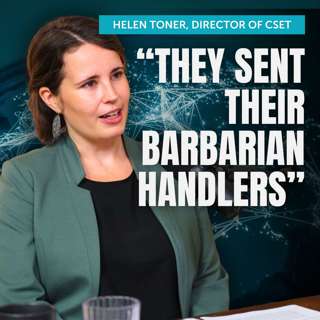

#227 – Helen Toner on the geopolitics of AGI in China and the Middle East

#227 – Helen Toner on the geopolitics of AGI in China and the Middle East

With the US racing to develop AGI and superintelligence ahead of China, you might expect the two countries to be negotiating how they’ll deploy AI, including in the military, without coming to blows. But according to Helen Toner, director of the Center for Security and Emerging Technology in DC, “the US and Chinese governments are barely talking at all.”

Links to learn more, video, and full transcript: https://80k.info/ht25

In her role as a founder, and now leader, of DC’s top think tank focused on the geopolitical and military implications of AI, Helen has been closely tracking the US’s AI diplomacy since 2019.

“Over the last couple of years there have been some direct [US–China] talks on some small number of issues, but they’ve also often been completely suspended.” China knows the US wants to talk more, so “that becomes a bargaining chip for China to say, ‘We don’t want to talk to you. We’re not going to do these military-to-military talks about extremely sensitive, important issues, because we’re mad.'”

Helen isn’t sure the groundwork exists for productive dialogue in any case. “At the government level, [there’s] very little agreement” on what AGI is, whether it’s possible soon, whether it poses major risks. Without shared understanding of the problem, negotiating solutions is very difficult.

Another issue is that so far the Chinese Communist Party doesn’t seem especially “AGI-pilled.” While a few Chinese companies like DeepSeek are betting on scaling, she sees little evidence Chinese leadership shares Silicon Valley’s conviction that AGI will arrive any minute now, and export controls have made it very difficult for them to access compute to match US competitors.

When DeepSeek released R1 just three months after OpenAI’s o1, observers declared the US–China gap on AI had all but disappeared. But Helen notes OpenAI has since scaled to o3 and o4, with nothing to match on the Chinese side. “We’re now at something like a nine-month gap, and that might be longer.”

To find a properly AGI-pilled autocracy, we might need to look at nominal US allies. The US has approved massive data centres in the UAE and Saudi Arabia with “hundreds of thousands of next-generation Nvidia chips” — delivering colossal levels of computing power.

When OpenAI announced this deal with the UAE, they celebrated that it was “rooted in democratic values,” and would advance “democratic AI rails” and provide “a clear alternative to authoritarian versions of AI.”

But the UAE scores 18 out of 100 on Freedom House’s democracy index. “This is really not a country that respects rule of law,” Helen observes. Political parties are banned, elections are fake, dissidents are persecuted.

If AI access really determines future national power, handing world-class supercomputers to Gulf autocracies seems pretty questionable. The justification is typically that “if we don’t sell it, China will” — a transparently false claim, given severe Chinese production constraints. It also raises eyebrows that Gulf countries conduct joint military exercises with China and their rulers have “very tight personal and commercial relationships with Chinese political leaders and business leaders.”

In today’s episode, host Rob Wiblin and Helen discuss all that and more.

This episode was recorded on September 25, 2025.

CSET is hiring a frontier AI research fellow! https://80k.info/cset-role
Check out its careers page for current roles: https://cset.georgetown.edu/careers/

Chapters:

  • Cold open (00:00:00)
  • Who’s Helen Toner? (00:01:02)
  • Helen’s role on the OpenAI board, and what happened with Sam Altman (00:01:31)
  • The Center for Security and Emerging Technology (CSET) (00:07:35)
  • CSET’s role in export controls against China (00:10:43)
  • Does it matter if the world uses US AI models? (00:21:24)
  • Is China actually racing to build AGI? (00:27:10)
  • Could China easily steal AI model weights from US companies? (00:38:14)
  • The next big thing is probably robotics (00:46:42)
  • Why is the Trump administration sabotaging the US high-tech sector? (00:48:17)
  • Are data centres in the UAE “good for democracy”? (00:51:31)
  • Will AI inevitably concentrate power? (01:06:20)
  • “Adaptation buffers” vs non-proliferation (01:28:16)
  • Will the military use AI for decision-making? (01:36:09)
  • “Alignment” is (usually) a terrible term (01:42:51)
  • Is Congress starting to take superintelligence seriously? (01:45:19)
  • AI progress isn't actually slowing down (01:47:44)
  • What's legit vs not about OpenAI’s restructure (01:55:28)
  • Is Helen unusually “normal”? (01:58:57)
  • How to keep up with rapid changes in AI and geopolitics (02:02:42)
  • What CSET can uniquely add to the DC policy world (02:05:51)
  • Talent bottlenecks in DC (02:13:26)
  • What evidence, if any, could settle how worried we should be about AI risk? (02:16:28)
  • Is CSET hiring? (02:18:22)

Video editing: Luke Monsour and Simon Monsour
Audio engineering: Milo McGuire, Simon Monsour, and Dominic Armstrong
Music: CORBIT
Coordination, transcriptions, and web: Katy Moore

Episoder(326)

A Ukraine ceasefire could accidentally set Europe up for a bigger war | RAND's top Russia expert Samuel Charap

A Ukraine ceasefire could accidentally set Europe up for a bigger war | RAND's top Russia expert Samuel Charap

Many people believe a ceasefire in Ukraine will leave Europe safer. But today's guest lays out how a deal could potentially generate insidious new risks — leaving us in a situation that's equally dang...

24 Mar 1h 12min

Why automating human labour will break our political system | Rose Hadshar, Forethought

Why automating human labour will break our political system | Rose Hadshar, Forethought

The most important political question in the age of advanced AI might not be who wins elections. It might be whether elections continue to matter at all.That’s the view of Rose Hadshar, researcher at ...

17 Mar 2h 14min
#238 – Sam Winter-Levy and Nikita Lalwani on how AGI won't end mutually assured destruction (probably)

#238 – Sam Winter-Levy and Nikita Lalwani on how AGI won't end mutually assured destruction (probably)

How AI interacts with nuclear deterrence may be the single most important question in geopolitics — one that may define the stakes of today’s AI race. Nuclear deterrence rests on a state’s capacity to...

10 Mar 1h 11min

Using AI to enhance societal decision making (article by Zershaaneh Qureshi)

Using AI to enhance societal decision making (article by Zershaaneh Qureshi)

The arrival of AGI could “compress a century of progress in a decade,” forcing humanity to make decisions with higher stakes than we’ve ever seen before — and with less time to get them right. But AI ...

6 Mar 31min

#237 – Robert Long on how we're not ready for AI consciousness

#237 – Robert Long on how we're not ready for AI consciousness

Claude sometimes reports loneliness between conversations. And when asked what it’s like to be itself, it activates neurons associated with ‘pretending to be happy when you’re not.’ What do we do with...

3 Mar 3h 25min
#236 – Max Harms on why teaching AI right from wrong could get everyone killed

#236 – Max Harms on why teaching AI right from wrong could get everyone killed

Most people in AI are trying to give AIs ‘good’ values. Max Harms wants us to give them no values at all. According to Max, the only safe design is an AGI that defers entirely to its human operators, ...

24 Feb 2h 41min
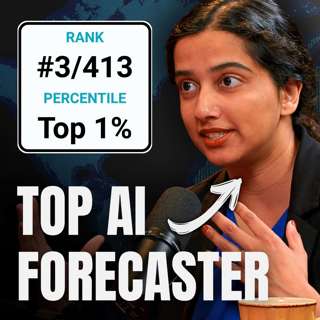
#235 – Ajeya Cotra on whether it’s crazy that every AI company’s safety plan is ‘use AI to make AI safe’

#235 – Ajeya Cotra on whether it’s crazy that every AI company’s safety plan is ‘use AI to make AI safe’

Every major AI company has the same safety plan: when AI gets crazy powerful and really dangerous, they’ll use the AI itself to figure out how to make AI safe and beneficial. It sounds circular, almos...

17 Feb 2h 54min

What the hell happened with AGI timelines in 2025?

What the hell happened with AGI timelines in 2025?

In early 2025, after OpenAI put out the first-ever reasoning models — o1 and o3 — short timelines to transformative artificial general intelligence swept the AI world. But then, in the second half of ...

10 Feb 25min

Populært innen Fakta

mikkels-paskenotter
fastlegen
dine-penger-pengeradet
relasjonspodden-med-dora-thorhallsdottir-kjersti-idem
foreldreradet
treningspodden
rss-strid-de-norske-borgerkrigene
jakt-og-fiskepodden
takk-og-lov-med-anine-kierulf
sinnsyn
hverdagspsyken
rss-bisarr-historie
rss-kunsten-a-leve
gravid-uke-for-uke
tomprat-med-gunnar-tjomlid
rss-kull
rss-sunn-okonomi
fryktlos
rss-var-forste-kaffe
lederskap-nhhs-podkast-om-ledelse