A 20 Minute Power-Based Field Test

A 20 Minute Power-Based Field Test


One key question we ask ourselves as coaches at FasCat, is if the athlete is responding to the training we have prescribed. Aka, are they getting faster? Our favorite "experiment" to answer this question is a good old fashioned 20 minute power based field test, which is free and can be conducted anywhere and anytime appropriate.

Reality Cycling

In a former life and career, I conducted hundreds of experiments as a research scientist in biotechnology and academic medical research laboratories designed to answer specific questions about the research projects I was working on. Spinal cord research, cancer, and novel cancer cures to name a few. At FasCat, we still perform "experiments" designed to evaluate our athletes' current physiology as it relates to their cycling performance. Still to this day the most practical, most relevant test of all is a 20 minute power based field test. With the exception of the gold standard, 40k time trial.

1463Increase your FTP with our Hill Climb Intervals Training Plan.

In the past we have conducted MLSS tests in an exercise physiology lab, but the reality is that cyclists need to test two to three times per year which is cost prohibitive and not practical for many athletes. Plus indoor power tends to be slightly less that outdoor power. A properly conducted field test cuts to the core of cycling performance and gives a great physiological assessment of the athlete (1), making it an indispensable tool for our coaches or the self coached athlete.

How Do I Conduct a Field Test?

In essence, a 20 minute power based field test is riding as fast as hard as you can for exactly 20 minutes. Just like a 20 minute time trial. Record your average power output and use that number as a benchmark and to determine your wattage based zones*. When available we'll recommend a steady grade hill free of stop signs, descents and any section of road that requires the athlete to stop pedalling. Ideally a 2-3% steady grade hill like this Strava segment. Steeper climbs tend to bog athletes' cadence down which skews the test results. Conversely, some athletes make greater power uphill than they can on the flats. Whichever you choose, it is absolutely imperative that you ensure your test is repeatable, accurate and reliable. Apples – apples.

Here's how: For the road cyclist and mountain biker an all out effort similar to your time trial pace of 20 minutes elicits a physiological response that has been found to be "the single greatest determinant of cycling performance in mass start cycling events" (1). We have experimented with 60 minute Field Tests and honestly not that many athletes can sustain that sort of mental effort for the full 60 minutes. If they can its a mental match we don't want to burn. On the other hand if we know the athlete can do a 60 minute field test once a year, it is the coaches discretion to prescribe one. It is especially beneficial to compare 60 minute field test data to ~ 60 minute 40k time trial data.

When choosing the roads for your field test let the terrain you have available dictate the specifics of your test (working within the 20 min range). After all, going for it from the bottom of a climb all the way to the top is more stimulating than working off your stopwatch. It may even be specific to your target event(s). For instance, a climber targeting a race with a decisive climb will want to specifically perform their test on a climb similar to the one found in the race. Heck, if you live nearby the race course, test on the race course! Conversely you may not even see a climb longer than one or two minutes where you live. That's cool; then find a stretch of road to measure how far you can ride in 20 minutes. If this is the case, pay special attention to the wind and humidity which will affect your aerodynamics and thus time. As long as you come back to the very same piece of road and start from the very same spot, under the same test conditions, your test will be repeatable.

*We take the average 20 minute power and subtract 5 – 10% to arrive at an athlete's 60 minute "Functional Threshold Power" or FTP. As a generally rule of thumb we use 5% for slow twitch aerobic athletes and 10% for athletes that have a well developed anaerobic system. We'll subtract 7.5% if we don't know about the athlete's anaerobic capacity.

Repeatability

Whatever you have nearby, find a stretch of road free of stops signs, intersections and corners — anything that would slow you down. In essence: go as hard as you can! Don't hold back one bit, go for it! Now here's the catch: remember everything about this test and duplicate it for your next test.

Items to keep the same (& ensure repeatability) include:
  • Your powermeter! Calibrated of course. Different powermeters unfortunately produce different results
  • Your bike: weight (including water bottles), body position, tires, tire pressure.
  • Your kit: jersey, shorts, helmet – – essentially you want to have the same aerodynamic characteristics from test to test.
  • Wind and weather conditions: test on a windless day under the same humidity – air density affects aerodynamics too!
  • Temperature: avoid testing between extreme temperature differences.
  • Come into the test rested, properly fueled, well hydrated with tons of motivation (you gotta go full gas!)
  • Perform the exact same warm up before each field test.
  • In a nutshell keep everything the same except for your fitness – that is the variable you are testing for.

Being able to compare tests and controlling for all other variables except your physiology or fitness allows you and your coach to interpret the efficacy of your training. These details may seem picky but are necessary to draw accurate comparisons.

Your results:

Test at the beginning of your training and then again after 8-12 weeks to measure your improvement. If your power goes up, guess what? Your training is working, keep going. If your power goes down or stays the same, guess what? Your training is not working and you need to change what you are doing. Its as simple as that.

All of our Six Week $49 Training Plans culminate with a field test so you can measure how much faster you've become!

Test not once, but twice, or more

If you have a new powermeter or are beginning a training program, perform a "baseline" field test for two reasons:

• To determine your wattage based training zones
• To establish a benchmark to measure future improvement

For a good test 'performance', approach the day with a minimum of 24 hours rest and go absolutely as hard as you can during the test. If you don't, the results will be inconclusive. Record the average power and continue with your next training cycle. Come back to the very same field test in 6-8 weeks under the same rested conditions and go for it again. By comparing the two average power outputs, you will be able to draw useful conclusions about your training. i.e. is it working? Test periodically throughout the year (we recommend no more than 3 times*) and carefully record your results in your training log. This will paint a big picture that is extremely useful when plotting out your next move and planning your next winning season.

Regular testing is THE BEST way to track performance and we do not recommend using mean maximal, mFTP or power profile charts that cull non "as hard as you can go" power outputs. By performing 20 minute tests, you'll also be able to compare this data with race data. For example, time trials where you went as hard as you could for 20 minutes or breakaways and long climbs.

Summary

• Go as hard as you can for the full 20 minutes
• Upload your data and analyze the average power output
• Make sure the test is 100% repeatable to eliminate all variables except your average power output improvement
• For indoor 20 minutes tests, see our indoor cycling 20 minute tip

Finally, testing yourself is a great start, but remember the ultimate measure of performance is performance itself. So get out there in a race, go hard, and duke it out! For further reading, please read the "Determining Threshold Power" training tip on VeloNews.

Reference

E.F. Coyle, A.R. Coggan, M.K. Hopper and T.J. Walters, "Determinants of endurance in well-trained cyclists." J Appl. Physiol 64:2622-2630, 1988

Copyright © 2020 FasCat Coaching – all rights reserved.

Join our *FREE* Athlete Forum to nerd out with FasCat coaches and athletes about your FTP, race data, power based training, or anything related to going fast on the bike!

Comments

The post A 20 Minute Power-Based Field Test appeared first on FasCat.

Denne episoden er hentet fra en åpen RSS-feed og er ikke publisert av Podme. Den kan derfor inneholde annonser.

Episoder(365)

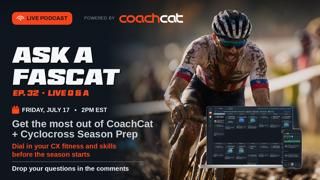
Ask a FasCat #31 , LIVE Q&A + your Summer Training

Ask a FasCat #31 , LIVE Q&A + your Summer Training

Summer Training is here 🚴 This week on Ask a FasCat (#31): durability rides, heat adaptation, race week tapers, and how to survive your local Tuesday night crit. You may also watch this podcast on ...

10 Jul 53min

Ask A FasCat #30

Ask A FasCat #30

On Ask a FasCat #30, we gave away a Stages Power Meter to the listener who asked the most thoughtful question + an annual CoachCat subscription to analyze all that shiny new power data. 🎥 Watch the ...

29 Mai 1h 1min

The 8-Minute Workout That Increases Your VO2 Max

The 8-Minute Workout That Increases Your VO2 Max

8 minutes of full-gas work. 14% VO2 max gain. But only if you do them right on the CoachCat training app. Your first 7 days FREE: https://fascatcoaching.com/app Dr. Izumi Tabata's 1996 study proved th...

18 Mai 16min

Build a Custom Training Plan from these 5 Questions

Build a Custom Training Plan from these 5 Questions

Build a custom cycling training plan in 5 questions. For a visual walk through of the custom plan builder watch this podcast on our youTube channel here https://youtu.be/nO94dhqgjBg In this podcast & ...

1 Mai 19min

Full Gas Zone 4, 5 & 6 Intervals

Full Gas Zone 4, 5 & 6 Intervals

Are you doing your zone 4, 5, and 6 intervals as hard as you can? Try CoachCat free: https://fascatcoaching.com/app  In this video, Coach Frank shows you how to go full gas and get more out of your in...

16 Apr 10min

5 Training Rules for Masters Cyclists (What Bicycling Magazine Left Out)

5 Training Rules for Masters Cyclists (What Bicycling Magazine Left Out)

Are you a master's cyclist trying to get faster but feel like something is missing from mainstream advice? Train this way FREE for 1 Month https://fascatcoaching.com/app In this video, Coach Frank bre...

25 Mar 12min

Unbound Gravel Training: Developing Your Diesel Watts

Unbound Gravel Training: Developing Your Diesel Watts

Coach Frank describes a 3 month Unbound training plan that you can follow FREE for 30 days → https://fascatcoaching.com/app Develop your Diesel Watt power by knowing how to train it in March, April, a...

4 Mar 17min

Gravel Pacing: the Right and the Wrong Way

Gravel Pacing: the Right and the Wrong Way

Are you making this gravel pacing mistake? It could be costing you 30 minutes or more — and you won't even feel it happening until it's too late.   In this video, Coach Frank breaks down the #1 pacing...

27 Feb 17min

Populært innen Sport

fotballpodden-2
fastlegen
alt-fortalt
ballspark
rss-tv-2-snakk-sport-vm
rss-gukild-johaug
viaplay-motor-pod
fotballpreik
rabona
rotsekk-en-podcast-i-sort-hvitt
unitedno
liverpoolno-pausepraten
rss-hor-na-vm-podden
breaking-marathon-limits
lopeprat
rss-youll-never-talk-alone-2
rss-aftenball
studio-a
united-we-podkast
rss-joggel-as