Cosmic Ray Neighbors: How Nearby Transients Solve the UHECR Mystery

Cosmic Ray Neighbors: How Nearby Transients Solve the UHECR Mystery

The origin of ultra-high-energy cosmic rays (UHECRs) has long been one of the central open questions in astroparticle physics. We dive into fascinating new research suggesting that the answer lies not in distant, powerful sources, but in **rare, stellar transients (like neutron star mergers) occurring right here in our neighboring galaxies**.


**Key Takeaways:**

* **Nearby Dominance:** The UHECR flux above 25 EeV is shown to be largely **dominated by just ten nearby galaxies located within 8 Mpc** of the Milky Way. This local overdensity strongly enhances the contribution of these close systems.

* **Explaining Hotspots:** This nearby transient model naturally accounts for the observed anisotropies in UHECR arrival directions. A remarkable finding is that seven of the ten brightest predicted galaxies coincide with the UHECR "hotspots" reported by the Telescope Array (TA) and the Pierre Auger Observatory (Auger), an overlap with a low chance probability ($p \simeq 0.003$).

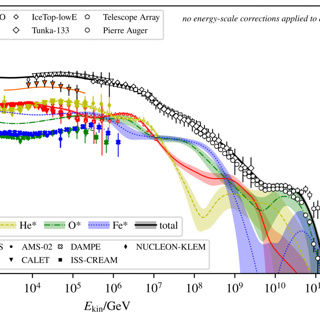
* **Spectral Tension Resolved:** The model explains persistent differences in energy spectra between the Northern sky (TA) and the Southern sky (Auger). The **dominant role of the nearby Andromeda galaxy** in the Northern sky accounts for the TA spectrum being harder and extending to higher energies.

* **Constraining Cosmic Magnetism:** Because the sources are nearby, the observed angular size of the UHECR hotspots reflects particle deflection in turbulent extragalactic magnetic fields (EGMF). This constraint implies an EGMF strength of approximately **1 nG**.

* **Composition and Time Delays:** The transient nature of the sources means that magnetic delays stretch the arrival times of cosmic rays based on their rigidity (E/Z). This effect explains why the observed composition becomes progressively heavier at the highest energies, and why individual species dominate within narrow energy intervals.


**Conclusion:**

This framework offers concrete, testable predictions for future experiments like AugerPrime and TA$\times$4, including the expected skew toward heavier nuclei in the flux from nearby galaxies and the potential appearance of proton hotspots at lower energies.


**Article Reference:**

This research is drawn from the paper: **"Rare Transients in Nearby Galaxies Explain Ultra–high–energy Cosmic Rays"** by I. Bartos and M. Kowalski (Excerpts from arXiv:2510.06193v1).


Acknowledements: Podcast prepared with Google/NotebookLM. Illustration credits: Osaka Metropolitan University/L-INSIGHT, Kyoto University/Ryuunosuke Takeshige

Denne episoden er hentet fra en åpen RSS-feed og er ikke publisert av Podme. Den kan derfor inneholde annonser.

Episoder(101)

Record-Breaker: Catching Gamma Rays from the Distant Quasar OP 313

Record-Breaker: Catching Gamma Rays from the Distant Quasar OP 313

In this episode, we dive into a groundbreaking astronomical discovery: the detection of very-high-energy (VHE) gamma rays from the quasar OP 313. Located at a redshift of $z = 0.997$, OP 313 has shatt...

1 Jun 20min

Ripples in Spacetime: Unpacking the GWTC-5.0 Catalog

Ripples in Spacetime: Unpacking the GWTC-5.0 Catalog

In this episode, we dive into the monumental release of the Gravitational-Wave Transient Catalog version 5.0 (GWTC-5.0) and the open data from the second part of the fourth observing run (O4b) by the ...

29 Mai 21min

SN 2017egm : Fermi-LAT's Breakthrough Gamma-Ray Detection

SN 2017egm : Fermi-LAT's Breakthrough Gamma-Ray Detection

In today’s episode, we dive into the mystery of superluminous supernovae (SLSNe)—rare, extreme astronomical events that shine 10 to 100 times brighter than standard core-collapse supernovae. For years...

22 Mai 23min

Supernovae on the RISE: Why Dead Stars Wake Up Decades Later

Supernovae on the RISE: Why Dead Stars Wake Up Decades Later

In this episode, we explore the fascinating phenomenon of core-collapse supernovae that refuse to fade away quietly. Years, or even decades, after their initial explosion, some of these stellar deaths...

20 Mai 17min

The SVOM Satellite: A New Era in Multi-Messenger Astronomy

The SVOM Satellite: A New Era in Multi-Messenger Astronomy

In this episode, we dive into the fascinating world of gamma-ray bursts (GRBs) and high-energy transients through the lens of the SVOM (Space-based Multi-band Variable Object Monitor) mission. Launche...

29 Apr 24min

Chasing the Flash: Hunting Neutron Star Mergers with CTAO

Chasing the Flash: Hunting Neutron Star Mergers with CTAO

In this episode, we dive into the thrilling world of multi-messenger astronomy! Ever since the historic detection of GW170817, scientists have known that binary neutron star (BNS) mergers can produce ...

14 Apr 19min

Tiling the Sky: A New Strategy for Finding Elusive GRBs

Tiling the Sky: A New Strategy for Finding Elusive GRBs

In this episode, we dive into the intense and fast-paced world of **Gamma-ray bursts (GRBs)—the most luminous and rapidly evolving transients in the Universe**. While space-based instruments like the ...

13 Apr 19min

Fast Radio Bursts & Magnetar X-Rays: A Peculiar Discovery

Fast Radio Bursts & Magnetar X-Rays: A Peculiar Discovery

In this episode, we dive into the deep cosmos to explore a recent astronomical breakthrough linking Fast Radio Bursts (FRBs)—enigmatic, millisecond-long cosmic transients—to extreme stellar objects kn...

7 Apr 22min

Populært innen Vitenskap

fastlegen
tingenes-tilstand
jss
rekommandert
liberal-halvtime
sinnsyn
forskningno
tomprat-med-gunnar-tjomlid
villmarksliv
rss-paradigmepodden
fjellsportpodden
kvinnehelsepodden
tidlose-historier
dekodet-2
rss-zahid-ali-hjelper-deg
rss-overskuddsliv
hva-er-greia-med
rss-rekommandert
rss-inn-til-kjernen-med-sunniva-rose
grunnstoffene