Will We Artificially Cool the Planet? The Science and Politics of Geoengineering with Ted Parson

Will We Artificially Cool the Planet? The Science and Politics of Geoengineering with Ted Parson

Global heating continues, despite the increased use of renewable energy sources and international policies attempting otherwise. Even as emissions reduction efforts continue, our world faces more extreme weather, sea level rise, and human health impacts, all of which are projected to accelerate in the coming decades. This raises an important but controversial question: at what point might more drastic interventions, like geoengineering, become necessary in order to cool the planet?

In this episode, Nate interviews Professor Ted Parson about solar geoengineering (specifically stratospheric aerosol injection) as a potential response to severe climate risks. They explore why humanity may need to consider deliberately cooling Earth by spraying reflective particles in the upper atmosphere, how the technology would work, as well as the risks and enormous governance challenges involved. Ted emphasizes the importance of having these difficult conversations now, so that we're prepared for the wide range of climate possibilities in the future.

How does stratospheric aerosol injection actually work? What is the likelihood that a major nation (or rogue billionaire) might employ this approach in the next thirty years? What ethical, moral, and biophysical concerns should we consider as we weigh the costs and benefits of further altering Earth's planetary balance?

About Ted Parson:

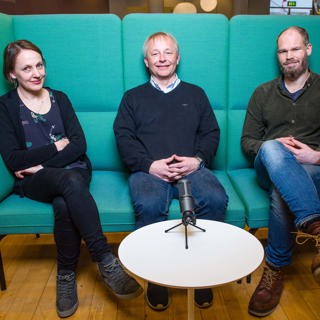
Edward A. (Ted) Parson is Dan and Rae Emmett Professor of Environmental Law and Faculty Director of the Emmett Institute on Climate Change and the Environment at the University of California, Los Angeles. Parson studies international environmental law and policy, the societal impacts and governance of disruptive technologies including geoengineering and artificial intelligence, and the political economy of regulation.

His most recent books are The Science and Politics of Global Climate Change (with Andrew Dessler), and A Subtle Balance: Evidence, Expertise, and Democracy in Public Policy and Governance, 1970-2010. His 2003 book, Protecting the Ozone Layer: Science and Strategy, won the Sprout Award of the International Studies Association and is widely recognized as the authoritative account of the development of international cooperation to protect the ozone layer.

In addition to his academic positions, Parson has worked and consulted for the White House Office of Science and Technology Policy, the Office of Technology Assessment of the U.S. Congress, the Privy Council Office of the Government of Canada, and the International Institute for Applied Systems Analysis (IIASA).

Show Notes and More

Watch this video episode on YouTube

Want to learn the broad overview of The Great Simplification in 30 minutes? Watch our Animated Movie.

---

Support The Institute for the Study of Energy and Our Future

Join our Substack newsletter

Join our Hylo channel and connect with other listeners

Episoder(384)

Martin Sheringer: "The Growing Threat from Chemical Pollution"

Martin Sheringer: "The Growing Threat from Chemical Pollution"

On this episode, Professor of environmental chemistry Martin Sheringer joins Nate. Together, they discuss Sheringer's most recent paper on PFAS - the 'forever chemicals, their ubiquity in waterways al...

21 Sep 20221h 17min

The 6th Pool..? | Frankly #8

The 6th Pool..? | Frankly #8

On this segment of Frankly, Nate responds to the predicament of increased use of forests, especially in Europe, for heating fuel in the face of declining availability of Natural Gas and other fossil f...

17 Sep 202213min

Douglas Rushkoff: "The Ultimate Exit Strategy"

Douglas Rushkoff: "The Ultimate Exit Strategy"

On this episode, Author and Professor Douglas Rushkoff joins Nate to discuss how human behavior interacts with technology and how we have arrived at a place with enormous wealth and income inequality ...

14 Sep 20221h 23min

Growth Until Not | Frankly #7

Growth Until Not | Frankly #7

Earlier this week there was a livestream debate highlighting the key points of the Green Growth and DeGrowth perspectives - this week's Frankly adds a 3rd 'growth critical' perspective  - that modern ...

9 Sep 202222min

Steve Vavrus: "Arctic Fever? Taking the Arctic's Temperature"

Steve Vavrus: "Arctic Fever? Taking the Arctic's Temperature"

On this episode, Climate Scientist Steve Vavrus joins Nate to discuss the Arctic and its critical impact on climate science. Why are the effects of warming so extreme in the Arctic, and what are the i...

7 Sep 202259min

Kiril Sokoloff: "What's the Most Important Question in Today's World?"

Kiril Sokoloff: "What's the Most Important Question in Today's World?"

On this episode, we meet with legendary financial icon Kiril Sokoloff to take a bird's eye view of the global energy/financial situation. Why is the financial community so complacent about peak oil an...

31 Aug 20221h 18min

The End Of Abundance | Frankly #6

The End Of Abundance | Frankly #6

On this segment of Frankly, Nate opines on the significance of French President Macron's statement we are nearing the "end of an era of abundance'. Nate shares what this watershed moment in the global...

30 Aug 20229min

Kris De Decker: "Low Tech: What, Why and How"

Kris De Decker: "Low Tech: What, Why and How"

On this episode, we meet with inventor, researcher and author Kris De Decker to understand the concept of "low tech" and its relevance in a high tech society and growth-driven economy. How does low t...

24 Aug 20221h 7min

Populært innen Vitenskap

fastlegen
tingenes-tilstand
jss
rekommandert
forskningno
sinnsyn
tomprat-med-gunnar-tjomlid
rss-nysgjerrige-norge
villmarksliv
rss-paradigmepodden
liberal-halvtime
nevropodden
fjellsportpodden
kvinnehelsepodden
rss-inn-til-kjernen-med-sunniva-rose
diagnose
smart-forklart
psykopoden
tidlose-historier
rss-rekommandert