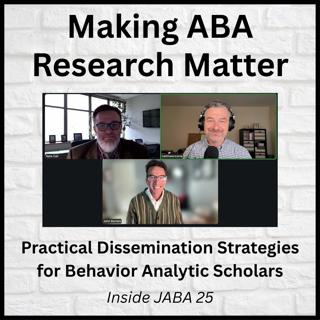
Making ABA Research Matter: Practical Dissemination Strategies for Behavior Analytic Scholars, Inside JABA 25

Making ABA Research Matter: Practical Dissemination Strategies for Behavior Analytic Scholars, Inside JABA 25

Episode Overview

In this special episode of the Behavioral Observations Podcast, I had the honor of celebrating the 25th installment of the Inside JABA Series. This one was particularly meaningful because it also marks the final appearance of Dr. John Borrero in his role as Editor-in-Chief of The Journal of Applied Behavior Analysis. I invited John to reflect on his three-year tenure—what he learned from reading an enormous volume of manuscripts, how his thinking evolved, and why adapting our language is essential if we want behavior analysis to reach broader audiences.

From there, we transitioned into an informative conversation with Dr. Nate Call from Emory University. Nate's recent work focuses on how we can better disseminate applied behavior analysis, not just distribute it. His paper, Scholarship as an Operating Class: Strategies and tactics for increasing dissemination of applied behavior analysis, has already shifted how I think about how our field packages and shares research. In this episode, Nate walked us through actionable strategies for increasing the reach and impact of our work.

Key Topics Covered in This Episode 1. John Borrero's Reflections from the Editor's Chair

John looked back on his three years as Editor-in-Chief, and I asked him what surprised him most. He talked about:

  • How important clear, accessible language is for dissemination
  • Why behavior analysts must evolve how we communicate without losing our scientific roots
  • Efforts to make JABA papers more accessible through translated articles
  • What it's like to manage a massive editorial workflow and team
2. The Real Difference Between Dissemination and Distribution

Nate clarified something that—and I'll admit—I hadn't always thought deeply about: there's a big difference between making your work available and ensuring your work is actually used.

Nate described it like:

  • Distribution = scattering seeds
  • Dissemination = preparing the soil so they actually grow

He also explained why early-career researchers often focus on distribution out of necessity, and how we can transition to more deliberate dissemination strategies over time.

3. Scholarship as an Operant Class

Nate walked me through the framework behind his recent paper. He described scholarly behavior as something shaped by contingencies—just like anything else. We talked about:

  • How individual and systemic consequences shape publishing choices
  • Why some of the most high-impact papers come from individuals rather than large labs
  • Concrete strategies we can use to increase the visibility and influence of our work
4. Boundary Encounters and Second-Generation Innovations

I asked Nate about how ideas move between disciplines, and he introduced the concept of boundary encounters.

We discussed:

  • Incoming vs. outgoing boundary encounters
  • How second-generation innovations help behavior analysis reach audiences outside our traditional spaces
  • Why these interactions are essential if we want ABA to have a broader societal impact
5. Expanding Our Methodological Toolkit

We took a deep dive into methodology and talked about the strengths of single-subject designs—as well as their limitations. Nate made a compelling case for:

  • When behavior analysts should consider Randomized Control Trials, implementation science, or mixed methods
  • Why diversifying methodologies helps us answer questions that matter to educators, policymakers, and grant reviewers
  • What we lose when we rely exclusively on traditional single-subject approaches
6. Participatory Action Research and Social Validity

I asked Nate to explain participatory action research, and he shared a powerful example involving first responders and families in crisis situations. He emphasized:

  • The importance of involving stakeholders early
  • How PAR elevates social validity and context
  • Why many federal funders now expect qualitative or participatory components
  • How behavior analysts can begin building these skills, even if it feels unfamiliar
7. Measuring Our Impact More Effectively

We also explored how to know whether dissemination is working. Nate and I discussed:

  • Bibliographic network analysis
  • Alt-metric measures
  • The importance of citing intentionally to strengthen high-quality scholarship within the field
8. Nate's Advice for New BCBAs

To close the episode, I asked Nate what he'd tell new behavior analysts entering the field. He encouraged them to:

  • Read widely—far beyond behavior-analytic journals
  • Become conversant in different research methods
  • Build collaborations with experts in qualitative, mixed, and implementation-science approaches
  • Think functionally about their own scholarly and professional behavior
9. Resources Mentioned in this Podcast

If you're passionate about increasing the influence of behavior analysis—whether through research, writing, teaching, or practice—this episode offers clear, functional guidance for how to do it.

Denne episoden er hentet fra en åpen RSS-feed og er ikke publisert av Podme. Den kan derfor inneholde annonser.

Episoder(337)

Conducta Verbal: Cultura, Contexto y Comunicación Funcional | BOP en ESP 18 con Janet Enriquez

Conducta Verbal: Cultura, Contexto y Comunicación Funcional | BOP en ESP 18 con Janet Enriquez

En este episodio, Miguel conversa con Janet sobre la conducta verbal desde una perspectiva práctica y cultural. A lo largo de la conversación, exploran por qué la conducta verbal sigue siendo una de l...

14 Jul 1h 23min
Essential for Living in Action: Building Meaningful Skills Through Everyday Events | Session 334 with Kristina Montgomery and Emily Beal Wilkinson

Essential for Living in Action: Building Meaningful Skills Through Everyday Events | Session 334 with Kristina Montgomery and Emily Beal Wilkinson

Many behavior analysts have experienced the frustration of teaching a skill successfully in one setting only to discover that it doesn't transfer to the situations where it actually matters. In this e...

30 Jun 1h 24min
Beyond 80% Correct: Rethinking Mastery Criteria in ABA: Session 333 with Sarah Richling & Dan Fienup

Beyond 80% Correct: Rethinking Mastery Criteria in ABA: Session 333 with Sarah Richling & Dan Fienup

How do we determine when a learner has truly mastered a skill? In behavior analysis, performance criteria such as "80% correct across two sessions" have become nearly ubiquitous. Yet despite their wid...

12 Jun 1h 12min
Helping Complex Kids Thrive Through Practical Behavioral Parenting Strategies: Jenny Demark, Linda Reinstein and Conrad Leung | Session 332

Helping Complex Kids Thrive Through Practical Behavioral Parenting Strategies: Jenny Demark, Linda Reinstein and Conrad Leung | Session 332

In this episode, I'm joined by Dr. Jenny Demark, Conrad Leung, and Dr. Linda Reinstein to talk about their new book, Complex Kids, Simple Solutions: How to Raise Resilient, Confident, Likable Kids. Th...

27 Mai 1h 9min
Supporting Individuals With Severe Problem Behavior Through Collaboration: Session 331 with Ben Seifert

Supporting Individuals With Severe Problem Behavior Through Collaboration: Session 331 with Ben Seifert

In Session 331, I sat down with Dr. Ben Seifert to talk about some of the most challenging — and important — work happening in applied behavior analysis today: supporting individuals with severe probl...

14 Mai 1h 3min

Supporting Health and Wellness in Developmental Disabilities: Session 330: Brandon May, Maggie Pavone, and Kate Heersink

Supporting Health and Wellness in Developmental Disabilities: Session 330: Brandon May, Maggie Pavone, and Kate Heersink

In this episode, I'm joined by Drs. Brandon May and Maggie Pavone, and Kate Heersink to talk about how we can better support healthier lifestyles for individuals with developmental disabilities. We st...

25 Apr 1h 13min

Train Smarter, Not Harder: Heart Rate Zones, VO2 Max, and Better Fitness: Session 329 with Nick Green

Train Smarter, Not Harder: Heart Rate Zones, VO2 Max, and Better Fitness: Session 329 with Nick Green

In Session 329, I'm joined once again by Dr. Nick Green, Ph.D., BCBA-D, who's been doing some really interesting work at the intersection of fitness and behavior science. In this episode, Nick walks u...

8 Apr 1h 1min

Conditioning Books as Reinforcers: How to Increase Reading Engagement in Young Children: Inside JABA 26

Conditioning Books as Reinforcers: How to Increase Reading Engagement in Young Children: Inside JABA 26

Episode Summary In this episode, I'm joined by Dr. Daniel Fienup, Dr. Kate Loomis, and Lilian Morales to discuss their recent paper in JABA, Turning the Page: Increasing children's preference for look...

2 Apr 1h 7min

Populært innen Vitenskap

fastlegen
tingenes-tilstand
jss
forskningno
liberal-halvtime
sinnsyn
rekommandert
dekodet-2
abels-tarn
tomprat-med-gunnar-tjomlid
villmarksliv
hva-er-greia-med
rss-kunstig-intelligens-med-elisabeth-maren-og-morten
rss-nysgjerrige-norge
fjellsportpodden
rss-rekommandert
kvinnehelsepodden
vett-og-vitenskap-med-gaute-einevoll
katastrofe-i-hjernen
nordnorsk-historie