Microsoft Fabric Digital Twin: How To Clean Up Messy Data, Build an Ontology & Get Real-Time Insights in OneLake

Microsoft Fabric Digital Twin: How To Clean Up Messy Data, Build an Ontology & Get Real-Time Insights in OneLake

Admins, you saw the title and asked the real question: is Fabric’s Digital Twin Builder finally the fix for our messy, siloed data—or just another data swamp wearing lipstick? In this episode, we start from that tension: the feature sits in Fabric’s Real-Time Intelligence, lands its twin data directly in OneLake, and promises a clean semantic layer on top of chaotic IoT feeds, ERP tables, and exports older than your payroll system. We break down what a digital twin really is in practice (a dynamic, ontology‑driven model of your real‑world assets and processes), why so many early twin projects collapsed under fragile ETL and schema chaos, and how Fabric’s approach—semantic canvas plus ontology—tries to replace glue‑and‑duct‑tape plumbing with reusable building blocks. Along the way, you’ll hear what actually changes for admins when twin data becomes just another Fabric item in OneLake: fewer “multiple source of truth” disasters, more predictable integration with Power BI and Real-Time Intelligence, and a path away from living inside CSVs and manual exports.

LOW-CODE OR LOW-PATIENCE? THE PROMISE AND THE CATCH

Fabric’s Digital Twin Builder sells itself as low‑code, and the semantic canvas is the star: a visual surface where you define namespaces, types, and instances, then wire them with relationships instead of writing JOINs by hand. This is where the “admins vs low‑code trauma” kicks in—most of us have scars from tools where drag‑and‑drop diagrams turned into unmaintainable spaghetti. We take that skepticism seriously and walk through what’s actually different here: the canvas enforces structure via ontology, so relationships and entities follow a consistent model rather than whatever naming conventions a random project team invented last year. With concrete examples like the SPIE property portfolio, you’ll see how a single twin model can unify asset data across sites and countries, reducing one‑off integration projects and giving operations teams portfolio‑wide visibility without custom exports per region. The catch is honest too: garbage in still means garbage out—Digital Twin Builder doesn’t magically fix malformed CSVs or broken telemetry—but once sources meet a basic standard, the low‑code surface becomes a real accelerator instead of GUI purgatory.

MASTERING THE SEMANTIC CANVAS WITHOUT LOSING YOUR SANITY

The heart of this episode is the semantic canvas and its ontology model: namespaces define your domains, types describe the concepts within them (e.g. pump, building, route, sensor), and instances represent the actual things in your environment. We walk through how to translate messy real‑world structures into a clean hierarchy, how to model relationships so you can trace from a failing sensor to maintenance schedules to financial impact, and how this differs from the old world of ad‑hoc tables and undocumented joins. You’ll learn practical tips for avoiding ontology bloat (too many hyper‑specific types), how to phase a twin rollout by starting with one domain and expanding, and how to keep subject‑matter experts involved without letting them blow up the structure. The goal is a canvas that feels like a reliable map, not a whiteboard sketch that only makes sense to the person who drew it.

REAL-TIME INSIGHT WITHOUT REAL-TIME CHAOS

Once the twin model is in place, the payoff lives in real‑time dashboards and alerts powered by Fabric’s Real-Time Intelligence and Power BI on top of OneLake. We explore how to wire telemetry and line‑of‑business data into the twin so that operations teams see live status instead of stale spreadsheets, and how to design views for different personas—from control‑room operators to finance and leadership. You’ll hear where the low‑code promise holds (fast wiring from twin to dashboards) and where you still need solid data engineering (clean ingestion, quality checks, and governance), plus how to avoid turning RTI into a noisy alert cannon that nobody trusts. By the end, you’ll know what a good “first twin” looks like, how to connect it to dashboards users actually adopt, and what governance you need so this doesn’t become “yet another real‑time project that died after the pilot.”

WHAT YOU’LL LEARN
  • What a digital twin really is in business terms and why so many early projects failed.
  • How Fabric’s Digital Twin Builder uses the semantic canvas and ontology (namespaces, types, instances) to tame messy data.
  • How low‑code modeling changes the roles of admins, data engineers, and subject‑matter experts in twin projects.
  • How twin data in OneLake plugs into Power BI and Real-Time Intelligence for live, portfolio‑wide insights.
  • Where Digital Twin Builder genuinely saves time—and where bad source data and weak governance will still hurt you.
  • A practical checklist to decide if Fabric’s Digital Twin is the right fit for your scenario or just extra complexity.
THE CORE INSIGHT

he core insight of this episode is that digital twins stopped failing because of “bad ideas” and started failing because of bad plumbing—fragile ETL, schema chaos, and one‑off models no one could maintain. Fabric’s Digital Twin Builder doesn’t magically fix upstream data, but it does offer a structured, ontology‑driven way to build twins directly in OneLake with real‑time connections, turning what used to be a fragile science project into a repeatable pattern. Once you treat ontology, semantic canvas, and OneLake integration as architecture rather than experimentation, digital twins shift from buzzword to a practical way to cut waste, break silos, and keep operations, finance, and IT aligned on the same live model of reality.

WHO THIS EPISODE IS FOR
  • Data and platform architects responsible for Microsoft Fabric, lakehouse, and real‑time analytics strategy.
  • Admins and operations leads who want real‑time visibility into assets and processes without building custom ETL monsters.
  • BI and analytics teams looking to move from static reports to live twin‑driven dashboards.
  • Consultants and partners evaluating whether Fabric’s Digital Twin Builder should be part of their reference architecture.
ABOUT THE AUTHOR / HOST

Mirko Peters is a Microsoft 365 and data platform consultant and host of the M365.FM podcast, helping organizations treat Microsoft 365, Fabric, and their data estate as one integrated operating system instead of disconnected tools. He works with teams running on Microsoft 365, Azure, and Fabric to design architectures, governance, and real‑time analytics patterns that prioritize reliability and clarity—so digital twins and dashboards reflect how the business actually runs, not how slide decks wish it did.

Become a supporter of this podcast: https://www.spreaker.com/podcast/m365-fm-modern-work-security-and-productivity-with-microsoft-365--6704921/support.

Denne episoden er hentet fra en åpen RSS-feed og er ikke publisert av Podme. Den kan derfor inneholde annonser.

Episoder(784)

AI, Power Platform & Developer Experience: The Next Frontier with Reza Niroomand [MVP]

AI, Power Platform & Developer Experience: The Next Frontier with Reza Niroomand [MVP]

Artificial intelligence is transforming software development faster than ever before. Low-code platforms are becoming more powerful, professional developers are embracing AI-assisted coding, and enter...

17 Jul 1h
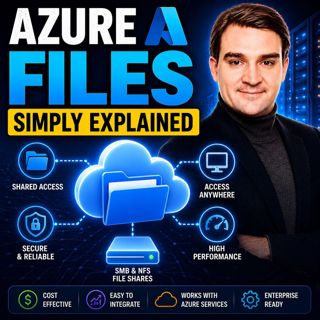
Azure Files - Simply Explained

Azure Files - Simply Explained

Azure Files is Microsoft's fully managed cloud file sharing service that allows you to create secure, scalable file shares without maintaining a traditional file server. Instead of purchasing hardware...

17 Jul 15min
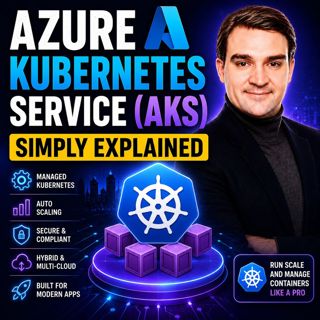
Azure Kubernetes Service (AKS) - Simply Explained

Azure Kubernetes Service (AKS) - Simply Explained

Azure Kubernetes Service (AKS) is Microsoft's fully managed Kubernetes platform that makes it easier to deploy, manage, and scale containerized applications in Azure. Instead of building and maintaini...

17 Jul 18min
Azure Container Apps - Simply Explained

Azure Container Apps - Simply Explained

Azure Container Apps make it possible to run modern containerized applications without the operational complexity of managing Kubernetes clusters. Instead of worrying about virtual machines, node pool...

17 Jul 15min
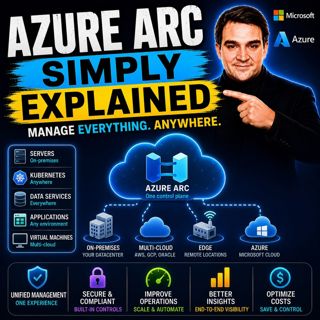
Azure Arc - Simply Explained

Azure Arc - Simply Explained

Modern IT environments rarely exist in a single cloud. Most organizations run Windows and Linux servers across on-premises data centers, Microsoft Azure, Amazon Web Services (AWS), Google Cloud Platfo...

17 Jul 17min
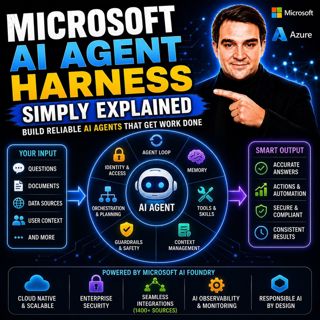
Microsoft AI Agent Harness - Simply Explained

Microsoft AI Agent Harness - Simply Explained

Writing the perfect AI prompt used to be the goal of every AI developer. But as businesses began asking AI to perform increasingly complex tasks—analyzing code, researching topics, coordinating workfl...

17 Jul 16min
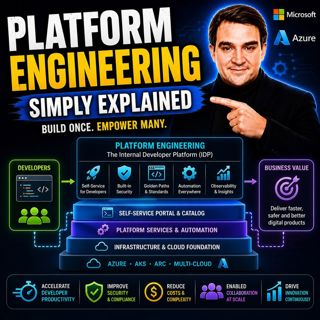
Platform Engineering - Simply Explained

Platform Engineering - Simply Explained

For years, DevOps promised to break down the barriers between development and operations by giving teams greater ownership over the software they build. While the idea was powerful, reality became far...

16 Jul 16min
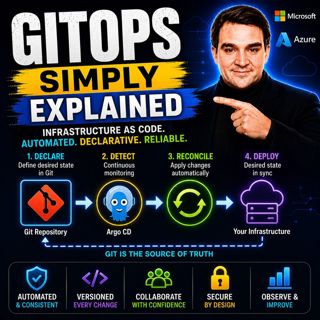
GitOps - Simply Explained

GitOps - Simply Explained

Managing Kubernetes manually quickly becomes a nightmare as environments grow. One engineer updates a deployment directly using kubectl, another changes a ConfigMap through the Azure portal, and sudde...

16 Jul 16min

Populært innen Politikk og nyheter

giver-og-gjengen-vg
aftenpodden-usa
fotballpodden-2
aftenpodden
forklart
stopp-verden
popradet
det-store-bildet
rss-gukild-johaug
hanna-de-heldige
rss-ness
aftenbla-bla
nokon-ma-ga
dine-penger-pengeradet
rss-penger-polser-og-politikk
lydartikler-fra-aftenposten
rss-utenrikskomiteen-med-bogen-og-grasvik
rss-hor-na-krim-2
e24-podden
unitedno