
DH Ep:45 The Dust Bowl Migration

DH Ep:45 The Dust Bowl Migration

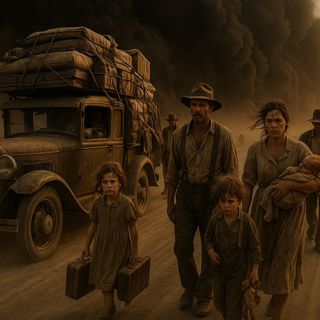
On April fourteenth, 1935, a wall of darkness seven thousand feet high and two hundred miles wide tore across the Great Plains at sixty miles per hour. Black Sunday wasn’t just a storm—it was the moment the Dust Bowl stopped being a hardship and became a breaking point. For hundreds of thousands of families already living in an apocalyptic landscape of dust, failed crops, and dying livestock, that day crushed whatever hope they had left.

What followed should have been a story of American compassion and resilience. Instead, it became one of the ugliest chapters of organized exploitation in our history. This episode of Disturbing History plunges into the Dust Bowl migration of the 1930s, when roughly three to four hundred thousand desperate people fled the Plains for California, believing they were chasing survival and a fresh start. But the promised land waiting at the edge of the map was built to profit from desperation.

California’s booming agricultural empire had perfected a system that depended on an endless supply of hungry labor. Corporate farms flooded the country with handbills advertising work, deliberately recruiting three times more people than they needed so wages could be driven below starvation levels. Families who had escaped one catastrophe arrived only to find another—one engineered by human hands.

Through survivor testimony and contemporary investigation, we step into the ditch camps where families slept under bridges, along drainage canals, and in makeshift shelters pieced together from tin, cardboard, canvas, and palm fronds. We walk through company camps that charged rent for dirt-floor shacks without plumbing or windows, and contractor camps where workers could labor for weeks and still end up in debt.

The economics of this system were brutal and clear: cotton-picking wages collapsed from a dollar fifty per hundred pounds to forty cents, even as growers claimed poverty while continuing to pay dividends to shareholders. Behind it all stood the Associated Farmers, a soothing name masking a corporate-backed anti-union machine that used vigilantes, spies, bought law enforcement, and intimidation to crush any hint of organizing.

The violence exploded into the open during the 1933 cotton strike in Pixley, California, when armed growers fired on unarmed workers, killing Mexican strikers and injuring many more. Sheriffs deputized hundreds of farm owners and loyalists, police broke peaceful picket lines with clubs and tear gas, and organizers were beaten, jailed, and driven out on manufactured charges. The terror was so widespread that the La Follette Committee’s congressional investigation later compared California’s farm labor system to fascist regimes rising in Europe.Some of the most devastating consequences fell on children.

In the camps, child mortality soared to more than double the state average. Schooling barely existed for many, with half never making it past third grade, and children as young as five or six working long days in the fields. Women suffered not only hunger and disease but predation from foremen who coerced sexual favors for work. Men who had once owned farms and fed their families were reduced to lining up for jobs, inspected like livestock, living under a humiliation that hollowed out entire communities. When federal intervention finally arrived, it exposed the truth California growers tried to deny. Clean government camps with running water and medical care proved the misery in the fields was never inevitable—it was chosen, because it was profitable.

National attention cracked open when The Grapes of Wrath and Dorothea Lange’s photographs, including the iconic “Migrant Mother,” forced the country to look directly at what was happening. Even after the La Follette Committee documented a coordinated assault on civil rights and echoed the warning signs of European fascism, the architects of the system faced no meaningful consequences.

World War Two eased the immediate crisis by creating labor shortages, but the machinery of exploitation didn’t stop—it simply found new bodies. The Bracero Program brought Mexican workers into the same fields under conditions often worse than what Dust Bowl migrants endured. And today, agricultural labor in the United States, carried largely by Latin American immigrants, still reflects that legacy: poverty wages, substandard housing, intimidation, and discrimination that feel hauntingly familiar.

The Dust Bowl migration reveals a truth that remains hard to face—American capitalism has repeatedly relied on someone being desperate enough to exploit, and when one group escapes the grinder, another is pulled in to replace them.

Have a forgotten historical mystery, disturbing event, unsolved crime, or hidden conspiracy you think deserves investigation?

Send your suggestions to brian@paranormalworldproductions.com.

Disturbing History is a dark history podcast exploring unsolved mysteries, secret societies, historical conspiracies, lost civilizations, and the shadowy stories buried beneath the surface of the past.

Follow the show and enable automatic downloads so you never miss a deep dive into history’s most unsettling secrets.

Because sometimes the truth is darker than fiction.

Denne episoden er hentet fra en åpen RSS-feed og er ikke publisert av Podme. Den kan derfor inneholde annonser.

Episoder(124)

Ike And The Alien Treaty

Ike And The Alien Treaty

On the night of February twentieth, 1954, President Dwight Eisenhower finished dinner at a private ranch in Palm Springs and vanished from public view. A wire service reportedly flashed that he was de...

19 Jul 1h 11min

FDR: The Man Who Could Have Been King

FDR: The Man Who Could Have Been King

He was elected President of the United States 4 times, and a whole generation of Americans grew up unable to remember anyone else in the office. In this episode of Disturbing History, we pull apart th...

17 Jul 1h 23min

The Fair Tax

The Fair Tax

Taxes don't sound like Disturbing History territory, until you learn the trail of blood and power behind them. This episode traces the entire violent history of taxation in America, from the Stamp Act...

15 Jul 1h 15min

The Smithsonian's Strange Phenomena Files

The Smithsonian's Strange Phenomena Files

There's a building in Washington where, for the better part of a century, ordinary Americans mailed in the impossible. Flesh that fell from a clear sky onto a Kentucky farmwife making soap. A swarm of...

12 Jul 1h 1min

Loving the Monster

Loving the Monster

Some nights the well runs dry, and I do what everybody does — I sink into the couch and let Netflix babysit me for a while. That's how I ended up watching The Worst Ex Ever, and that's how I ended up ...

10 Jul 1h 1min

The Rise and Ruin of the FLDS Church

The Rise and Ruin of the FLDS Church

He was the mouthpiece of God to ten thousand followers. To the FBI, he was a face on the Ten Most Wanted list. And to a Nevada state trooper working a dark stretch of Interstate Fifteen, he was just a...

8 Jul 1h 7min

Children Sent Through the Mail

Children Sent Through the Mail

In the winter of nineteen fourteen, a five-year-old girl named May Pierstorff stood on a train platform in Grangeville, Idaho, with fifty-three cents in postage stamps pinned to her coat. Her parents ...

5 Jul 1h 1min

The Poison Bottles America Trusted

The Poison Bottles America Trusted

Before the Food and Drug Administration, before warning labels, before anyone had to prove a medicine was safe or even admit what was inside it, America ran on the bottle.This episode opens the cabine...

3 Jul 59min

Populært innen Samfunn

rss-spartsklubben
giver-og-gjengen-vg
konspirasjonspodden
aftenpodden
aftenpodden-usa
rss-nesten-hele-uka-med-lepperod
alt-fortalt
rss-henlagt-andy-larsgaard
popradet
wolfgang-wee-uncut
grenselos
fladseth
rss-dette-ma-aldri-skje-igjen
198-land-med-einar-trnquist
rss-siktet
sophie-leser
lydartikler-fra-aftenposten
relasjonspodden-med-dora-thorhallsdottir-kjersti-idem
rss-frekvens-med-anine-olsen
rss-herrepanelet