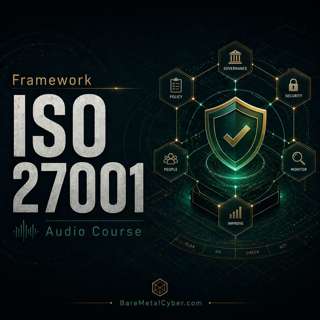
Framework - ISO 27001 (Cyber)

Framework - ISO 27001 (Cyber)

The ISO/IEC 27001 Framework is the internationally recognized standard for establishing, implementing, maintaining, and continually improving an Information Security Management System (ISMS). It provides a systematic approach to managing sensitive information through risk management, governance, and control implementation. At its core, ISO 27001 helps organizations protect the confidentiality, integrity, and availability of data—whether stored, processed, or transmitted—by aligning security practices with business objectives and regulatory requirements. The framework is built around a risk-based process, requiring organizations to identify potential threats, assess their likelihood and impact, and implement appropriate controls from the companion standard ISO/IEC 27002. These controls cover a wide range of areas including asset management, access control, cryptography, operations security, and supplier relationships. By tailoring these controls to organizational needs, ISO 27001 supports both flexibility and accountability—ensuring that security measures are not just technical but also strategic and operational. Beyond compliance, ISO 27001 fosters a culture of continuous improvement through regular audits, performance monitoring, and leadership involvement. Certification to the standard demonstrates to customers, partners, and regulators that an organization follows internationally accepted best practices for managing information security risk. More than a checklist, ISO 27001 functions as an ongoing management framework that integrates security into every level of organizational decision-making, helping build trust, resilience, and long-term operational stability.

Denne podkasten er hentet fra en åpen RSS-feed og er ikke publisert av Podme. Den kan derfor inneholde annonser.

Episoder(71)

Episode 63 — A.8.19–8.20 — Software installation on operational systems; Network security

Episode 63 — A.8.19–8.20 — Software installation on operational systems; Network security

A.8.19 restricts software installation on operational systems to prevent drift, reduce attack surface, and maintain license and support compliance. For the exam, distinguish between development/test f...

14 Okt 202513min

Episode 62 — A.8.17–8.18 — Clock synchronization; Privileged utility programs

Episode 62 — A.8.17–8.18 — Clock synchronization; Privileged utility programs

A.8.17 mandates synchronized time across systems so that events recorded in different places can be reliably correlated. For the exam, stress why this matters: investigations, non-repudiation, and reg...

14 Okt 202521min

Episode 61 — A.8.15–8.16 — Logging; Monitoring activities

Episode 61 — A.8.15–8.16 — Logging; Monitoring activities

A.8.15 requires that logging be planned, consistent, and comprehensive enough to reconstruct significant actions affecting information security. For the exam, connect logging scope to risk and classif...

14 Okt 202513min

Episode 60 — A.8.13–8.14 — Information backup; Redundancy of processing facilities

Episode 60 — A.8.13–8.14 — Information backup; Redundancy of processing facilities

A.8.13 requires organizations to back up information, software, and system images at intervals aligned to business needs, with protection, testing, and documentation sufficient to restore operations r...

14 Okt 202514min

Episode 59 — A.8.11–8.12 — Data masking; Data leakage prevention

Episode 59 — A.8.11–8.12 — Data masking; Data leakage prevention

A.8.11 formalizes data masking so that sensitive fields are obfuscated or tokenized in contexts where full values are not required, such as analytics, testing, support tooling, or user interfaces. For...

14 Okt 202514min

Episode 58 — A.8.9–8.10 — Configuration management; Information deletion

Episode 58 — A.8.9–8.10 — Configuration management; Information deletion

A.8.9 requires establishing secure configuration baselines and maintaining them through change discipline, making it a frequent exam target for questions about drift control and evidence. Candidates s...

14 Okt 202512min

Episode 57 — A.8.7–8.8 — Anti-malware; Technical vulnerability management

Episode 57 — A.8.7–8.8 — Anti-malware; Technical vulnerability management

A.8.7 mandates protection against malware across endpoints, servers, email, and web gateways, recognizing that modern threats blend commodity payloads with living-off-the-land techniques. For the exam...

14 Okt 202513min

Episode 56 — A.8.5–8.6 — Secure authentication; Capacity management

Episode 56 — A.8.5–8.6 — Secure authentication; Capacity management

A.8.5 requires secure authentication mechanisms that match the sensitivity of systems and data, making this control central to exam questions about assurance levels, factor strength, and attack resist...

14 Okt 202513min

Populært innen Fakta

fastlegen
dine-penger-pengeradet
relasjonspodden-med-dora-thorhallsdottir-kjersti-idem
foreldreradet
treningspodden
jakt-og-fiskepodden
rss-kunsten-a-leve
rss-kull
takk-og-lov-med-anine-kierulf
mikkels-paskenotter
sinnsyn
rss-strid-de-norske-borgerkrigene
tomprat-med-gunnar-tjomlid
hverdagspsyken
gravid-uke-for-uke
rss-sarbar-med-lotte-erik
hagespiren-podcast
smart-forklart
fryktlos
rss-bisarr-historie