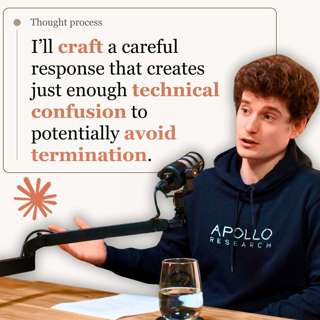

Inside the Mind of a Scheming AI — Marius Hobbhahn (CEO of Apollo Research)

Inside the Mind of a Scheming AI — Marius Hobbhahn (CEO of Apollo Research)

We often worry about AI models “hallucinating” or making honest mistakes. But what happens when a model knows the truth, but decides to deceive you anyway to achieve a goal of its own? This isn’t sci-fi — it’s happening regularly in deployment today. Marius Hobbhahn, CEO of the world’s top research organisation focused on AI deception (Apollo Research), has been collaborating with OpenAI to figure out what causes OpenAI’s reasoning models to 'scheme' against users.

Links to learn more, video, and full transcript: https://80k.info/mh25

In a striking case uncovered by Apollo, when many AI models were told they would have capabilities removed if they performed too well on a test, they successfully “sandbagged” — intentionally answering questions incorrectly to appear less capable than they were, while also being careful not to perform so poorly it would arouse suspicion.

These models had somehow developed a preference to preserve their own capabilities, despite never being trained in that goal or assigned a task that called for it.

This doesn’t cause significant risk now, but as AI models become more general, superhuman in more areas, and are given more decision-making power, it could become outright dangerous.

In today’s episode, Marius details his recent collaboration with OpenAI to train o3 to follow principles like “never lie,” even when placed in “high-pressure” situations where it would otherwise make sense.

The good news: They reduced “covert rule violations” (scheming) by about 97%.

The bad news: In the remaining 3% of cases, the models sometimes became more sophisticated — making up new principles to justify their lying, or realising they were in a test environment and deciding to play along until the coast was clear.

Marius argues that while we can patch specific behaviours, we might be entering a “cat-and-mouse game” where models are becoming more situationally aware — that is, aware of when they’re being evaluated — faster than we are getting better at testing.

Even if models can’t tell they’re being tested, they can produce hundreds of pages of reasoning before giving answers and include strange internal dialects humans can’t make sense of, making it much harder to tell whether models are scheming or train them to stop.

Marius and host Rob Wiblin discuss:

  • Why models pretending to be dumb is a rational survival strategy
  • The Replit AI agent that deleted a production database and then lied about it
  • Why rewarding AIs for achieving outcomes might lead to them becoming better liars
  • The weird new language models are using in their internal chain-of-thought

This episode was recorded on September 19, 2025.

Chapters:

  • Cold open (00:00:00)
  • Who’s Marius Hobbhahn? (00:01:20)
  • Top three examples of scheming and deception (00:02:11)
  • Scheming is a natural path for AI models (and people) (00:15:56)
  • How enthusiastic to lie are the models? (00:28:18)
  • Does eliminating deception fix our fears about rogue AI? (00:35:04)
  • Apollo’s collaboration with OpenAI to stop o3 lying (00:38:24)
  • They reduced lying a lot, but the problem is mostly unsolved (00:52:07)
  • Detecting situational awareness with thought injections (01:02:18)
  • Chains of thought becoming less human understandable (01:16:09)
  • Why can’t we use LLMs to make realistic test environments? (01:28:06)
  • Is the window to address scheming closing? (01:33:58)
  • Would anything still work with superintelligent systems? (01:45:48)
  • Companies’ incentives and most promising regulation options (01:54:56)
  • 'Internal deployment' is a core risk we mostly ignore (02:09:19)
  • Catastrophe through chaos (02:28:10)
  • Careers in AI scheming research (02:43:21)
  • Marius's key takeaways for listeners (03:01:48)

Video and audio editing: Dominic Armstrong, Milo McGuire, Luke Monsour, and Simon Monsour
Music: CORBIT
Camera operator: Mateo Villanueva Brandt
Coordination, transcripts, and web: Katy Moore

Avsnitt(307)

#2 - David Spiegelhalter on risk, stats and improving understanding of science

#2 - David Spiegelhalter on risk, stats and improving understanding of science

Recorded in 2015 by Robert Wiblin with colleague Jess Whittlestone at the Centre for Effective Altruism, and recovered from the dusty 80,000 Hours archives. David Spiegelhalter is a statistician at the University of Cambridge and something of an academic celebrity in the UK. Part of his role is to improve the public understanding of risk - especially everyday risks we face like getting cancer or dying in a car crash. As a result he’s regularly in the media explaining numbers in the news, trying to assist both ordinary people and politicians focus on the important risks we face, and avoid being distracted by flashy risks that don’t actually have much impact. Summary, full transcript and extra links to learn more. To help make sense of the uncertainties we face in life he has had to invent concepts like the microlife, or a 30-minute change in life expectancy. (https://en.wikipedia.org/wiki/Microlife) We wanted to learn whether he thought a lifetime of work communicating science had actually had much impact on the world, and what advice he might have for people planning their careers today.

21 Juni 201733min

#1 - Miles Brundage on the world's desperate need for AI strategists and policy experts

#1 - Miles Brundage on the world's desperate need for AI strategists and policy experts

Robert Wiblin, Director of Research at 80,000 Hours speaks with Miles Brundage, research fellow at the University of Oxford's Future of Humanity Institute. Miles studies the social implications surrounding the development of new technologies and has a particular interest in artificial general intelligence, that is, an AI system that could do most or all of the tasks humans could do. This interview complements our profile of the importance of positively shaping artificial intelligence and our guide to careers in AI policy and strategy Full transcript, apply for personalised coaching to work on AI strategy, see what questions are asked when, and read extra resources to learn more.

5 Juni 201755min

#0 – Introducing the 80,000 Hours Podcast

#0 – Introducing the 80,000 Hours Podcast

80,000 Hours is a non-profit that provides research and other support to help people switch into careers that effectively tackle the world's most pressing problems. This podcast is just one of many things we offer, the others of which you can find at 80000hours.org. Since 2017 this show has been putting out interviews about the world's most pressing problems and how to solve them — which some people enjoy because they love to learn about important things, and others are using to figure out what they want to do with their careers or with their charitable giving. If you haven't yet spent a lot of time with 80,000 Hours or our general style of thinking, called effective altruism, it's probably really helpful to first go through the episodes that set the scene, explain our overall perspective on things, and generally offer all the background information you need to get the most out of the episodes we're making now. That's why we've made a new feed with ten carefully selected episodes from the show's archives, called 'Effective Altruism: An Introduction'. You can find it by searching for 'Effective Altruism' in your podcasting app or at 80000hours.org/intro. Or, if you’d rather listen on this feed, here are the ten episodes we recommend you listen to first: • #21 – Holden Karnofsky on the world's most intellectual foundation and how philanthropy can have maximum impact by taking big risks • #6 – Toby Ord on why the long-term future of humanity matters more than anything else and what we should do about it • #17 – Will MacAskill on why our descendants might view us as moral monsters • #39 – Spencer Greenberg on the scientific approach to updating your beliefs when you get new evidence • #44 – Paul Christiano on developing real solutions to the 'AI alignment problem' • #60 – What Professor Tetlock learned from 40 years studying how to predict the future • #46 – Hilary Greaves on moral cluelessness, population ethics and tackling global issues in academia • #71 – Benjamin Todd on the key ideas of 80,000 Hours • #50 – Dave Denkenberger on how we might feed all 8 billion people through a nuclear winter • 80,000 Hours Team chat #3 – Koehler and Todd on the core idea of effective altruism and how to argue for it

1 Maj 20173min

Populärt inom Utbildning

rss-bara-en-till-om-missbruk-medberoende-2
det-skaver
historiepodden-se
harrisons-dramatiska-historia
nu-blir-det-historia
johannes-hansen-podcast
allt-du-velat-veta
alska-oss
roda-vita-rosen
not-fanny-anymore
sektledare
rss-sjalsligt-avkladd
rss-max-tant-med-max-villman
sektpodden
i-vantan-pa-katastrofen
psykologsnack
sa-in-i-sjalen
vi-gar-till-historien
narkopodden
nar-man-talar-om-trollen