Day 14 of One Month to a Better Board

Day 14 of One Month to a Better Board

The bribery and corruption case of GlaxoSmithKline PLC (GSK) resonated across the corporate globe. While many questions are still unanswered, one that seems to be at the forefront of the inquiry was where was the GSK Board of Directors? This matter demonstrates role of a Board of Directors is becoming more important and more of a critical part of any effective compliance program. In an article in the NACD Directorship, entitled “Corruption in China and Elsewhere Demands Board Oversight”, Eric Zwisler and Dean Yoost noted that as “Boards are ultimately responsible for risk oversight” any Board of a company with operations in China “needs to have a clear understanding of its duties and responsibilities under the FCPA and other international laws, such as the U.K. Bribery Act”. Why should China be on the radar of Boards? Since 2010, over 25% of all FCPA enforcement actions have derived from China. Corruption can be endemic in China. Further FCPA enforcement actions have made clear that Chinese businesses are quite adept at appearing compliant while hiding unacceptable business practices. A Board of Directors should be aware that a well-crafted compliance program must be complemented with a thorough understanding of frontline business practices and constant auditing of actual practices, not just a paper compliance program. This means that both monitoring and auditing should be visible to the board. Echoing one of the Board’s roles, as articulated in the FCPA Guidance, the authors believe that a “board must ensure that the human resources committed to compliance management and reporting relationships are commensurate with the level of compliance risk.” So if that risk is perceived to be high in a country, such as China, the Board should follow the prescription in the Guidance which states “the amount of resources devoted to compliance will depend on the company’s size, complexity, industry, geographical reach, and risks associated with the business. In assessing whether a company has reasonable internal controls, DOJ and SEC typically consider whether the company devoted adequate staffing and resources to the compliance program given the size, structure, and risk profile of the business.” To help achieve these goals, the authors suggest a list of questions that they believe every director should ask about a company’s business in China. How is “tone at the top” established and communicated? How are business practice risks assessed? Are effective standards, policies and procedures in place to address these risks? What procedures are in place to identify and mitigate fraud, theft, corruption? What local training is conducted on business practices and is it effective? Are incentives provided to promote the correct behaviors? How is the detection of improper behavior monitored and audited? How is the effectiveness of the compliance program reviewed and initiated? If a problem is identified, how is an independent and thorough investigation assured? Third parties generally present the most risk under a FCPA compliance program and that as much as 95 percent of reported FCPA cases involve the use of third-party intermediaries such as agents. However, in China all potential opportunities retain some level of compliance related issues. As joint ventures and the acquisition of Chinese entities are important business strategies for many western companies, it is important to have Board oversight in the mergers and acquisition process. The authors understand that “non-compliant business practices and how to bring these into compliance is often a major and defining deal risk.” But, more importantly, it is a company’s “inability to understand actual business practices, the impact of those practices on the core business, and effectively dealing with a transition plan is one of the main reasons why joint ventures and acquisitions fail.” So even if the conduct of an acquisition target was legal or tolerated in its home country, once that target is acquired and subject to the FCPA or Bribery Act, such conduct must stop. However, if such conduct ends, it may so devalue the core assets of the acquired entity so as to ruin the business basis for the transaction. The authors cite back to the FCPA Guidance and its prescribed due diligence in the pre-acquisition stage as a key to this dilemma. But those guidelines also make clear that post-acquisition integration is a must to avoid FCPA liability if the illegal conduct continues after the transaction is completed. The authors conclude by articulating that many Boards are not engaged enough to understand the way that their company is conducting business, particularly in a business environment as challenging as China. They believe that a Board should have a “detailed understanding of the business if it is to be an effective safeguard against fraud or corrupt practices.” They remind us that not only should a Board understand the specific financial risks to a company if a FCPA violation is uncovered; but perhaps more importantly the “potential impact on the corporate culture and the risk to the company’s reputation, including the reputations of individual board members.” Finally, the authors believe that “effective oversight of corruption in China will only become increasingly more important”. That may be the most important lesson for any Board collective or Board member individually to take away from the ongoing GSK corruption and bribery scandal. Three Key Takeaways China presents the highest FCPA risk and after GSK domestic law corruption risk. Chinese companies’ adept at hiding corrupt business practices from their western owners. M&A work is equally risky and should be managed accordingly. Learn more about your ad choices. Visit megaphone.fm/adchoices

Det här avsnittet är hämtat från ett öppet RSS-flöde och publiceras inte av Podme. Det kan innehålla reklam.

Avsnitt(1622)

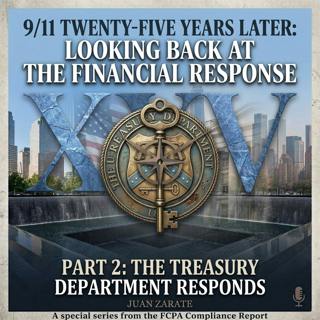
9/11 Twenty-Five Years Later: Part 2: Juan Zarate - The Treasury Department Responds

9/11 Twenty-Five Years Later: Part 2: Juan Zarate - The Treasury Department Responds

Ed. Note-Five years ago, I looked back on 9/11 in a 20 year retrospective. This week is the 25th anniversary of that event. I am rerunning this award winning podcast so that we never forget. On the ...

7 Sep 18min

9/11 Twenty-Five Years Later: Part 1: Gabe Hidalgo - Needing to Make a Difference

9/11 Twenty-Five Years Later: Part 1: Gabe Hidalgo - Needing to Make a Difference

Ed. Note-Five years ago, I looked back on 9/11 in a 20 year retrospective. This week is the 25th anniversary of that event. I am rerunning this award winning podcast so that we never forget. On the ...

6 Sep 20min
Mara Senn on AI-Native, Human-in-the-Loop Investigations for Compliance

Mara Senn on AI-Native, Human-in-the-Loop Investigations for Compliance

In this episode, Tom Fox welcomes Mara Senn, founder and CEO of Ethakos, about her path from big law and a decade as a partner at Arnold & Porter to anti-corruption work at the Kleptocracy Initiative,...

31 Aug 31min

Charisma Doesn’t Scale, Controls Do: Compliance Lessons from Ted Lasso

Charisma Doesn’t Scale, Controls Do: Compliance Lessons from Ted Lasso

In this episode, I take things in a very different direction. Last week I did a 5-part blog post series on leadership lessons from the hit TV show Ted Lasso. I took those 5 blog posts and fed them int...

24 Aug 24min

Data Analytics in Compliance: Lessons from Scoular

Data Analytics in Compliance: Lessons from Scoular

In this episode, Tom Fox welcomes back Vince Walden, CEO of konaAI, which is the sponsor of this podcast series. Vince is well known for his leadership in data analytics, machine learning, and AI, and...

17 Aug 29min

The Berko Verdict with Mike Volkov

The Berko Verdict with Mike Volkov

In this episode, Tom Fox welcomes back his good friend and colleague Mike Volkov and takes a deep dive into the Asante Berko FCPA guilty verdict. They question why Berko went to trial given the stren...

10 Aug 33min

Matt Ellis Wrap-Up from Cartels, FTO Risk, and Corporate Compliance Conference

Matt Ellis Wrap-Up from Cartels, FTO Risk, and Corporate Compliance Conference

In this episode, Tom Fox welcomes back Matt Ellis of Miller & Chevalier to recap ACI’s inaugural two-day Cartel Conference in Washington, DC, highlighting an unusually collaborative, high-energy atmos...

3 Aug 36min

The Business Case for Going Back into Venezuela with Loren Steffy

The Business Case for Going Back into Venezuela with Loren Steffy

Welcome to the award-winning FCPA Compliance Report, the longest-running podcast in compliance. In this episode, Tom welcomes back former Houston Chronicle business columnist Loren Steffy to discuss t...

27 Juli 19min

Populärt inom Business & ekonomi

framgangspodden
rss-jossan-nina
varvet
rss-borsens-finest
24fragor
svd-tech-brief
avanzapodden
badfluence
uppgang-och-fall
lastbilspodden
rss-inga-dumma-fragor-om-pengar
bathina-en-podcast
rikatillsammans-om-privatekonomi-rikedom-i-livet
fill-or-kill
kapitalet-en-podd-om-ekonomi
rss-veckans-trade
rss-dagen-med-di
rss-kort-lang-analyspodden-fran-di
bilar-med-sladd
tabberaset