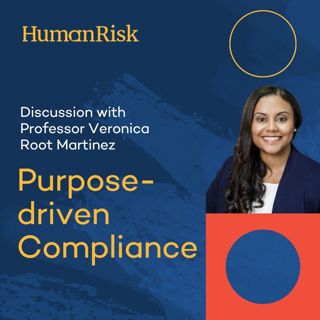
Professor Veronica Root Martinez on Purpose-Driven Compliance

Professor Veronica Root Martinez on Purpose-Driven Compliance

Who determines what 'good' Compliance actually looks like? The obvious answer is regulators (and in some jurisdictions) prosecutors. But what if it were the regulated Firms themselves? That's the idea behind purpose-driven compliance, which I'm exploring on this episode.

Episode Summary
To explore this, I'm joined by Veronica Root Martinez, Professor of Law at Duke University School of Law, to explore a deceptively simple but unsettling idea: 100% compliance is impossible. While we often behave as though perfect compliance is the goal — and in some safety-critical domains it must be — most organisational compliance involves humans. And humans make mistakes. Things get missed. Context changes. Stuff goes wrong.

So if perfection isn’t realistic, the real question becomes: how do organisations decide what really matters? The traditional answer has been to look outward — to regulators, enforcement authorities, and in some jurisdictions (particularly the US), prosecutors. Their priorities, expressed through sentencing guidelines, enforcement actions, and settlements, end up defining what “good” compliance looks like.

Veronica challenges that logic. She argues that this gets things the wrong way round. Instead of letting enforcement priorities dictate behaviour, she makes the case for purpose-driven compliance — where organisations set their own priorities based on their purpose, values, and actual risks, rather than chasing shifting regulatory expectations. Along the way, the conversation explores culture, human judgment, psychological safety, technology, experimentation, and why “best practice” can sometimes make things worse rather than better.

This episode is for anyone who writes rules, enforces them — or simply has to live under them.

Guest Biography
Veronica Root Martinez
is a Professor of Law at Duke University School of Law, where she researches corporate compliance, ethics, and organisational culture. Her work on purpose-driven compliance challenges enforcement-led models and explores how organisations can set priorities based on their own purpose, values, and risks.

Before entering academia, Veronica practised as an associate at a large law firm in Washington, DC, where she worked on regulatory and white-collar matters — experience that strongly informs the practical orientation of her research.

Links

Professor Veronica Root Martinez – Faculty Profile
https://law.duke.edu/fac/martinez

Veronica on LinkedIn
https://www.linkedin.com/in/veronica-root-martinez/

Purpose-Driven Compliance (paper discussed in the episode)
https://papers.ssrn.com/sol3/papers.cfm?abstract_id=6078766


AI-Generated Timestamped Summary
00:00 – 02:00 | “Because they said so”
Christian reframes compliance as a universal human experience — not just a professional discipline — and introduces the problem of rules justified solely by regulatory expectation.

02:00 – 05:30 | Why 100% compliance is impossible
Veronica explains why modern organisations cannot realistically achieve perfect compliance when humans are involved — and why pretending otherwise creates problems.

05:30 – 10:30 | Tolerated misconduct and cultural drift
How allowing “small” rule-breaking can escalate into bigger issues, drawing on behavioural ethics and real-world corporate failures.

10:30 – 14:30 | Risk, prioritisation, and what really matters
A discussion of risk-based thinking, irrecoverable vs recoverable errors, and why organisations — not regulators — are best placed to set priorities.

14:30 – 18:30 | Enforcement swings and resilience
Why compliance programmes built around enforcement trends are fragile, expensive, and reactive — and how purpose-driven approaches create stability. 18:30 – 23:30 | Innovation, uncertainty, and guardrails
Why regulators are always behind innovation — and how values-based guardrails help employees make decisions in uncharted territory.

23:30 – 30:30 | Technology, AI, and the human in the loop
The limits of automation, the danger of over-reliance on tech, and why human judgment remains essential.

30:30 – 36:30 | Rules, loopholes, and malicious compliance
How overly detailed rulebooks create loopholes — and why purpose and principles offer a better basis for accountability.

36:30 – 40:30 | The Costco example
A powerful illustration of simplicity: four ethical principles that employees can actually understand and use.

40:30 – 45:30 | Training, regulators, and unintended consequences
Why blanket training requirements often miss the mark — and how enforcement agreements can accidentally undermine effectiveness.

45:30 – 52:30 | Measuring culture and compliance effectiveness
Moving beyond counting inputs to assessing outputs, including psychological safety, Speak Up systems, and cultural indicators.

52:30 – 57:30 | Experimentation and learning
Why failed interventions aren’t failure — they’re information — and why compliance should be treated as an evolving experiment.

57:30 – End | Reclaiming responsibility
A closing reflection on extrinsic motivation, “because I said so,” and why purpose-driven compliance offers a more human, defensible, and sustainable way forward.

Det här avsnittet är hämtat från ett öppet RSS-flöde och publiceras inte av Podme. Det kan innehålla reklam.

Avsnitt(368)

Will Tarrant on Service: Closing the gap between brand promise and reality

Will Tarrant on Service: Closing the gap between brand promise and reality

What makes great service? It’s one of those things we instantly recognise when we experience it, but struggle to define. And while organisations spend huge amounts of time trying to design seamless cu...

8 Maj 1h

Dr Carissa Véliz on Prophecy

Dr Carissa Véliz on Prophecy

What if prediction isn’t about knowing the future, but controlling it?  On this episode, I'm joined by a leading thinker on digital ethics, privacy and technology to explore the idea of prophecy.Episo...

25 Apr 1h 2min

Dr C Thi Nguyen on How to stop playing someone else's game

Dr C Thi Nguyen on How to stop playing someone else's game

We like to think we choose what matters. But what if the goals we’re chasing… aren’t actually ours?Episode Summary My guest on this episode is Dr. C. Thi Nguyen, philosopher and author of The Score: H...

12 Apr 1h 8min

Phil Dobson on Cognitive Leadership

Phil Dobson on Cognitive Leadership

We tend to assume that if we’re working hard, we’re working well. But what if that isn’t true?Episode SummaryMy guest on this episode is Phil Dobson, author of The Brain Book and founder of Brain Work...

4 Apr 1h 9min

Professor Mark Stoyle on The Western Rising of 1549

Professor Mark Stoyle on The Western Rising of 1549

What lessons does a religious protest that led to an uprising  in 1549 have to do with human risk?At first glance, not very much. It’s easy to see it as a distant historical event — something about re...

22 Mars 1h 4min

Jeffrey Ludlow on What A Sign Is...

Jeffrey Ludlow on What A Sign Is...

What exactly is a sign?  At first glance, that might sound like a strange question. Signs are everywhere: telling us where to go, what to do, what not to do, and sometimes what might happen if we igno...

14 Mars 1h 4min

Marc Ross on The Art of The Negroni

Marc Ross on The Art of The Negroni

What Can a Cocktail Teach Us About Curiosity and Creativity? At first glance, documenting Negronis around the world might sound like a frivolous hobby. But could a simple cocktail become a vehicle for...

7 Mars 45min

Tom & Sue Hardin On Wired On Wall Street

Tom & Sue Hardin On Wired On Wall Street

What’s the difference between a mistake… and a bad decision? My guest knows this only too well. Tom Hardin has been on the show several times before. As Tipper X, he wore a wire for the FBI and helped...

28 Feb 1h 15min

Populärt inom Vetenskap

allt-du-velat-veta
dumma-manniskor
p3-dystopia
ufo-sverige
rss-ufobortom-rimligt-tvivel
kapitalet-en-podd-om-ekonomi
svd-nyhetsartiklar
hacka-livet
paranormalt-med-caroline-giertz
ufo-sverige-2
rss-spraket
sexet
rss-vetenskapsradion
medicinvetarna
det-morka-psyket
rss-vetenskapsradion-2
dumforklarat
rss-dennis-world
rss-tidslinjen-podcast
rss-tidsmaskinen