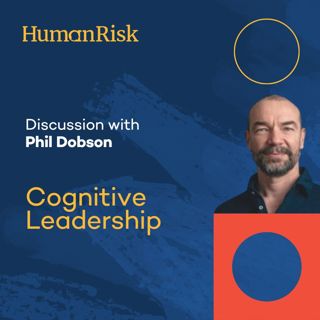
Phil Dobson on Cognitive Leadership

Phil Dobson on Cognitive Leadership

We tend to assume that if we’re working hard, we’re working well. But what if that isn’t true?

Episode Summary
My guest on this episode is Phil Dobson, author of The Brain Book and founder of Brain Workshops, about what he calls 'cognitive leadership': using neuroscience and psychology to help people sustain performance, think more clearly, and navigate uncertainty. Phil explains how a broken ankle led him from music and sales into hypnotherapy, neuroscience, and leadership development, and why he believes most of us are never properly taught how our brains actually work.

In a wide-ranging discussion, we explore the difference between productivity and effectiveness, why attention may be our most valuable asset, and how modern working life often undermines flow, creativity, and good decision-making. We also discuss stress, workload, digital distraction, the limits of measurement, and what organisations get wrong when they try to manage people as if more time always equals more value.

Discover how leaders can create better conditions for thinking, resilience, creativity, and change; and why understanding the human brain matters far beyond the workplace.

Episode Summaruy
  • why most of us are taught far too little about how our brains work
  • Phil’s unusual route from musician to hypnotherapist to neuroscience-based leadership adviser
  • the difference between being productive and being effective
  • why self-employment sharpened Phil’s focus on impact rather than activity
  • how experimentation, iteration, and reflection shape better ways of working
  • the distinction between fun and fulfilment
  • flow states and why modern life makes them harder to access
  • the growing importance of attention in a world of distraction
  • why stress management has to include workload management, not just breathing techniques
  • how rest, breaks, and so-called “unproductive” time often drive insight and creativity
  • why measuring people too narrowly can damage performance
  • how understanding the brain helps leaders navigate change and uncertainty
  • why improving human decision-making matters not just for performance, but for reducing costly mistakes
AI-Generated Timestamped Summary
00:00 — Introduction: busyness vs effectiveness
02:00 — Phil’s journey into cognitive leadership
07:00 — Productivity vs effectiveness (and the 80/20 shift)
12:00 — Experimentation, habits, and fulfilment
17:00 — Flow, focus, and attention under pressure
22:00 — Attention as a critical (and under threat) asset
27:00 — Why knowing isn’t the same as doing
31:00 — Rethinking productivity: energy, creativity, and insight
36:00 — The neuroscience of better thinking (default mode network)
40:00 — Measurement, management, and leadership challenges
45:00 — Human performance beyond the workplace
50:00 — Human error, decision-making, and risk
55:00 — Evolving work: shorter weeks and smarter working
58:00 — Leading change with a brain-based approach
01:03:00 — Final reflections and closing

Relevant Links
Phil's website - https://phildobson.com/

Brain Workshops - https://brainworkshops.co.uk/

Phil on LinkedIn - https://www.linkedin.com/in/brainworkshops/

The Brain Book - https://www.amazon.com/Brain-Book-Smarter-Concise-Advice/dp/1910649732

Det här avsnittet är hämtat från ett öppet RSS-flöde och publiceras inte av Podme. Det kan innehålla reklam.

Avsnitt(377)

Paul Craven on Living With Uncertainty

Paul Craven on Living With Uncertainty

What happens when someone who spends his life thinking about risk, decision-making and human behaviour is confronted with an uncertainty he simply can’t control?Episode summaryMy guest is Paul Craven,...

15 Aug 51min
Benji Wilson on why we rate everything

Benji Wilson on why we rate everything

Why do we rate everything and why do we do so on a scale of one to five stars? What happens when systems designed to help us make better choices start influencing our behaviour in ways we don’t necess...

8 Aug 1h 4min
Mark Heywood on The Stories We Tell About Ourselves

Mark Heywood on The Stories We Tell About Ourselves

What parts of yourself have you learned to hide in order to be taken seriously? My guest on this episode is Mark Heywood, a friend of the show, returning guest and someone I've collaborated with on a ...

2 Aug 1h 21min
Gill Kernick on Grenfell -  the disaster we still haven't learned from

Gill Kernick on Grenfell - the disaster we still haven't learned from

When something goes badly wrong, we investigate it. Reports are written. Recommendations are made. Lessons are identified. But do we actually learn them?Episode SummaryReturning to the show, Gill Kern...

21 Juli 57min
Anna Rössler on Finding Your Voice — Online, On Stage and At Work

Anna Rössler on Finding Your Voice — Online, On Stage and At Work

What does jazz singing have to do with LinkedIn? More than you might think. This week's guest, Anna Rössler, has built a career helping senior leaders find their voice online while simultaneously deve...

5 Juli 1h 1min
David Grosse on The Unconvention

David Grosse on The Unconvention

What happens when two people who spend their careers thinking about human behaviour meet in a London pub and start complaining about conferences? Apparently, they decide to organise one.Episode Summar...

25 Juni 48min
Freewheeling on Human Risk with Thomas Ableman

Freewheeling on Human Risk with Thomas Ableman

Why is it so hard to stop people playing vides, music or phone calls out loud on public transport — and what does that tell us about changing human behaviour? Show Summary This episode of The Human Ri...

11 Juni 45min

Jill Wick on The Human Side of Cybersecurity

Jill Wick on The Human Side of Cybersecurity

What if the best way to improve cybersecurity — or any other form of human risk — wasn't another policy, training course, or piece of technology, but a board game?  That's the kind of question my gues...

30 Maj 1h 3min

Populärt inom Vetenskap

dumma-manniskor
p3-dystopia
allt-du-velat-veta
hacka-livet
rss-vetenskapsradion
ufo-sverige
svd-nyhetsartiklar
bildningspodden
rss-vetenskapsradion-2
halsorevolutionen
rss-spraket
medicinvetarna
sexet
barnpsykologerna
vetenskapsradion
det-morka-psyket
paranormalt-med-caroline-giertz
rss-ufobortom-rimligt-tvivel
ufo-sverige-2
rss-kriminologerna