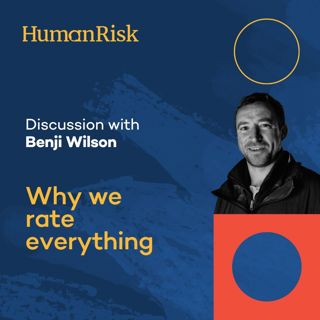
Benji Wilson on why we rate everything

Benji Wilson on why we rate everything

Why do we rate everything and why do we do so on a scale of one to five stars? What happens when systems designed to help us make better choices start influencing our behaviour in ways we don’t necessarily notice?

Episode Summary
My guest is Benji Wilson, a journalist, TV critic and author of Rate This Book. Benji’s day job involves rating other people’s work, but when his children pointed out that Rotten Tomatoes was also rating him, it prompted him to investigate the ratings culture that surrounds us. In our conversation, we explore where ratings came from, why the five-star system became dominant and the psychology that makes us pay attention to the opinions of people we’ve never met.

We discuss social proof and the wisdom of crowds, why we often use ratings to avoid making bad decisions rather than to identify the very best option, and what happens when reviews are fake, manipulated or simply unfair.

We also explore the consequences of moving from rating products and services to rating people, including Uber drivers, hospitality workers and doctors, and why a single negative review can have significant consequences.Benji also explains how ratings might have applications in places we wouldn’t necessarily expect, including workplace appraisals and even democracy, where alternative voting systems use ratings to allow people to express more nuanced preferences.

And, appropriately for someone who has written a book called Rate This Book, we discuss what it feels like when the ratings are turned back on you — including why an anonymous three-star review might actually be more useful than a perfect five-star score.

Guest Profile
Benji is a journalist, author and TV critic. His book, Rate This Book, explores how ratings and reviews came to dominate modern life, the psychology that makes them work and what happens when the systems designed to help us make choices begin shaping those choices themselves.

Links
AI-Generated Timestamped Summary

00:00 — Introduction: why we rate everything
01:45 — Benji’s life as a TV critic and discovering that Rotten Tomatoes was also rating him.
03:30 — Where ratings came from, from our instinct to rank things to the emergence of star ratings.
08:30 — The psychology of ratings: prospect theory, avoiding bad decisions and why we rely on other people’s opinions.
10:15 — Why five stars became the dominant rating system.
16:00 — Experts versus crowds, social proof and why thousands of reviews can feel so persuasive.
20:00 — Fake reviews, manipulated ratings and why critical thinking still matters.
25:00 — What happens when we move from rating products to rating people — and the real-world consequences of negative reviews.
29:30 — Reputation management, review blackmail and whether ratings platforms need greater regulation.
33:30 — Ratings and democracy: could STAR voting offer a less binary way of choosing politicians?38:30 — Workplace appraisals, reciprocal ratings and what happens when a numerical score overwhelms everything else.
43:00 — Uber and how our relationship with rating systems changes over time.
44:30 — What it feels like to have Rate This Book rated — including Benji’s mysterious three-star review.
47:30 — Why three stars may be our most natural — and least useful — rating.
52:30 — How writing the book changed Benji’s own behaviour and why trusted personal recommendations can beat aggregated reviews.
56:30 — Why companies really want our ratings and the commercial incentives behind endless requests for feedback.
01:01:00 — Amazon Vine, gamification and how rating systems can influence the people doing the rating.
01:02:30 — Where to find Benji and Rate This Book, plus the inevitable invitation to rate both the book and the podcast.

Det här avsnittet är hämtat från ett öppet RSS-flöde och publiceras inte av Podme. Det kan innehålla reklam.

Avsnitt(376)

Mark Heywood on The Stories We Tell About Ourselves

Mark Heywood on The Stories We Tell About Ourselves

What parts of yourself have you learned to hide in order to be taken seriously? My guest on this episode is Mark Heywood, a friend of the show, returning guest and someone I've collaborated with on a ...

2 Aug 1h 21min

Gill Kernick on Grenfell -  the disaster we still haven't learned from

Gill Kernick on Grenfell - the disaster we still haven't learned from

When something goes badly wrong, we investigate it. Reports are written. Recommendations are made. Lessons are identified. But do we actually learn them?Episode SummaryReturning to the show, Gill Kern...

21 Juli 57min

Anna Rössler on Finding Your Voice — Online, On Stage and At Work

Anna Rössler on Finding Your Voice — Online, On Stage and At Work

What does jazz singing have to do with LinkedIn? More than you might think. This week's guest, Anna Rössler, has built a career helping senior leaders find their voice online while simultaneously deve...

5 Juli 1h 1min

David Grosse on The Unconvention

David Grosse on The Unconvention

What happens when two people who spend their careers thinking about human behaviour meet in a London pub and start complaining about conferences? Apparently, they decide to organise one.Episode Summar...

25 Juni 48min

Freewheeling on Human Risk with Thomas Ableman

Freewheeling on Human Risk with Thomas Ableman

Why is it so hard to stop people playing vides, music or phone calls out loud on public transport — and what does that tell us about changing human behaviour? Show Summary This episode of The Human Ri...

11 Juni 45min

Jill Wick on The Human Side of Cybersecurity

Jill Wick on The Human Side of Cybersecurity

What if the best way to improve cybersecurity — or any other form of human risk — wasn't another policy, training course, or piece of technology, but a board game?  That's the kind of question my gues...

30 Maj 1h 3min

Tobias Sturesson: from cult to corporate culture

Tobias Sturesson: from cult to corporate culture

What can businesses learn from cults?It might sound like an uncomfortable comparison: one involves strategy meetings, values statements and quarterly targets; the other manipulation, charismatic leade...

23 Maj 1h 8min

Populärt inom Vetenskap

p3-dystopia
dumma-manniskor
allt-du-velat-veta
hacka-livet
ufo-sverige
rss-vetenskapsradion
rss-kriminologerna
svd-nyhetsartiklar
bildningspodden
det-morka-psyket
rss-vetenskapsradion-2
halsorevolutionen
ufo-sverige-2
medicinvetarna
dumforklarat
vetenskapsradion
sexet
rss-odla
barnpsykologerna
paranormalt-med-caroline-giertz