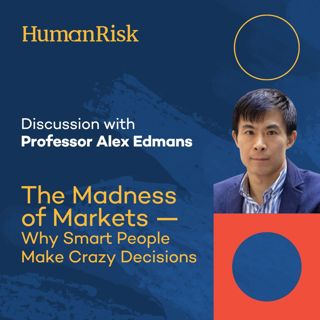
Professor Alex Edmans on the Madness of Markets — Why Smart People Make Crazy Decisions

Professor Alex Edmans on the Madness of Markets — Why Smart People Make Crazy Decisions

What can financial markets teach us about human behaviour? Why might the size of a CEO’s signature tell us something useful about the company they run? And why, even when smart investors know something is probably a bubble, might they keep investing anyway?

Episode Summary
My guest on this episode is Professor Alex Edmans, who returns to the show to discuss his new book, The Madness of Markets: Why Smart Investors Make Crazy Decisions and How to Exploit Them. As the title suggests, this is a book about financial markets. But our conversation is really about something much broader: human behaviour.

Markets ought to be places where irrationality gets eliminated. They contain millions of participants, huge amounts of data and some of the smartest and best-paid people in the world. Yet people still overreact, follow the herd, become overconfident, refuse to admit mistakes and pay attention to things that shouldn't matter.

Alex explains why that happens and what it can teach us about decision-making beyond investing.We explore why seemingly trivial information can move markets, the fine line between conviction and delusion, and why information that's hiding in plain sight can sometimes tell us more than sophisticated financial analysis. Alex share why corporate jets, unusual locations for shareholder meetings and even the size of a CEO's signature can offer clues about how a company is run.

We also discuss information overload and our preference for things we can measure, why more disclosure isn't necessarily better disclosure, and how organisations can exploit the limits of human attention — including the strategic release of bad news on Friday afternoons.

He also considers the impact of AI; machines can process enormous quantities of quantitative information without some of our human biases, but qualitative judgements about character, culture and trustworthiness may still require people. The future, Alex argues, isn't necessarily human or machine, but human and machine. Along the way, we explore bubbles, loss aversion, sunk costs, incentives in investment banking, financial literacy and regulation.

And, ultimately, we return to a simple idea: markets behave irrationally because they're made up of human beings.

Guest Biography
Alex Edmans is Professor of Finance at London Business School, an author, speaker and expert on behavioural finance, responsible business and corporate governance. Before entering academia, Alex worked in investment banking at Morgan Stanley. His research has been widely published, and he has won numerous awards for teaching. His previous books include Grow the Pie and May Contain Lies, the latter of which was the subject of his previous appearance on the podcast.

Links
Alex Edmans' website: https://alexedmans.com/

Alex Edmans on LinkedIn: https://www.linkedin.com/in/aedmans/

The Madness of Markets: https://www.penguinrandomhouse.com/books/821903/the-madness-of-markets-by-alex-edmans/

Alex's previous appearance on the show — Professor Alex Edmans on Misinformation: https://www.humanriskpodcast.com/professor-alex-edmans-on-misinformation/

AI-Generated Timestamped Summary
[00:00:00] Introduction — what financial markets can teach us about human behaviour

[00:01:45] Why Alex wrote The Madness of Markets and why markets are driven by psychology as well as economics

[00:03:15] Markets as a laboratory for human behaviour — if millions of investors can get things wrong, what does that tell us about small groups making decisions?

[00:04:40] Three types of mistakes: overreaction, underreaction and focusing on the wrong information

[00:06:20] Loss aversion and the sunk cost fallacy — why admitting a previous decision was wrong is so difficult

[00:07:20] Combining memorable anecdotes with large-scale evidence, from Isaac Newton to market bubbles

[00:08:45] Why highly intelligent and sophisticated investors still make systematic mistakes

[00:10:40] Finding signals in unexpected places — why more data isn't necessarily better data

[00:12:20] What corporate jets, remote shareholder meetings, CEO photographs and signature sizes might reveal about leadership[

00:14:00] Information hiding in plain sight and how Alex's collection of unusual academic research became a book

[00:17:00] Why more corporate disclosure isn't necessarily helpful — and our preference for quantitative over qualitative information

[00:19:30] Creativity, silos and finding connections that other people miss

[00:21:00] Football, national mood and the stock market — demonstrating how emotion can affect prices

[00:23:00] Recognising our own humanity and why stress and emotion affect even highly experienced decision-makers

[00:24:00] AI and investing — what machines can do better and where human qualitative judgement still matters

[00:26:30] Why market inefficiencies don't disappear even after researchers reveal them

[00:28:00] Knowing there's a bubble but continuing to invest — why being right in the long term can still get you into trouble in the short term

[00:30:00] Investment horizons, other people's money and why your objectives determine what counts as a sensible decision

[00:31:40] Information overload — why watching markets too closely can make investors worse at investing

[00:33:15] How these principles extend beyond financial markets to housing, collectibles and other major decisions

[00:35:20] Mergers and acquisitions, investment bankers and the problem of misaligned incentives

[00:37:00] How organisations exploit human attention — including why bad news tends to arrive on Friday afternoons

[00:39:00] Could changing when and how we work help us notice information that everyone else misses?

[00:41:00] How writing the book changed Alex's own investment decisions, from rebalancing tech holdings to paying attention to fees

[00:43:00] Why Alex hasn't set up his own investment fund and how he applies behavioural insights to his portfolio

[00:46:00] Taking the broader view — why Alex prefers researching, teaching and explaining markets to running money

[00:48:00] Why The Madness of Markets was really 22 years in the making

[00:50:00] Democratising investing, financial literacy and helping people understand the risks they're taking

[00:53:30] Regulation, hidden costs and why making the right information salient may be more useful than simply providing more information

[00:55:45] Are markets really crazy — or are they simply an unusually visible example of humans being human?

[00:58:00] Why the lessons of the book ultimately go far beyond investing

Det här avsnittet är hämtat från ett öppet RSS-flöde och publiceras inte av Podme. Det kan innehålla reklam.

Avsnitt(382)

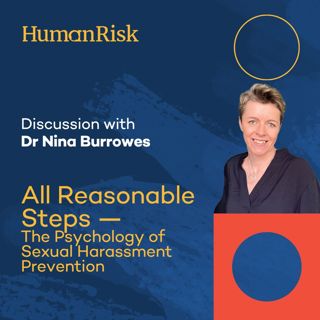
Dr Nina Burrowes on All Reasonable Steps: The Psychology of Sexual Harassment Prevention

Dr Nina Burrowes on All Reasonable Steps: The Psychology of Sexual Harassment Prevention

What does it actually take to prevent sexual harassment at work? Policies, training, reporting mechanisms and statements of zero tolerance are one thing. Creating a workplace where sexual harassment i...

25 Sep 1h 6min
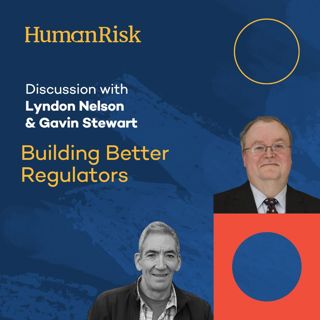
Lyndon Nelson & Gavin Stewart on Building Better Regulators

Lyndon Nelson & Gavin Stewart on Building Better Regulators

What if understanding regulation could help us spot when politicians are promising the impossible? Regulation sounds simple in theory. Something poses a risk, so we create rules and a regulator to con...

7 Sep 1h 23min
Roger Dooley on The Persuasion Engine

Roger Dooley on The Persuasion Engine

What if AI could help us understand people better, rather than simply replacing what humans do?Episode summaryHow can we use AI to become better at persuasion, communication and understanding human be...

1 Sep 59min
Annie Wagstaff on The Joy of Curiosity

Annie Wagstaff on The Joy of Curiosity

What’s the last thing you learned simply because you wanted to know?Episode summaryWhy do we feel the need to justify what we learn? My guest on this episode is Annie Wagstaff, a musician and composer...

23 Aug 1h
Paul Craven on Living With Uncertainty

Paul Craven on Living With Uncertainty

What happens when someone who spends his life thinking about risk, decision-making and human behaviour is confronted with an uncertainty he simply can’t control?Episode summaryMy guest is Paul Craven,...

15 Aug 51min
Benji Wilson on why we rate everything

Benji Wilson on why we rate everything

Why do we rate everything and why do we do so on a scale of one to five stars? What happens when systems designed to help us make better choices start influencing our behaviour in ways we don’t necess...

8 Aug 1h 4min
Mark Heywood on The Stories We Tell About Ourselves

Mark Heywood on The Stories We Tell About Ourselves

What parts of yourself have you learned to hide in order to be taken seriously? My guest on this episode is Mark Heywood, a friend of the show, returning guest and someone I've collaborated with on a ...

2 Aug 1h 21min

Populärt inom Vetenskap

dumma-manniskor
p3-dystopia
rss-mottagningen
allt-du-velat-veta
angestpodden
kapitalet-en-podd-om-ekonomi
rss-ronden
det-morka-psyket
ufo-sverige
svd-nyhetsartiklar
4health-med-anna-sparre
sexet
rss-vetenskapsradion
rss-arkeologi-historia-podden-som-graver-i-vart-kulturlandskap
bildningspodden
rss-spraket
rss-vetenskapsradion-2
ideer-som-forandrar-varlden
rss-ufobortom-rimligt-tvivel
rss-geopodden-2