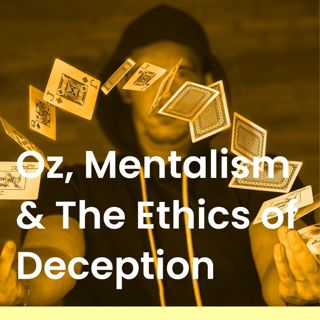

Oz the Mentalist & The Ethics of Deception

Oz the Mentalist & The Ethics of Deception

This week’s disagreement is on Oz The Mentalist and the Ethics of Deception.

This episode is about magic and mentalism, but, more than that, it’s about the nature of how we form beliefs, determine what is real, what is true, and the social consequences of mass deception.

First off: who is Oz the Mentalist?

He’s the guy you’ve probably seen in your social media feed, appearing to read the minds of celebrities. He’s performed live at the Golden Globes and appeared on Howard Stern, The View, and 60 Minutes. He’s the guy who guesses the name of a celebrity’s high school crush or their third-grade teacher.

Oz doesn’t claim to be psychic. His tagline is: “I don’t read minds, I read people.” He says he has extraordinary powers of perception. On Joe Rogan’s podcast, he compared himself to Jason Bourne—someone who can read micro-expressions, facial tics, and eye movements to uncover whatever is inside your head.

That’s what separates mentalism from traditional magic. In magic, everyone knows a trick is happening. With mentalism, performers distance themselves from magic entirely. Oz constantly says he doesn’t do magic tricks. Instead, he says he uses real psychological tools to access people’s thoughts.

He’s turned those alleged abilities into a self-help empire, with a viral TED Talk titled “How to Read Minds Without Magic” and a New York Times bestselling book, Read Your Mind.

I became fascinated with Oz a few months ago. My son is obsessed with magic, so we started watching his videos together and trying to figure out how the tricks worked. And honestly, I was pretty confused. None of the explanations we came up with made much sense. Then I came across a video from an Australian law student named Stevie Baskin, who came out of nowhere and started posting a five-hour viral video debunking Oz and mentalism.

So how does a mentalist guess the name of your third-grade teacher? What kind of intense training lets someone peer inside your head and know exactly what you’re thinking?

It turns out the answer is a lot more straightforward than you might think—and I’m sharing it because it’s important context for this conversation.

Mentalists use a range of techniques, but one of the most common is something called pre-show. Before the show even begins, the mentalist and the guest agree on the question that will be asked later during the performance.

The guest writes down the answer in a notepad. The mentalist might say something like, “Tear it off and put it in your pocket so you can’t change your answer when we’re live.” But it’s not a normal notepad. It’s a special one that secretly records the writing on the sheet underneath. When the guest hands the pad back, the mentalist already knows the answer—before the show even starts. From there, the rest is just acting. There are other variations of this too, involving special cell phone apps or surreptitiously designed websites.

It kind of bothered me when I learned that. With the TED Talk and the New York Times bestseller, it felt like Oz had moved beyond entertainment and into something closer to misinformation—and monetizing it.

Stevie Baskin agreed to come on the show to discuss the ethics of all of this. And to represent the other side, I wanted someone who actually practices mentalism. So I’m very grateful to mentalist, The Amazing Dr. Scott, for joining us. When not performing mentalism, Dr. Scott AKA Dr. Scott Barry Kaufman is a renowned cognitive scientist and professor at Columbia University.

The Guests

Steve Baskin is a skeptic, rationalist, and YouTube sensation who is in the midst of earning a law degree. Stevie crafted a five-hour YouTube video critiquing metadeceptions and articulating way mentalists like Oz Pearlman present create moral hazards for everyone. Stevie’s video, Metadception: The Truth About Oz Pearlmen has close to 200k views and has created a stir amongst both fans and critics of mentalism, and the greater mentalist community.

Dr. Scott Barry Kaufman is a psychologist, coach, best-selling author, professor, keynote speaker, and mentalist. Dr. Kaufman is a professor of psychology at Columbia University and director of the Center for Human Potential, and is among the top 1% most cited scientists in the world for his research on intelligence and creativity. Dr. Kaufman’s writing has appeared in The Atlantic, Scientific American, Psychology Today, and Harvard Business Review, and he is the author and editor of 11 books, including his most recent book Rise Above: Overcome a Victim Mindset, Empower Yourself, and Realize Your Full Potential.

Questions or comments about this episode? Email us at podcast@thedisagreement.com or find us on X and Instagram @thedisagreementhq. Subscribe to our newsletter: https://thedisagreement.substack.com/

Det här avsnittet är hämtat från ett öppet RSS-flöde och publiceras inte av Podme. Det kan innehålla reklam.

Avsnitt(43)

Is AI Eroding Human Intelligence?

Is AI Eroding Human Intelligence?

On April 14, we recorded a live episode on the Fusion stage at the ASU/GSV education conference in San Diego. We dove into what I would argue is one of the most important questions, not just in educat...

1 Maj 37min

The Case for American Power

The Case for American Power

Today we’re trying something new on the show –  it’s a different kind of book review, where we have a healthy disagreement around the core arguments made in a recently released book. The book is The C...

29 Jan 59min

Live from Harvard: Parents' Rights and K-12 Curriculum

Live from Harvard: Parents' Rights and K-12 Curriculum

Today, we’re sharing a special live recording of The Disagreement at the Harvard Graduate School of Education*. Our topic: Parents' Rights and K-12 Curriculum. This is our first live recording in a un...

4 Dec 202548min

How to Disagree About Gaza and Zohran Mamdani

How to Disagree About Gaza and Zohran Mamdani

Today, we’re continuing our How to Disagree series with an episode called How to Disagree On Gaza and Zohran Mamdani.A reminder: these episodes feature coaching sessions and real-life disagreements. O...

4 Nov 202547min
How to Disagree About Gender with a Close Friend (Part II)

How to Disagree About Gender with a Close Friend (Part II)

Today, we’re doing the second episode in our new series: How to Disagree.A reminder: these episodes feature coaching sessions and real-life disagreements. Our goal is to equip everyone with the skills...

31 Okt 202553min
How To Disagree About Gender with a Close Friend (Part I)

How To Disagree About Gender with a Close Friend (Part I)

Today, we’re introducing the first episode in a new series: How to Disagree. As we expand our work to model and enable productive disagreement across lines of difference, we are trying something new w...

24 Okt 202551min

AI in Education: A Force for Good?

AI in Education: A Force for Good?

Recently, First Lady Melania Trump convened the second White House Task Force on Artificial Intelligence in Education. There is simultaneously an incredible amount of excitement around AI in schools a...

2 Okt 20251h 4min

Populärt inom Politik & nyheter

aftonbladet-krim
p3-krim
aftonbladet-daily
svenska-fall
rss-krimstad
rss-krimreportrarna
flashback-forever
motiv
politiken
rss-vad-fan-hande
rss-sanning-konsekvens
svd-ledarredaktionen
de-fyras-gang
spar
mannen-utan-spar
rss-flodet
tv4-nyheterna-story
rss-expressen-dok
rss-frandfors-horna
fordomspodden