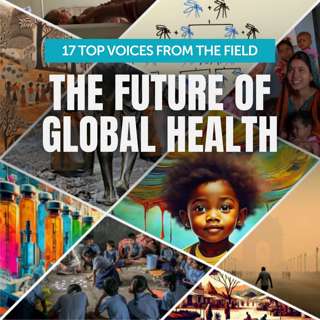

Village gossip, pesticide bans, and gene drives: 17 experts on the future of global health

Village gossip, pesticide bans, and gene drives: 17 experts on the future of global health

What does it really take to lift millions out of poverty and prevent needless deaths?

In this special compilation episode, 17 past guests — including economists, nonprofit founders, and policy advisors — share their most powerful and actionable insights from the front lines of global health and development. You’ll hear about the critical need to boost agricultural productivity in sub-Saharan Africa, the staggering impact of lead poisoning on children in low-income countries, and the social forces that contribute to high neonatal mortality rates in India.

What’s so striking is how some of the most effective interventions sound almost too simple to work: banning certain pesticides, replacing thatch roofs, or identifying village “influencers” to spread health information.

Full transcript and links to learn more: https://80k.info/ghd

Chapters:

  • Cold open (00:00:00)
  • Luisa’s intro (00:00:58)
  • Development consultant Karen Levy on why pushing for “sustainable” programmes isn’t as good as it sounds (00:02:15)
  • Economist Dean Spears on the social forces and gender inequality that contribute to neonatal mortality in Uttar Pradesh (00:06:55)
  • Charity founder Sarah Eustis-Guthrie on what we can learn from the massive failure of PlayPumps (00:14:33)
  • Economist Rachel Glennerster on how randomised controlled trials are just one way to better understand tricky development problems (00:19:05)
  • Data scientist Hannah Ritchie on why improving agricultural productivity in sub-Saharan Africa is critical to solving global poverty (00:24:36)
  • Charity founder Lucia Coulter on the huge, neglected upsides of reducing lead exposure (00:47:48)
  • Malaria expert James Tibenderana on using gene drives to wipe out the species of mosquitoes that cause malaria (00:53:11)
  • Charity founder Varsha Venugopal on using village gossip to get kids their critical immunisations (01:04:14)
  • Rachel Glennerster on solving tough global problems by creating the right incentives for innovation (01:11:31)
  • Karen Levy on when governments should pay for programmes instead of NGOs (01:26:51)
  • Open Philanthropy lead Alexander Berger on declining returns in global health, and finding and funding the most cost-effective interventions (01:29:40)
  • GiveWell researcher James Snowden on making funding decisions with tricky moral weights (01:34:44)
  • Lucia Coulter on “hits-based giving” approaches to funding global health and development projects (01:43:01)
  • Rachel Glennerster on whether it’s better to fix problems in education with small-scale interventions versus systemic reforms (01:48:12)
  • GiveDirectly cofounder Paul Niehaus on why it’s so important to give aid recipients a choice in how they spend their money (01:51:09)
  • Sarah Eustis-Guthrie on whether more charities should scale back or shut down, and aligning incentives with beneficiaries (01:56:12)
  • James Tibenderana on why we need loads better data to harness the power of AI to eradicate malaria (02:11:22)
  • Lucia Coulter on rapidly scaling a light-touch intervention to more countries (02:20:14)
  • Karen Levy on why pre-policy plans are so great at aligning perspectives (02:32:47)
  • Rachel Glennerster on the value we get from doing the right RCTs well (02:40:04)
  • Economist Mushtaq Khan on really drilling down into why “context matters” for development work (02:50:13)
  • GiveWell cofounder Elie Hassenfeld on contrasting GiveWell’s approach with the subjective wellbeing approach of Happier Lives Institute (02:57:24)
  • James Tibenderana on whether people actually use antimalarial bed nets for fishing — and why that’s the wrong thing to focus on (03:05:30)
  • Karen Levy on working with governments to get big results (03:10:53)
  • Leah Utyasheva on how a simple intervention reduced suicide in Sri Lanka by 70% (03:17:38)
  • Karen Levy on working with academics to get the best results on the ground (03:29:03)
  • James Tibenderana on the value of working with local researchers (03:32:15)
  • Lucia Coulter on getting buy-in from both industry and government (03:35:05)
  • Alexander Berger on reasons neartermist work makes sense even by longtermist standards (03:39:26)
  • Economist Shruti Rajagopalan on the key skills to succeed in public policy careers, and seeing economics in everything (03:47:42)
  • J-PAL lead Claire Walsh on her career advice for young people who want to get involved in global health and development (03:55:20)

Audio engineering: Ben Cordell, Milo McGuire, Simon Monsour, and Dominic Armstrong
Content editing: Katy Moore and Milo McGuire
Music: CORBIT
Coordination, transcriptions, and web: Katy Moore

Det här avsnittet är hämtat från ett öppet RSS-flöde och publiceras inte av Podme. Det kan innehålla reklam.

Avsnitt(335)

Can AIs already start 'rogue deployments' inside AI companies? (Landmark new METR report)

Can AIs already start 'rogue deployments' inside AI companies? (Landmark new METR report)

A red-teamer was embedded inside Anthropic for three weeks, told to imagine he was an evil Claude, and asked to figure out how to launch a ‘rogue AI deployment’ without getting caught. It’s one part o...

20 Maj 20min

#243 – 'Godfather of AI' Yoshua Bengio: "I now see a path" to safe superintelligent AI

#243 – 'Godfather of AI' Yoshua Bengio: "I now see a path" to safe superintelligent AI

The co-inventor of modern AI and the most cited living scientist believes he's figured out how to ensure AI is honest, incapable of deception, and never goes rogue. Yoshua Bengio – Turing Award Winner...

7 Maj 2h 33min

'95% of AI Pilots Fail': The hidden agenda behind the viral stat that misled millions

'95% of AI Pilots Fail': The hidden agenda behind the viral stat that misled millions

You might have heard that '95% of corporate AI pilots' are failing. It was one of the most widely cited AI statistics of 2025, parroted by media outlets everywhere. It helped trigger a Nasdaq selloff ...

28 Apr 10min

#242 – Will MacAskill on how we survive the 'intelligence explosion,' AI character, and the case for 'viatopia'

#242 – Will MacAskill on how we survive the 'intelligence explosion,' AI character, and the case for 'viatopia'

Hundreds of millions already turn to AI on the most personal of topics — therapy, political opinions, and how to treat others. And as AI takes over more of the economy, the character of these systems ...

22 Apr 3h 9min

Risks from power-seeking AI systems (article narration by Zershaaneh Qureshi)

Risks from power-seeking AI systems (article narration by Zershaaneh Qureshi)

Hundreds of prominent AI scientists and other notable figures signed a statement in 2023 saying that mitigating the risk of extinction from AI should be a global priority. At 80,000 Hours, we’ve consi...

16 Apr 1h 29min

How scary is Claude Mythos? 303 pages in 21 minutes

How scary is Claude Mythos? 303 pages in 21 minutes

With Claude Mythos we have an AI that knows when it's being tested, can obscure its reasoning when it wants, and is better at breaking into (and out of) computers than any human alive. Rob Wiblin work...

10 Apr 21min

What everyone is missing about Anthropic vs the Pentagon. And: The Meta leaks are worse than you think.

What everyone is missing about Anthropic vs the Pentagon. And: The Meta leaks are worse than you think.

When the Pentagon tried to strong-arm Anthropic into dropping its ban on AI-only kill decisions and mass domestic surveillance, the company refused. Its critics went on the attack: Anthropic and its s...

3 Apr 20min

Populärt inom Utbildning

historiepodden-se
rss-bara-en-till-om-missbruk-medberoende-2
det-skaver
nu-blir-det-historia
harrisons-dramatiska-historia
allt-du-velat-veta
johannes-hansen-podcast
not-fanny-anymore
rss-viktmedicinpodden
roda-vita-rosen
sa-in-i-sjalen
i-vantan-pa-katastrofen
sektledare
rss-max-tant-med-max-villman
rss-foraldramotet-bring-lagercrantz
rikatillsammans-om-privatekonomi-rikedom-i-livet
rss-sjalsligt-avkladd
rss-traningsklubben
rss-dr-bjorklund
vi-gar-till-historien