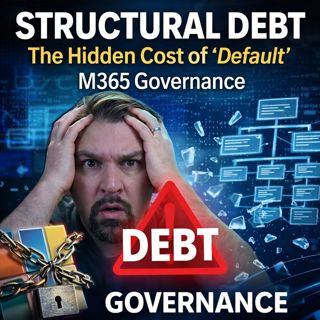

Structural Debt: The Hidden Cost of 'Default' M365 Governance

Structural Debt: The Hidden Cost of 'Default' M365 Governance

Microsoft 365 governance, risk management, and compliance are no longer about isolated incidents or policy gaps. In modern M365 environments, risk behaves as a system outcome—driven by friction, defaults, and human behavior under pressure. Oversharing, workspace sprawl, shadow IT, and Copilot exposure are not random problems. They are predictable results of how your Microsoft 365 environment is designed. In this episode, Mirko Peters explains why traditional governance models fail, how structural debt accumulates silently, and why AI makes these weaknesses impossible to ignore.

🧠 CORE IDEA

Most organizations believe governance fails when people break the rules. But in reality, governance fails when the environment makes the right behavior too hard to sustain. When Microsoft 365 becomes slow, unclear, or restrictive under real-world pressure, work doesn’t stop—it moves. It moves to unmanaged tools, external platforms, and invisible workflows. That is where risk actually lives today.

⚠️ RISK HAS CHANGED SHAPE

Microsoft 365 risk is no longer defined by dramatic events like breaches or malicious insiders. Instead, it accumulates through everyday behavior:
  • A sharing link reused for convenience
  • A new Team created to avoid confusion
  • A file copied outside the tenant to meet a deadline
These actions feel productive—but they quietly expand access, fragment control, and create long-term exposure. Once AI and Copilot enter the environment, this accumulated reality becomes instantly visible and operational.

🧩 STRUCTURAL DEBT IN MICROSOFT 365

Structural debt is not about bad code or outdated scripts. It is the sum of past decisions that still shape behavior today:
  • Permissions granted quickly and never removed
  • Workspaces created without lifecycle or ownership
  • Defaults accepted without business context
  • Connectors added without full visibility
This debt compounds silently. It doesn’t break the system—it redefines how the system behaves.

🔄 WHY DEFAULTS ARE NEVER NEUTRAL

Defaults in Microsoft 365 are not just technical settings—they are behavioral signals. They define what feels normal:
  • How easy it is to share
  • How fast a workspace can be created
  • How frictionless external collaboration becomes
If the default path is fast and open, while the governed path is slow and unclear, users will always follow the default. Not because they are careless—but because they are trying to get work done.

📂 THE THREE FAILURE PATTERNS
  1. Open-by-Default Sharing Sharing starts as a single action but becomes a long-term access pattern.
  2. Links persist, permissions expand, and visibility grows beyond original intent.
  3. 2. Workspace Sprawl Teams and SharePoint sites multiply faster than they are managed.
  4. Ownership fades, context fragments, and inactive workspaces remain fully accessible. 3. Unmanaged Connectors & Shadow IT When governance creates friction, work moves.
  5. External tools, apps, and workflows emerge as structural compensation, not rebellion. 🤖 WHY AI (COPILOT) CHANGES EVERYTHING AI does not create risk—it reveals and amplifies it.
  • Overshared data becomes instantly retrievable
  • Old workspaces become active knowledge sources
  • Fragmented environments become searchable systems
What was previously hidden behind friction is now operational at scale. AI removes the safety illusion of “nobody will find it.”
⚡ THE REAL PROBLEM: RISK MIGRATION
Traditional governance assumes:
👉 If you block a risky action, risk is reduced But in reality:
👉 If you block the path, work moves somewhere else Risk doesn’t disappear—it relocates.
  • Block sharing → files move externally
  • Slow provisioning → teams create shadow workspaces
  • Complex approvals → connectors bypass governance
This is risk migration—and it is invisible in most dashboards.

🧭 THE LEADERSHIP BLIND SPOT

Leaders often see:
  • Policies enabled
  • Secure Score improving
  • Controls in place
But they don’t see:
  • Waiting times for access
  • Frequency of workarounds
  • Off-platform collaboration patterns
This creates a dangerous illusion:
👉 Visible control ≠ Controlled behavior

🏗️ FROM RESTRICTION TO RESILIENCE

Most organizations respond by tightening control. But restriction alone creates fragility. Resilient governance works differently. It ensures:
👉 The safe path is also the fastest path That means:
  • Fast, governed workspace creation
  • Built-in ownership and lifecycle from day one
  • Clear collaboration zones (Open, Controlled, Sensitive)
  • Early classification and protection
  • Visibility into connectors and external flows
Governance must function as an operating system, not just a control system.

🚀 THE 30-DAY SHIFT

Instead of launching another long transformation program, start with a focused shift: Pick a high-pressure business area and redesign one thing:
👉 Make the governed path easier than the workaround Measure:
  • Startup speed of collaboration
  • Reduction in exceptions
  • Decrease in off-platform work
  • Adoption of governed environments
If the system holds real work under pressure, governance is working. If not, risk is already migrating.

🔎 WHAT LEADERS SHOULD AUDIT NOW
Move beyond policy checks and start auditing behavior:
  • Where does work wait?
  • Where does it duplicate?
  • Where does it drift?
  • Where does it leave Microsoft 365?
These are not operational annoyances—they are risk signals.

🎙️ ABOUT THE HOST – MIRKO PETERS

Mirko Peters translates how technology actually shapes business reality. He focuses on Microsoft 365 governance, security, and operating models—helping organizations move from theoretical control to systems that work under real pressure. Through M365 FM, he breaks down complex topics like Purview, Entra, Copilot, and AI governance into clear, actionable insights that connect architecture decisions to business outcomes. His core belief:

👉 Technology doesn’t fail—design does.

🎧 FINAL THOUGHT Risk in Microsoft 365 is no longer about isolated mistakes. It is about the behavior your environment produces every day. If the system makes safe work slow and difficult, people will compensate. And in modern organizations:
👉 Compensation becomes risk.

Become a supporter of this podcast: https://www.spreaker.com/podcast/m365-fm-modern-work-security-and-productivity-with-microsoft-365--6704921/support.

Det här avsnittet är hämtat från ett öppet RSS-flöde och publiceras inte av Podme. Det kan innehålla reklam.

Avsnitt(871)

Microsoft Fabric Apps - Simply Explained

Microsoft Fabric Apps - Simply Explained

Microsoft Fabric Apps are a new way to build modern, data-driven web applications directly inside Microsoft Fabric. Rather than managing servers, APIs, databases, authentication, and hosting separatel...

30 Juli 16min

Beyond the Prompt: Mastering Microsoft Copilot for Real Productivity with Jess Stratton [MVP]

Beyond the Prompt: Mastering Microsoft Copilot for Real Productivity with Jess Stratton [MVP]

Jess Stratton shares her unique career journey from independent Lotus Notes developer to one of the world's most recognized Microsoft 365 educators. After joining LinkedIn Learning, she created traini...

30 Juli 53min

The Death of the Chatbot: Why Your Dataverse Strategy Is Broken

The Death of the Chatbot: Why Your Dataverse Strategy Is Broken

Microsoft Copilot has transformed how organizations interact with AI, making conversational experiences more accessible than ever. But while chat-based AI delivers immediate productivity gains, it doe...

29 Juli 1h 41min

The Future of IT Is Agentic: Inside Windows 365, Intune & Microsoft's AI Vision with Christiaan Brinkhoff

The Future of IT Is Agentic: Inside Windows 365, Intune & Microsoft's AI Vision with Christiaan Brinkhoff

Christiaan Brinkhoff shares the remarkable career path that took him from speaking at community events and writing technical blogs to becoming one of the key people behind Microsoft's modern cloud des...

29 Juli 1h 29min
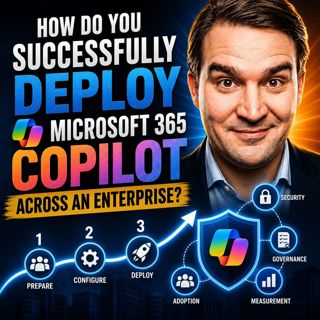
How Do You Successfully Deploy Microsoft 365 Copilot Across an Enterprise?

How Do You Successfully Deploy Microsoft 365 Copilot Across an Enterprise?

A successful Microsoft 365 Copilot deployment begins long before licenses are assigned. Organizations should first define measurable business outcomes, identify high-value use cases, and secure execut...

29 Juli 1h 32min

From Pilot to Production: Building Enterprise AI That Actually Delivers with Leon Gordon [MVP]

From Pilot to Production: Building Enterprise AI That Actually Delivers with Leon Gordon [MVP]

Leon Gordon explains why most enterprise AI initiatives never reach production and introduces the concept of the Pilot Tax—the hidden cost organizations pay when AI projects remain stuck in proof-of-c...

28 Juli 59min

Microsoft Purview is a Trap: The Hard Truth About Data Governance

Microsoft Purview is a Trap: The Hard Truth About Data Governance

Microsoft Purview is included with many Microsoft 365 subscriptions, making it incredibly easy to enable. That convenience is also its biggest danger. Because there is no procurement process or large ...

28 Juli 1h 1min

From Excel Expert to Microsoft MVP: Empowering Millions with Data, Dashboards & AI with Karen Abecia [Microsoft MVP]

From Excel Expert to Microsoft MVP: Empowering Millions with Data, Dashboards & AI with Karen Abecia [Microsoft MVP]

aren Abecia shares the remarkable journey that transformed a passion for Microsoft Excel into a global career as one of the world's best-known Excel educators. She explains how discovering creative sp...

27 Juli 59min
Populärt inom Politik & nyheter

svenska-fall
p3-krim
rss-krimstad
aftonbladet-daily
aftonbladet-krim
rss-sanning-konsekvens
flashback-forever
rss-krimreportrarna
tv4-nyheterna-story
motiv
mannen-utan-spar
rss-frandfors-horna
rss-flodet
rss-vad-fan-hande
rss-aftonbladet-krim
spar
de-fyras-gang
politiken
olyckan-inifran
rss-mord-forsvinnanden