
Microsoft Purview is a Trap: The Hard Truth About Data Governance

Microsoft Purview is a Trap: The Hard Truth About Data Governance

Microsoft Purview is included with many Microsoft 365 subscriptions, making it incredibly easy to enable. That convenience is also its biggest danger. Because there is no procurement process or large implementation project, many organizations activate Purview without defining clear business goals, ownership, or governance. The result is often a catalog filled with thousands of scanned assets, confusing permissions, and business users who abandon the platform after their first experience. This episode explains why Purview itself is not the problem—the real challenge is how organizations approach data governance. Governance must begin with business objectives, ownership, and change management before any scans are executed or collections are created.

STOP BUILDING A CATALOG — START SOLVING BUSINESS PROBLEMS
One of the biggest mistakes organizations make is attempting to catalog their entire data estate from day one. Instead of asking, "What data do we have?", they should ask, "What business question are we trying to answer?" Every successful Microsoft Purview deployment should begin with a single, measurable use case such as fraud detection, customer churn prediction, or regulatory reporting. That single question determines which data sources need to be scanned, who should own the data, which governance domain is required, and what success looks like. Building one valuable data product first creates trust, enables rapid feedback, and provides a repeatable blueprint for future governance initiatives. A focused rollout consistently delivers better adoption than a large-scale "Big Bang" implementation.

DESIGNING MICROSOFT PURVIEW FOR SCALE
The episode provides a deep architectural walkthrough of Microsoft Purview's governance model, explaining the four permission layers that control access: the Tenant Layer, the Data Map, the Unified Catalog, and Governance Domains. Rather than assigning permissions directly to individuals, organizations should package permissions into role-based Microsoft Entra groups aligned with real business personas. The discussion also covers how to organize collections around business domains instead of technical platforms, why governance domains should mirror business ownership, and how data products become the bridge between raw technical assets and meaningful business outcomes. By structuring Purview around people, business processes, and ownership rather than databases and technologies, organizations create a catalog that employees can actually understand and use.

DATA PRODUCTS, OWNERSHIP, AND THE MEDALLION ACCOUNTABILITY MODEL
Governance only succeeds when ownership is clearly defined. The episode explains how data products bring together assets from multiple platforms under a single business purpose, complete with owners, glossary terms, policies, and approval workflows. It also explores how accountability shifts throughout a modern data platform using the Medallion Architecture. Bronze data remains the responsibility of source system owners, Silver data belongs to engineering teams responsible for transformations, and Gold data becomes the responsibility of business-facing data product owners. Explicit ownership at every stage eliminates ambiguity during audits, improves trust in analytics, and ensures someone is always accountable when business-critical data or AI models produce unexpected results.

SECURING MICROSOFT PURVIEW WITHOUT CREATING CHAOS
Because Microsoft Purview administrators can elevate their own permissions and control nearly every aspect of the platform, privileged access requires special attention. The episode explains why Privileged Identity Management (PIM) should always protect high-privilege roles using just-in-time access, approval workflows, multi-factor authentication, limited activation windows, and full auditing. Beyond security, the rollout strategy itself determines long-term success. Organizations should begin with one governance domain, one business question, one data product, and one pilot audience before expanding. The episode concludes by highlighting the most common implementation failures—including permission sprawl, missing ownership, inconsistent reader permissions, excessive scanning, and poor collection design—and provides practical recommendations for avoiding each of them while building a scalable, business-driven Microsoft Purview governance strategy.

Become a supporter of this podcast: https://www.spreaker.com/podcast/m365-fm-modern-work-security-and-productivity-with-microsoft-365--6704921/support.

Det här avsnittet är hämtat från ett öppet RSS-flöde och publiceras inte av Podme. Det kan innehålla reklam.

Avsnitt(865)

From Excel Expert to Microsoft MVP: Empowering Millions with Data, Dashboards & AI with Karen Abecia [Microsoft MVP]

From Excel Expert to Microsoft MVP: Empowering Millions with Data, Dashboards & AI with Karen Abecia [Microsoft MVP]

aren Abecia shares the remarkable journey that transformed a passion for Microsoft Excel into a global career as one of the world's best-known Excel educators. She explains how discovering creative sp...

27 Juli 59min

The Copilot Credit Trap- Why Your AI Economy is Already Broken

The Copilot Credit Trap- Why Your AI Economy is Already Broken

For decades, enterprise software followed a predictable financial model. Organizations purchased licenses, assigned them to users, and budgeted annual IT spending with confidence. AI changes that comp...

26 Juli 1h 12min

The End of AI Bloat: Why Modern Agents Need Skills

The End of AI Bloat: Why Modern Agents Need Skills

Many AI agents start out fast, responsive, and surprisingly intelligent. But after a few months of real-world use, something changes. Response times increase, costs rise, prompts become enormous, and ...

26 Juli 1h 13min

THE DEATH OF THE PROXY: Architecting Dataverse for the Agent Fabric

THE DEATH OF THE PROXY: Architecting Dataverse for the Agent Fabric

For years, Microsoft's recommended architecture for connecting AI assistants like Claude Desktop to Dataverse relied on a local STDIO proxy. It was simple, easy to install, and perfectly suited for in...

26 Juli 59min

The Death of the Pipeline: Why AI Agents are Replacing Traditional

The Death of the Pipeline: Why AI Agents are Replacing Traditional

For more than two decades, CI/CD pipelines have been the backbone of modern software delivery. Developers commit code, automated builds run, tests execute, security scans complete, someone approves th...

25 Juli 1h 9min

The Productivity Illusion: Why AI is Breaking Your Engineering KPIs

The Productivity Illusion: Why AI is Breaking Your Engineering KPIs

At first glance, the numbers look incredible. Deployment frequency is increasing, pull requests are being merged faster than ever, AI is generating more code, and engineering teams appear dramatically...

25 Juli 1h 15min
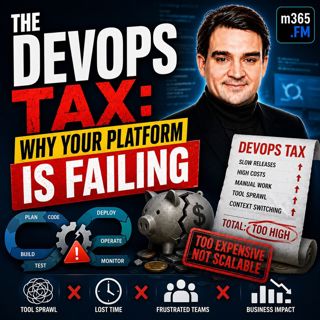
The DevOps Tax: Why Your Platform is Failing

The DevOps Tax: Why Your Platform is Failing

Welcome to another episode of Knowledge Nuggets with Mirko Peters. Today we're exploring The DevOps Tax—the hidden cost that silently reduces engineering productivity, increases cognitive overload, an...

25 Juli 1h 18min

Populärt inom Politik & nyheter

svenska-fall
p3-krim
aftonbladet-daily
aftonbladet-krim
rss-sanning-konsekvens
flashback-forever
tv4-nyheterna-story
rss-krimstad
rss-krimreportrarna
motiv
de-fyras-gang
rss-frandfors-horna
rss-vad-fan-hande
rss-flodet
politiken
mannen-utan-spar
rss-aftonbladet-krim
spar
krimmagasinet
grans