
The Copilot Credit Trap- Why Your AI Economy is Already Broken

The Copilot Credit Trap- Why Your AI Economy is Already Broken

For decades, enterprise software followed a predictable financial model. Organizations purchased licenses, assigned them to users, and budgeted annual IT spending with confidence. AI changes that completely. Modern AI platforms are no longer sold purely as software—they're becoming consumption-based services where autonomous agents perform work on your behalf. Every action, every reasoning cycle, every orchestration task, and every AI workflow consumes credits instead of simply using a fixed license. This episode explains why Copilot Credits fundamentally change enterprise budgeting, why governance becomes more important than licensing, and how organizations must rethink identity, permissions, auditing, FinOps, and AI compliance before autonomous agents become part of everyday business operations.

FROM SOFTWARE LICENSES TO AI ECONOMICS
Traditional enterprise software was easy to budget. Organizations counted employees, purchased licenses, and forecasted annual costs with relatively little uncertainty. AI introduces a completely different financial model. Instead of paying only for access, organizations increasingly pay for work performed. Every autonomous action performed by an AI agent consumes credits based on:
  • Reasoning complexity
  • Runtime
  • Context size
  • Tool usage
  • Model selection
This transforms AI from a predictable software expense into an operational resource similar to cloud compute. The presentation argues that organizations are no longer purchasing software—they're purchasing autonomous labor, and that fundamentally changes IT economics.

THE COPILOT CREDIT TRAP
The biggest misconception surrounding Copilot Credits is that they simply represent another licensing model. They don't. Credits become the currency of AI work. A lightweight task may consume relatively few credits. Complex reasoning tasks involving multiple enterprise systems, long context windows, and autonomous orchestration consume dramatically more. Costs now scale according to:
  • Agent behavior
  • Task complexity
  • Organizational adoption
  • Workflow automation
rather than simply employee count. Organizations may believe they have predictable AI costs because licensing appears fixed, while actual consumption grows continuously behind the scenes. This hidden variability creates what the presentation describes as the Copilot Credit Trap.

WHY FINANCE CAN NO LONGER PREDICT COSTS
Finance departments have traditionally planned annual software budgets using fixed subscription pricing. Consumption-based AI disrupts that model. Instead of budgeting for employees, organizations must now forecast:
  • Daily agent activity
  • Departmental usage
  • Business workflows
  • Credit consumption
  • Seasonal demand
  • Automation growth
Small changes in adoption can produce disproportionately large cost increases. The challenge isn't simply higher spending. It's the loss of financial predictability. Variable AI consumption introduces volatility that traditional IT budgeting processes were never designed to manage.

VISIBILITY IS THE FIRST GOVERNANCE PROBLEM
Many organizations cannot accurately answer basic questions such as:
  • Which AI agents currently exist?
  • Which departments deployed them?
  • Which systems can they access?
  • Which business processes do they automate?
  • How much do they cost?
The presentation describes this as the visibility crisis. Shadow AI deployments appear through:
  • Copilot Studio
  • Power Automate
  • Departmental automation
  • Third-party AI integrations
  • Custom workflows
Without a complete inventory, governance becomes impossible because organizations cannot secure, monitor, or budget for systems they don't even know exist.

PERMISSIONS BECOME MULTIPLIED
One of the most significant risks discussed throughout the session is permission amplification. AI agents inherit the permissions of the identities under which they operate. If a user can access HR records, the agent can also access them. If a user can modify SharePoint documents, schedule meetings, or send emails, so can the agent. Unlike humans, however, agents perform these actions at machine speed and enterprise scale. This dramatically amplifies existing governance weaknesses, especially in environments suffering from years of permission creep and excessive data sharing. The presentation argues that AI doesn't create governance problems—it magnifies the ones organizations already have.

AUTONOMY REQUIRES NEW GOVERNANCE
Traditional software waits for users. Autonomous agents do not. Modern AI systems:
  • Send emails
  • Update records
  • Schedule meetings
  • Trigger workflows
  • Coordinate with other agents
often after only an initial approval. As conditions change during execution, agents adapt automatically. This makes traditional approval processes insufficient. Organizations must introduce:
  • Human approval gates
  • Escalation rules
  • Spending thresholds
  • Risk classifications
  • Continuous monitoring
Governance moves from documentation into active operational control.

THE EU AI ACT CHANGES EVERYTHING
One of the central themes of the presentation is the approaching regulatory landscape. Organizations deploying AI into HR, finance, customer services, or other sensitive business functions face increasing governance obligations under the EU AI Act. High-risk AI systems require:
  • Risk management
  • Technical documentation
  • Human oversight
  • Audit trails
  • Incident reporting
  • Continuous monitoring
Compliance is no longer simply about technology. It becomes an enterprise operating capability involving legal, compliance, security, and business leadership working together.

IDENTITY IS THE FOUNDATION
The presentation argues that autonomous agents require independent identities rather than sharing user accounts. Each agent should receive:
  • Dedicated identity
  • Scoped permissions
  • Least-privilege access
  • Independent audit trail
  • Lifecycle management
This enables organizations to distinguish human actions from autonomous agent behavior while improving accountability and reducing operational risk. Identity becomes the foundation upon which every other governance capability depends

Become a supporter of this podcast: https://www.spreaker.com/podcast/m365-fm-modern-work-security-and-productivity-with-microsoft-365--6704921/support.

Det här avsnittet är hämtat från ett öppet RSS-flöde och publiceras inte av Podme. Det kan innehålla reklam.

Avsnitt(863)

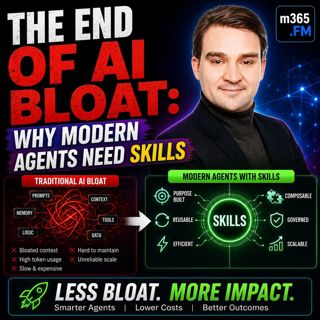
The End of AI Bloat: Why Modern Agents Need Skills

The End of AI Bloat: Why Modern Agents Need Skills

Many AI agents start out fast, responsive, and surprisingly intelligent. But after a few months of real-world use, something changes. Response times increase, costs rise, prompts become enormous, and ...

26 Juli 0s

THE DEATH OF THE PROXY: Architecting Dataverse for the Agent Fabric

THE DEATH OF THE PROXY: Architecting Dataverse for the Agent Fabric

For years, Microsoft's recommended architecture for connecting AI assistants like Claude Desktop to Dataverse relied on a local STDIO proxy. It was simple, easy to install, and perfectly suited for in...

26 Juli 0s
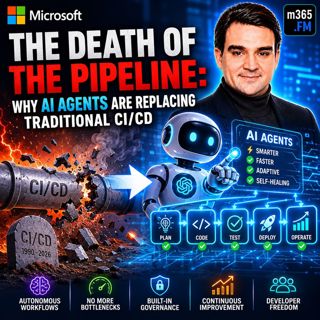
The Death of the Pipeline: Why AI Agents are Replacing Traditional

The Death of the Pipeline: Why AI Agents are Replacing Traditional

For more than two decades, CI/CD pipelines have been the backbone of modern software delivery. Developers commit code, automated builds run, tests execute, security scans complete, someone approves th...

25 Juli 0s
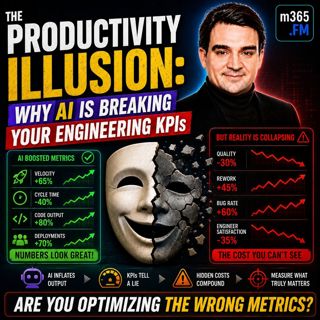
The Productivity Illusion: Why AI is Breaking Your Engineering KPIs

The Productivity Illusion: Why AI is Breaking Your Engineering KPIs

At first glance, the numbers look incredible. Deployment frequency is increasing, pull requests are being merged faster than ever, AI is generating more code, and engineering teams appear dramatically...

25 Juli 0s
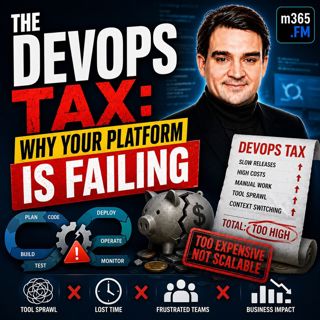
The DevOps Tax: Why Your Platform is Failing

The DevOps Tax: Why Your Platform is Failing

Welcome to another episode of Knowledge Nuggets with Mirko Peters. Today we're exploring The DevOps Tax—the hidden cost that silently reduces engineering productivity, increases cognitive overload, an...

25 Juli 0s

Microsoft Purview Insider Risk Management - Simply Explained

Microsoft Purview Insider Risk Management - Simply Explained

Welcome to another episode of Knowledge Nuggets with Mirko Peters. Today we're exploring Microsoft Purview Insider Risk Management, Microsoft's intelligent solution for identifying risky user behavior...

24 Juli 0s

Microsoft Purview Information Protection - Simply Explained

Microsoft Purview Information Protection - Simply Explained

Welcome to another episode of Knowledge Nuggets with Mirko Peters. Today we're exploring Microsoft Purview Information Protection, the foundation of Microsoft's data classification and protection stra...

24 Juli 0s

Populärt inom Politik & nyheter

svenska-fall
p3-krim
aftonbladet-daily
aftonbladet-krim
flashback-forever
rss-krimstad
tv4-nyheterna-story
rss-sanning-konsekvens
motiv
rss-krimreportrarna
mannen-utan-spar
de-fyras-gang
rss-vad-fan-hande
rss-frandfors-horna
politiken
spar
rss-flodet
krimmagasinet
grans
olyckan-inifran