The Productivity Illusion: Why AI is Breaking Your Engineering KPIs

The Productivity Illusion: Why AI is Breaking Your Engineering KPIs

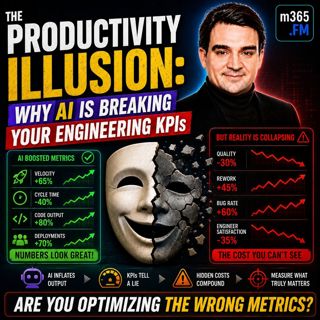
At first glance, the numbers look incredible. Deployment frequency is increasing, pull requests are being merged faster than ever, AI is generating more code, and engineering teams appear dramatically more productive. Executive dashboards are filled with green indicators suggesting software delivery has entered a new golden age. But beneath those impressive metrics lies a very different reality. AI has accelerated code generation, but it hasn't eliminated engineering work. Instead, it has shifted the bottlenecks from writing code to reviewing, validating, governing, and understanding it. Organizations are producing significantly more code while simultaneously experiencing more incidents, higher cognitive load, greater technical debt, and increased developer burnout.

THE PRODUCTIVITY ILLUSION
The central message of this session is simple: More code does not automatically mean more productivity. AI has dramatically increased engineering output, but many organizations are confusing output with value. According to the presentation:
  • AI now generates a significant portion of production code.
  • Pull request throughput has nearly doubled.
  • Developers save substantial time on repetitive coding tasks.
  • Yet production incidents, code churn, review times, and cognitive load have all increased.
Rather than removing engineering constraints, AI has simply moved them further downstream into review, testing, operations, and governance. The dashboard still reports success—but the engineering system itself is becoming increasingly fragile.

WHY TRADITIONAL KPIs ARE FAILING
Many engineering organizations still rely heavily on classic DevOps metrics such as:
  • Deployment Frequency
  • Lead Time
  • Change Failure Rate
  • Mean Time To Recovery (MTTR)
These metrics were designed for a world where humans wrote nearly all production code. AI fundamentally changes that assumption. Today's bottleneck is no longer writing software. It is understanding software. Deployment frequency may increase while review queues explode. Lead time may decrease while technical debt grows. Change failure rates may appear acceptable while code requires constant rewrites. The presentation argues that traditional engineering dashboards measure activity, not system health.

WHEN MORE CODE CREATES MORE PROBLEMS
One of the strongest themes throughout the presentation is the unintended consequence of AI-generated software. Developers can now create thousands of lines of code within minutes. Human reviewers, however, still need to verify every important architectural, security, and business decision. As pull requests become larger and more complex:
  • Review times increase dramatically.
  • Senior engineers become bottlenecks.
  • Production incidents rise.
  • Technical debt accumulates faster.
  • More code requires future maintenance.
Instead of removing engineering work, AI shifts effort toward verification and understanding. The engineering organization appears faster while becoming increasingly overloaded.

THE COGNITIVE LOAD CRISIS
Perhaps the most important concept discussed is cognitive load. AI reduces the effort required to write code. It dramatically increases the effort required to understand that code. Developers now spend increasing amounts of time:
  • Reviewing AI-generated implementations.
  • Understanding unfamiliar logic.
  • Switching between contexts.
  • Verifying correctness.
  • Explaining code the AI never documented.
The presentation distinguishes between productive engineering effort and unnecessary mental overhead. Instead of solving business problems, engineers increasingly spend their cognitive capacity validating machine-generated output. The result is lower developer satisfaction despite higher apparent productivity.

THE TOXIC KPI TRAP
Organizations naturally optimize whatever they measure. The problem arises when the metrics themselves no longer represent organizational health. Examples include:
  • Maximizing AI-generated code percentage.
  • Increasing deployment frequency.
  • Optimizing story points.
  • Reducing review duration.
  • Maximizing pull requests per developer.
Each metric improves individually. Meanwhile:
  • Rework increases.
  • Stability declines.
  • Technical debt grows.
  • Review quality drops.
  • Engineers burn out.
The presentation argues that these KPIs encourage organizations to optimize motion instead of meaningful outcomes. Good numbers do not necessarily represent healthy engineering systems.

FROM ACTIVITY TO FLOW
A major recommendation is replacing activity-based thinking with flow-based measurement. Instead of asking: "How much did we ship?" Organizations should ask: "How efficiently does work move through the system?" Important flow metrics include:
  • Flow efficiency
  • Queue age
  • Review cycle time
  • Work in Progress (WIP)
  • Bottleneck identification
  • Rework rate
These metrics reveal where work actually becomes blocked rather than simply counting completed deployments. The presentation argues that AI has shifted engineering constraints from development toward review and verification, making flow measurement far more valuable than raw throughput metrics.

DORA 5 AND REWORK RATE
One of the most practical recommendations is expanding traditional DORA metrics with a fifth dimension: Rework Rate. Rather than simply measuring deployment speed, organizations should track how much recently written code must be rewritten shortly afterward. High rework indicates:
  • Weak verification
  • Poor code durability
  • Fragile architectures
  • Inadequate reviews
  • Incorrect AI usage
Rework becomes a much stronger indicator of long-term engineering quality than deployment frequency alone. The presentation positions this as one of the most valuable indicators for AI-assisted software development.

BURNOUT IS A SYSTEM METRIC
Another major insight is that burnout should be viewed as an engineering metric—not merely an HR concern. The presentation connects rising cognitive load with:
  • Developer dissatisfaction
  • Increased context switching
  • Longer review cycles
  • Night and weekend work
  • Higher attrition
  • Lower software quality
When developers spend most of their day reviewing AI-generated code rather than solving meaningful business problems, engineering quality gradually declines. Organizations that ignore these signals risk losing their most experienced engineers while dashboards continue reporting "improved productivity."


Become a supporter of this podcast: https://www.spreaker.com/podcast/m365-fm-modern-work-security-and-productivity-with-microsoft-365--6704921/support.

Det här avsnittet är hämtat från ett öppet RSS-flöde och publiceras inte av Podme. Det kan innehålla reklam.

Avsnitt(859)

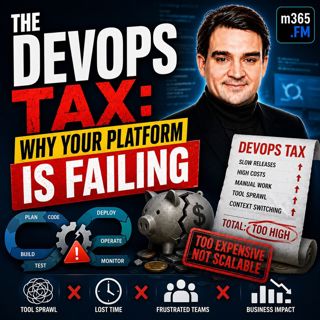
The DevOps Tax: Why Your Platform is Failing

The DevOps Tax: Why Your Platform is Failing

Welcome to another episode of Knowledge Nuggets with Mirko Peters. Today we're exploring The DevOps Tax—the hidden cost that silently reduces engineering productivity, increases cognitive overload, an...

25 Juli 0s

Microsoft Purview Insider Risk Management - Simply Explained

Microsoft Purview Insider Risk Management - Simply Explained

Welcome to another episode of Knowledge Nuggets with Mirko Peters. Today we're exploring Microsoft Purview Insider Risk Management, Microsoft's intelligent solution for identifying risky user behavior...

24 Juli 0s

Microsoft Purview Information Protection - Simply Explained

Microsoft Purview Information Protection - Simply Explained

Welcome to another episode of Knowledge Nuggets with Mirko Peters. Today we're exploring Microsoft Purview Information Protection, the foundation of Microsoft's data classification and protection stra...

24 Juli 0s

Microsoft Purview Data Loss Prevention (DLP) - Simply Explained

Microsoft Purview Data Loss Prevention (DLP) - Simply Explained

Welcome to another episode of Knowledge Nuggets with Mirko Peters. Today we're exploring Microsoft Purview Data Loss Prevention (DLP), one of the most important security capabilities in Microsoft 365 ...

24 Juli 0s

Microsoft Entra Private Access - Simply Explained

Microsoft Entra Private Access - Simply Explained

Welcome to another episode of Knowledge Nuggets with Mirko Peters. Today we're exploring Microsoft Entra Internet Access, Microsoft's modern cloud-native approach to secure internet connectivity that ...

24 Juli 0s
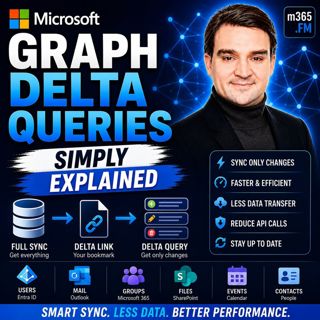
Microsoft Graph Delta Queries - Simply Explained

Microsoft Graph Delta Queries - Simply Explained

Welcome to another episode of Knowledge Nuggets with Mirko Peters. Today we're exploring Microsoft Graph Delta Queries, one of the most powerful features for building efficient synchronization solutio...

24 Juli 0s

Responsible AI Is Good Business — Featuring Wiebke Apitzsch

Responsible AI Is Good Business — Featuring Wiebke Apitzsch

Artificial intelligence is transforming every industry, but successful AI adoption requires far more than deploying the latest models or building autonomous agents. In this episode of M365.fm, Mirko P...

24 Juli 0s

Populärt inom Politik & nyheter

svenska-fall
p3-krim
aftonbladet-krim
aftonbladet-daily
rss-krimstad
flashback-forever
tv4-nyheterna-story
motiv
rss-sanning-konsekvens
mannen-utan-spar
de-fyras-gang
rss-vad-fan-hande
rss-krimreportrarna
spar
rss-frandfors-horna
politiken
rss-aftonbladet-krim
olyckan-inifran
krimmagasinet
grans