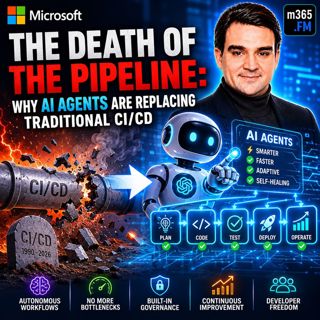

The Death of the Pipeline: Why AI Agents are Replacing Traditional

The Death of the Pipeline: Why AI Agents are Replacing Traditional

For more than two decades, CI/CD pipelines have been the backbone of modern software delivery. Developers commit code, automated builds run, tests execute, security scans complete, someone approves the deployment, and production is updated. This model transformed software engineering and enabled DevOps to become the industry standard. But the world has changed. Cloud-native applications, Kubernetes, AI, multi-cloud architectures, and thousands of daily deployments have pushed traditional pipelines beyond what they were designed to handle. The real bottleneck is no longer automation—it's the fact that automation still revolves around human decision-making and linear workflows. This episode explores a radical shift: replacing sequential CI/CD pipelines with intelligent, autonomous AI agents that reason, collaborate, and adapt in real time. We'll examine why traditional pipelines are reaching their limits, how agentic systems fundamentally change software delivery, and why governance—not autonomy—is becoming the defining architectural challenge of the next generation of DevOps.

WHY THE TRADITIONAL PIPELINE IS BREAKING
Traditional CI/CD pipelines were designed around a simple assumption: Humans make the important decisions. A developer commits code. The pipeline builds. Tests execute. Security scans run. Then someone reviews. Someone approves. Someone decides whether deployment should continue. Every approval introduces waiting. Every handoff introduces latency. Every manual decision becomes another bottleneck. This worked perfectly when organizations deployed once every few weeks. Today's cloud-native organizations deploy hundreds or even thousands of times every day. At that scale, human approval is no longer primarily a safety mechanism. It becomes the slowest component in the entire delivery system. The pipeline itself isn't broken. Its underlying operating model is.

AUTOMATION ISN'T THE SAME AS INTELLIGENCE
Many organizations tried solving pipeline bottlenecks through automation. They built scripts. They created runbooks. They automated approvals. Initially this improved delivery speed. Eventually another problem appeared. Scripts only work inside predefined conditions. Whenever infrastructure changes, scripts begin failing. New Kubernetes versions... Changed APIs... Different deployment strategies... Updated security requirements... Every infrastructure evolution requires maintaining automation itself. Traditional automation has no understanding of context. It executes procedures. It doesn't reason. Organizations eventually spend enormous effort maintaining automation instead of benefiting from it. The presentation argues that static automation reaches a ceiling because modern infrastructure changes faster than rule-based systems can keep up.

AI AGENTS CHANGE THE MODEL
An AI agent is fundamentally different from a script. Scripts execute instructions. Agents reason. Instead of simply matching predefined rules, an agent continuously:
  • Observes system state
  • Understands context
  • Evaluates possible actions
  • Chooses the safest strategy
  • Learns from previous outcomes
Imagine a degraded service. A script simply restarts it. An AI agent first investigates. Is this really a service failure? Is memory leaking? Is traffic unusually high? Would a canary rollout be safer than a restart? Could restarting actually make the situation worse? Rather than following procedures, AI agents operate using policies and objectives. That distinction fundamentally changes software delivery because the system adapts instead of merely executing instructions.

FROM PIPELINES TO AGENT FABRICS
Perhaps the biggest concept introduced in this session is that the future isn't a faster pipeline—it isn't a pipeline at all. Traditional delivery is sequential. Commit. Build. Test. Deploy. Each stage waits for the previous one. Agentic systems replace this with an AI fabric. Multiple specialized agents operate simultaneously. One analyzes security. Another writes tests. Another validates performance. Another evaluates deployment strategy. Instead of waiting for sequential stages, agents continuously exchange information while reasoning together. Researchers increasingly describe this model as Continuous Agentic Continuous Deployment (CA/CD) where reasoning replaces stage gates. The result isn't simply faster deployment. It's an entirely different operating model built around collaboration rather than sequence.

THE SUPERVISOR-WORKER ARCHITECTURE
Production AI systems don't consist of one giant intelligent agent. Instead, they increasingly adopt the Supervisor-Worker architecture. A supervisor agent owns the business objective. Specialized worker agents focus on individual domains:
  • Security
  • Testing
  • Performance
  • Deployment
  • Compliance
Workers analyze their specific area. The supervisor coordinates the work, combines expert recommendations, and makes the final decision. This architecture provides several advantages:
  • Clear accountability
  • Easier auditing
  • Better scalability
  • Independent specialization
  • Easier maintenance
Rather than creating one enormous AI system responsible for everything, organizations compose smaller expert agents that collaborate through orchestration. Companies adopting this architecture are reporting significantly faster delivery cycles while maintaining stronger governance.

AUTONOMY ISN'T THE GOAL
One of the most important lessons throughout the presentation is that full autonomy is neither realistic nor desirable. Current AI agents still require frequent human correction. Rather than viewing this as failure, organizations should treat it as a natural safety mechanism. The goal becomes appropriate autonomy. Low-risk activities may execute completely automatically. Medium-risk actions require human confirmation. High-risk production deployments remain supervised. Authority expands gradually based on measured performance. Autonomy is earned—not assumed. Successful organizations build tiered governance where AI gains additional responsibility only after consistently demonstrating reliable decision quality.

GOVERNANCE BECOMES ARCHITECTURE
Traditional governance relied on documents and policies. Agentic systems require something much stronger. Governance becomes architecture. Instead of saying: "Agents should only deploy approved services." Organizations technically prevent any other deployment from happening. Every agent receives:
  • Cryptographic identity
  • Scoped permissions
  • Short-lived credentials
  • Policy validation
  • Continuous authorization
  • Complete audit logging
Every action is validated immediately before execution. Agents don't merely promise to follow policy. The architecture prevents them from violating it. This represents one of the largest architectural shifts introduced by autonomous software delivery-

MULTI-AGENT COMMITTEES
Some decisions are too complex for a single agent. The presentation introduces another emerging architectural pattern: The Multi-Agent Committee. Rather than relying on one AI model, multiple specialist agents independently evaluate the same decision. For example:
  • Security Agent
  • Performance Agent
  • Code Review Agent
  • Compliance Agent
Each produces an independent recommendation. The supervisor synthesizes their conclusions before approving deployment. This dramatically improves decision quality because multiple expert perspectives identify different classes of problems. When disagreement occurs, the system naturally escalates to a human instead of forcing artificial certainty. Collective reasoning becomes safer than relying on any individual model.

Become a supporter of this podcast: https://www.spreaker.com/podcast/m365-fm-modern-work-security-and-productivity-with-microsoft-365--6704921/support.

Det här avsnittet är hämtat från ett öppet RSS-flöde och publiceras inte av Podme. Det kan innehålla reklam.

Avsnitt(861)

THE DEATH OF THE PROXY: Architecting Dataverse for the Agent Fabric

THE DEATH OF THE PROXY: Architecting Dataverse for the Agent Fabric

For years, Microsoft's recommended architecture for connecting AI assistants like Claude Desktop to Dataverse relied on a local STDIO proxy. It was simple, easy to install, and perfectly suited for in...

26 Juli 0s
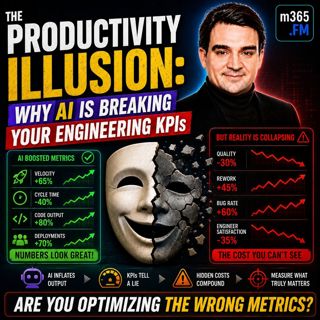
The Productivity Illusion: Why AI is Breaking Your Engineering KPIs

The Productivity Illusion: Why AI is Breaking Your Engineering KPIs

At first glance, the numbers look incredible. Deployment frequency is increasing, pull requests are being merged faster than ever, AI is generating more code, and engineering teams appear dramatically...

25 Juli 0s
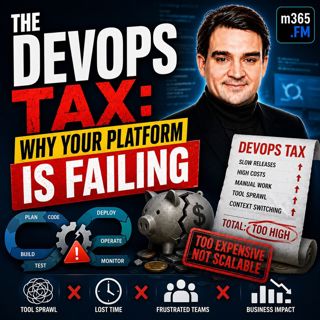
The DevOps Tax: Why Your Platform is Failing

The DevOps Tax: Why Your Platform is Failing

Welcome to another episode of Knowledge Nuggets with Mirko Peters. Today we're exploring The DevOps Tax—the hidden cost that silently reduces engineering productivity, increases cognitive overload, an...

25 Juli 0s

Microsoft Purview Insider Risk Management - Simply Explained

Microsoft Purview Insider Risk Management - Simply Explained

Welcome to another episode of Knowledge Nuggets with Mirko Peters. Today we're exploring Microsoft Purview Insider Risk Management, Microsoft's intelligent solution for identifying risky user behavior...

24 Juli 0s

Microsoft Purview Information Protection - Simply Explained

Microsoft Purview Information Protection - Simply Explained

Welcome to another episode of Knowledge Nuggets with Mirko Peters. Today we're exploring Microsoft Purview Information Protection, the foundation of Microsoft's data classification and protection stra...

24 Juli 0s
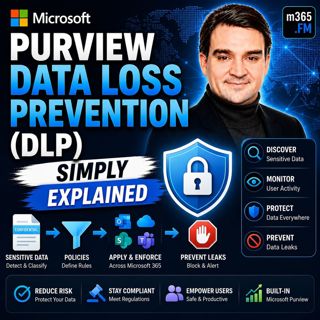
Microsoft Purview Data Loss Prevention (DLP) - Simply Explained

Microsoft Purview Data Loss Prevention (DLP) - Simply Explained

Welcome to another episode of Knowledge Nuggets with Mirko Peters. Today we're exploring Microsoft Purview Data Loss Prevention (DLP), one of the most important security capabilities in Microsoft 365 ...

24 Juli 0s

Microsoft Entra Private Access - Simply Explained

Microsoft Entra Private Access - Simply Explained

Welcome to another episode of Knowledge Nuggets with Mirko Peters. Today we're exploring Microsoft Entra Internet Access, Microsoft's modern cloud-native approach to secure internet connectivity that ...

24 Juli 0s

Populärt inom Politik & nyheter

svenska-fall
p3-krim
aftonbladet-daily
aftonbladet-krim
flashback-forever
rss-krimstad
tv4-nyheterna-story
rss-sanning-konsekvens
motiv
rss-krimreportrarna
mannen-utan-spar
de-fyras-gang
rss-vad-fan-hande
rss-frandfors-horna
politiken
spar
rss-flodet
krimmagasinet
grans
olyckan-inifran