The Two Kinds of “Alone” Every Filmmaker Knows I Deep Dive on Ep. 278

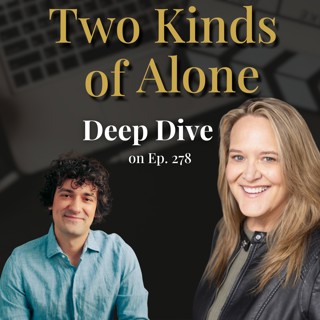
The Two Kinds of “Alone” Every Filmmaker Knows I Deep Dive on Ep. 278

What is the difference between solitude and loneliness, and why does every creative person need to understand it?

There are two kinds of being alone in creative work, and they are not the same thing. One makes the work great. The other wears you down to nothing. The difference between solitude and loneliness is the difference between sustainable creative life and creative burnout, and most of us never learn to tell them apart.

In this Deep Dive, host Christian Taylor takes a single line from her conversation with filmmaker Armin Korsos, that filmmaking can be a very lonely process, and explores what it actually means to be alone in creative work, and what turns the hard kind of alone into the kind that makes the work matter.

In this Deep Dive on Documentary First Episode 278 with Armin Korsos, Christian draws a line between loneliness and solitude. Loneliness is the desert. Solitude is the garden. The work, she argues, is learning to turn one into the other, and then finding the people who remind you that the loneliness was never a sign of failure. It was just part of the work.

Anchored in Henri Nouwen's image of the desert and the garden, and C.S. Lewis on friendship from The Four Loves, this episode is for filmmakers, writers, voice actors, painters, small business owners, and anyone who does the quiet work alone and needs to be reminded they are not the only one.

In this episode, Christian explores:
  • The difference between solitude and loneliness, and why creative people confuse them
  • Why the most creative moments come from being alone, and why the work needs the quiet
  • The second kind of alone: the lonely math of budgets, fundraising, and payroll
  • Why that weight is not a sign you are failing, but a sign you are doing the work
  • What both kinds of alone are forging in you at the same time
  • Why you cannot offer anything in a room of peers until the time alone has happened
  • How finding your people can feel like an oasis in the desert
  • What community actually does for the work, and what it does not do
  • Why you are built for both solitude and community, and need both

CHAPTERS

0:00 The Two Kinds of Alone

0:20 Armin Korsos on the Lonely Process

1:13 The Outside View vs. the Inside Reality

1:36 The First Alone. Solitude as the Creative Garden

3:38 The Second Alone. The Lonely Math of Filmmaking

5:28 Finding Your People. The Oasis in the Desert

7:26 What Community Does for the Work

Frequently Asked Questions

What is the difference between solitude and loneliness?

Solitude is chosen, generative time alone that creative work requires. It is where you hear what a story is asking for and find your own voice. Loneliness is the heavier, often involuntary weight of carrying the hard parts of the work by yourself, the budgets, the rejections, the decisions no one else can make for you. The writer Henri Nouwen framed the spiritual task as converting the desert of loneliness into a garden of solitude.

Why is filmmaking so lonely?

From the outside, filmmaking looks like the festival, the poster, and the applause. From the inside, most of the work is one person alone with the thing: the edit, the budget, the fundraising, the difficult conversations with crew. The finished film never shows the months spent alone with a spreadsheet, so the loneliness stays invisible. It is a normal part of the work, not a sign of failure.

What did Henri Nouwen say about loneliness and solitude?

In Reaching Out (1975), Nouwen wrote that to live a spiritual life we must first find the courage to enter into the desert of our loneliness and to change it by gentle and persistent efforts into a garden of solitude. He described the movement from loneliness to solitude as the beginning of any spiritual life.

How do creative people deal with isolation?

By holding two things at once: protecting the solitude the work requires, and building a community that reminds them the loneliness is shared. The time alone is what makes the work. The people are what keep you the kind of person who can keep making it. You are built for both, and you need both.

About the Topic and Sources

Henri Nouwen, Reaching Out: The Three Movements of the Spiritual Life (1975)

The Dutch priest, professor, and writer whose image of the desert of loneliness and the garden of solitude anchors this episode. His exact words: “To live a spiritual life we must first find the courage to enter into the desert of our loneliness and to change it by gentle and persistent efforts into a garden of solitude.”

C.S. Lewis, The Four Loves (1960)

Lewis on how friendship is born. The moment one person says to another, “What? You too? I thought I was the only one.” Christian connects this to meeting her friend Sarah in 1989 over a shared love of Lewis, Winnie the Pooh, and the Bible.

About Documentary First: The Deep Dive

Each week, host Christian Taylor takes an insight from a recent Documentary First filmmaker interview and explores it through literature, philosophy, current culture, and the universal human experience. It is a companion show to Documentary First, built for documentary filmmakers, lovers of story, and anyone who wants to think more deeply about what we are watching. Christian Taylor is a documentary filmmaker (The Girl Who Wore Freedom), actress, voice actor, and podcast host based in the United States.

Resources Mentioned

Documentary First Episode 278 with Armin Korsos: https://pod.fo/e/41b633

Henri Nouwen, Reaching Out: The Three Movements of the Spiritual Life (1975):

https://www.henrinouwen.org/books/reaching-out

C.S. Lewis, The Four Loves (1960):

https://www.cslewis.com/four-types-of-love/

Caymanite (Armin Korsos): https://www.caymanite.us

Filmmaker Friday Chicago: https://www.filmmakerfridays.org

The Utah Beach Museum, Normandy: https://www.utah-beach.com

Listen and Follow

Listen on your favorite podcast app: https://podfollow.com/documentary-first

YouTube: https://www.youtube.com/@documentaryfirst

Support the show on Patreon: https://www.patreon.com/c/DocumentaryFirst

Connect

Documentary First on all platforms: https://linktr.ee/doc1st

Christian Taylor on LinkedIn: https://linkedin.com/in/meetchristiantaylor

Det här avsnittet är hämtat från ett öppet RSS-flöde och publiceras inte av Podme. Det kan innehålla reklam.

Avsnitt(290)

Ep. 278 I Adapt or Die: A Working Filmmaker with AI in 2026

Ep. 278 I Adapt or Die: A Working Filmmaker with AI in 2026

Adapt or die. What does that actually look like for a working filmmaker?Chicago documentary filmmaker Armin Korsos has a working filmmaker's answer to the question every documentarian is wrestling wit...

21 Maj 55min

Anthropic's $1.5B Mistake. Yours Could Cost More. I Deep Dive on Ep. 277

Anthropic's $1.5B Mistake. Yours Could Cost More. I Deep Dive on Ep. 277

What does a $1.5 billion AI lawsuit have in common with your unwritten will?In September 2025, Anthropic agreed to pay $1.5 billion to settle the largest copyright lawsuit in U.S. history. The reason ...

14 Maj 8min

Ep. 277 I Why Does One Documentary Clip Cost $70,000? Music Licensing and Fair Use

Ep. 277 I Why Does One Documentary Clip Cost $70,000? Music Licensing and Fair Use

How much does the average documentary filmmaker's biggest licensing mistake cost?A 30-second Jackson 5 clip can run a documentary $50,000 to $70,000 in licensing fees. Veteran ARC Producer Teddy Canno...

7 Maj 25min

The First Generation to Live Shorter Lives Than Their Parents | Deep Dive on Ep. 276

The First Generation to Live Shorter Lives Than Their Parents | Deep Dive on Ep. 276

What if the documentaries no streaming platform will buy are the ones that could save your kid's life?Today's children may be the first generation in American history to live shorter lives than their ...

30 Apr 15min

Ep. 276 I Robin Canfield on Teaching iPhone Documentary in 20 Countries

Ep. 276 I Robin Canfield on Teaching iPhone Documentary in 20 Countries

Why do documentary subjects freeze for a professional camera - but open up to an iPhone?Robin Canfield shares why he films with iPhones, how he teaches documentary in twenty countries, and the communi...

23 Apr 51min

They Wanted My Voice to Train AI - What Thoreau Knew About Living Deliberately in a Revolution: Deep Dive on Ep. 275

They Wanted My Voice to Train AI - What Thoreau Knew About Living Deliberately in a Revolution: Deep Dive on Ep. 275

Someone tried to harvest Christian's voice for AI training. The pitch was polished, the project sounded real. But when she responded with ten professional questions, the conversation ended. Permanentl...

16 Apr 12min

Ep. 275 I Erik & Chris Ewers on PBS Funding, AI & Directing Goldblum, Clooney & Streep

Ep. 275 I Erik & Chris Ewers on PBS Funding, AI & Directing Goldblum, Clooney & Streep

Even with Ken Burns and Don Henley attached, funding a PBS documentary is brutal. So what hope do the rest of us have?Erik and Christopher Ewers get real about PBS funding, AI’s impact on filmmaking, ...

9 Apr 39min

Populärt inom Samhälle & Kultur

podme-dokumentar
aftonbladet-krim
en-mork-historia
gynning-berg
svenska-fall
p3-dokumentar
creepypodden-med-jack-werner
skaringer-nessvold
killradet
hor-har
kod-katastrof
flashback-forever
aftonbladet-daily
vad-blir-det-for-mord
rss-brottsutredarna
rss-mer-an-bara-morsa
p1-dokumentar
historiska-brott
mardromsgasten
rysarpodden