
S9 Ep33: Did the sewing machine liberate women?

S9 Ep33: Did the sewing machine liberate women?

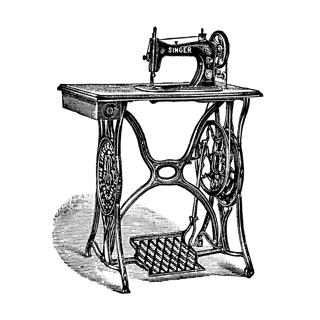
In January 1860 the New York Times gave its blessing to a new machine: the sewing machine. These "iron needle-women", it wrote, were the only invention that could be claimed “chiefly for women's benefit”. Sewing was women's work in the nineteenth century, rich or poor, and a machine could now do it in a fraction of the time. So did it set women free?

Philipp Ager and Davide Coluccia have traced the adoption of the sewing machine in Massachusetts between 1850 and 1900, using census records and digitised business directories to work out who was exposed to it, in the factory and in the home. For poorer women the machine meant work, in garment factories and in boot and shoe production; they married later, had fewer children, and many never married at all. For wealthier women, who had few acceptable jobs open to them, the hours it saved went into earlier marriage and earlier motherhood. Philipp tells Tim Phillips the story of a machine that had very different impacts in different social classes.

The research behind this episode:

Ager, Philipp, and Davide Coluccia. 2026. "Liberation Technology? The Impact of the Sewing Machine on Women." CEPR Discussion Paper No. 21496. CEPR Press, Paris and London. CEPR Discussion Papers are gated; CEPR members and subscribing institutions can download the paper at the link.

To cite this episode:

Phillips, Tim, and Philipp Ager. 2026. "Did the Sewing Machine Liberate Women?" VoxTalks Economics (podcast).

Assign this as extra listening. The citation above is formatted and ready for a reading list or VLE.

About the guests

Philipp Ager is professor of economics at the University of Mannheim, a Research Fellow of the Centre for Economic Policy Research, and an editorial board member at Explorations in Economic History. His research spans the economic history of the United States, technological change, and the long-run effects of crises and disasters; his work on the Great Fire of London of 1666 featured in an earlier episode of VoxTalks Economics.

Research and sources cited in this episode

The Song of the Shirt. Thomas Hood's poem about a destitute seamstress was first published anonymously in Punch in December 1843. Hood based it on the case of Mrs Biddell, a London widow prosecuted after pawning clothes she had been given to sew.

Godey's Lady's Book. The most widely read women's magazine in the US at the time crowned the sewing machine "the queen of inventions" in 1860, having calculated that a man's shirt took 20,620 stitches and 14 hours to sew by hand, against an hour and a quarter by machine.

Singer and the Sewing Machine: A Capitalist Romance. Ruth Brandon's 1977 biography of Isaac Singer (Google Books) is the source for both Singer quotations read in this episode. .

How the Other Half Lives. Jacob Riis, a Danish-born police reporter in New York, published his account of tenement and sweatshop life in 1890 (free at Project Gutenberg). The shirtmaker's testimony read in this episode was given to the State Board of Arbitration during the shirtmakers' strike and reported by Riis in his chapter on the working girls of New York.

The household appliance revolution. Philipp contrasts the sewing machine with the washing machines and vacuum cleaners that arrived two generations later, which economists have credited with freeing women to join the workforce; "Engines of Liberation" by Jeremy Greenwood, Ananth Seshadri and Mehmet Yorukoglu, Review of Economic Studies, 2005, covers this topic. The sewing machine saved time in the same way, but in the 1860s far fewer acceptable jobs awaited the women whose time it saved.

More VoxTalks Economics episodes

The economic effect of the Great Fire of London. Philipp Ager's previous visit to VoxTalks Economics, with Paul Sharp, on what contemporary records reveal about London's uneven recovery after 1666.

Related reading on VoxEU

Gender norms and the labour market, a VoxEU column on how norms, both internalised and enforced by peers, constrain women's labour market outcomes; the modern counterpart of the stigma that kept married women in Massachusetts out of paid work.

Det här avsnittet är hämtat från ett öppet RSS-flöde och publiceras inte av Podme. Det kan innehålla reklam.

Avsnitt(474)

S9 Ep47: The Next Generation: PSE 2026

S9 Ep47: The Next Generation: PSE 2026

Travel broadens the mind. So the Voxtalks visits a conference, we find the most interesting research from economists just starting out, and hand three of them a microphone. Ad that is today's episode,...

7 Aug 33min

S9 Ep46: Absorbing shocks since 1891

S9 Ep46: Absorbing shocks since 1891

Recorded at the PSE-CEPR Policy Forum 2026.A country wants a stable exchange rate, it wants money to move freely across its borders, and it wants to set its own interest rates. It's a well-known trile...

5 Aug 20min

S9 Ep45: Tariff Confusion

S9 Ep45: Tariff Confusion

If you run a business that exports to the United States, how big is the tariff you have to pay? In 2025 that question was hard to answer. Between February and December, 53 separate announcements intro...

31 Juli 31min

S9 Ep44: How superpowers shape trade

S9 Ep44: How superpowers shape trade

Recorded at the PSE-CEPR Policy Forum, Paris School of Economics.Tariffs move trade around, but so does economic power. When one economy dominates, other countries fall into step with it. They trade w...

29 Juli 15min

S9 Ep43: Navigating industrial policy

S9 Ep43: Navigating industrial policy

Recorded at the PSE-CEPR Policy Forum, Paris.In 2019 the IMF called the increasing adoption of industrial policy: "The return of the policy that shall not be named". No one is scared to name it in 202...

24 Juli 21min

S9 Ep42: The Safety Paradox

S9 Ep42: The Safety Paradox

Recorded at the PSE-CEPR Policy Forum, Paris School of Economics, June 2026.In 1941 the United States banned oil exports to Japan, to punish aggression without fighting a war. Historians now argue the...

22 Juli 20min

S9 Ep41: Making teenagers read newspapers

S9 Ep41: Making teenagers read newspapers

French teenagers carry a smartphone with access to almost anything, but few of them have been using it to read the news.Julia Cagé (Sciences Po, CEPR) ran an experiment to test the one barrier everyon...

17 Juli 20min

S9 Ep40: Are net zero commitments greenwash?

S9 Ep40: Are net zero commitments greenwash?

Sixty-three percent of large companies worldwide had made a net zero commitment by 2023, up from close to none in 2018. But if the target date is 2050, that's several corporate lifetimes away, and the...

15 Juli 24min

Populärt inom Business & ekonomi

framgangspodden
badfluence
dynastin
varvet
uppgang-och-fall
avanzapodden
svd-tech-brief
rss-inga-dumma-fragor-om-pengar
fill-or-kill
lastbilspodden
tabberaset
rss-kort-lang-analyspodden-fran-di
rikatillsammans-om-privatekonomi-rikedom-i-livet
rss-borslunch
rss-dagen-med-di
rss-veckans-trade
borslunch-2
ekonomiekot-extra
rss-hos-psykologen
rss-dominoeffekten