
Fluent in Money, Illiterate in Wealth

Fluent in Money, Illiterate in Wealth

In most languages, the word for wealth still carries traces of its origin — wellbeing, capability, the conditions of a good life. In English, that meaning was stripped out somewhere between the Champagne Fairs and the Industrial Revolution. What remained was net worth. The vocabulary change was not neutral. It was a cognitive trap — and almost every personal finance mistake you can make flows directly from it.

In this episode:

  • Why the word "wealth" has already corrupted your financial decision-making — and why Latin, German, and Scandinavian speakers are working from a less broken map than their English-speaking counterparts
  • Pierre Bourdieu's 1986 framework: economic, cultural, social, and symbolic capital — why the person who understands the conversion rules between them holds a structural advantage over the person who only tracks one column, and what the data on education premiums, referral hiring, and superstar CEO compensation actually shows about how capital moves
  • The 2020–2025 American monetary cycle as a masterclass in wealth as flow: three phases, three completely different winning asset classes, and why the common variable in every case was not the asset — it was understanding where the credit was going before it arrived
  • The subprime counter-case: how $19 trillion in household net worth evaporated not because houses changed, but because the flow of credit around them reversed — and what that means for every asset you currently treat as permanent
  • Four wealth traps that recur across income levels and generations: the signifier fallacy, financial FOMO (57% of Americans have made a financial decision after seeing someone else's lifestyle online), the experience economy, and the relative comparison trap that explains why a country with one of the highest GDP per capita levels among large advanced economies ranked 24th in the 2025 World Happiness Report
  • The Rockefeller versus Vanderbilt case: why one of the greatest fortunes in American history was gone within two generations while the other is still distributing income to 170 heirs across six — and why the difference had nothing to do with the original amount
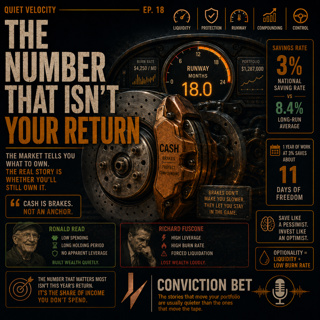
  • The mathematics of freedom: why cutting $10,000 in annual spending has the same effect on financial independence as accumulating $250,000 in capital, and why temporal sovereignty — the capacity to control your own time — may be the only form of wealth that cannot be manufactured, borrowed, or stored

Read the written version — with the data, the Bourdieu framework laid out in full, and the card layouts that don't translate to audio — at quietvelocity1.substack.com, the companion Substack to Conviction Bet.

New episodes weekly. Subscribe on Apple Podcasts, Spotify, YouTube, or Amazon Music.

Conviction Bet is independent investment commentary. Nothing in this episode is investment advice.

Det här avsnittet är hämtat från ett öppet RSS-flöde och publiceras inte av Podme. Det kan innehålla reklam.

Avsnitt(13)

The Quietest Edge

The Quietest Edge

The Quietest Edge: Why Your Fund’s Return Isn’t Your ReturnPicture two people buying the same fund and holding it through the same market. On paper, they own the same investment. In practice, they can...

25 Juni 26min

Who Settles the Check: Who Really Pays for the AI Build-Out

Who Settles the Check: Who Really Pays for the AI Build-Out

Who Settles the Check: Who Really Pays for the AI Build-OutPicture the most expensive dinner ever ordered. The finest of everything, courses still arriving, nobody checking the price. The whole mood o...

19 Juni 27min

The Oracle, Decoded: How They Reverse-Engineered Warren Buffett

The Oracle, Decoded: How They Reverse-Engineered Warren Buffett

For fifty years, Warren Buffett's record looked like magic — a once-in-a-century gift you either have or you don't. Then three quantitative researchers took that genius apart, piece by piece, and foun...

10 Juni 26min

The Credit Card That Owns the Mint

The Credit Card That Owns the Mint

A US Treasury bond is the asset the whole financial system calls risk-free — the benchmark every other risk is measured against. This year, the most conservative institutions on earth started quietly ...

4 Juni 27min

Read the Label: What's Actually Inside the S&P 500

Read the Label: What's Actually Inside the S&P 500

Buying the S&P 500 feels like the most diversified decision in investing. It has quietly become one of the most concentrated.The index everyone owns hasn't changed — but the recipe underneath has. Sev...

1 Juni 23min

Dead Reckoning: What the 4% Rule Cannot See

Dead Reckoning: What the 4% Rule Cannot See

Most retirement planning math is correct. The problem is the question it's answering.The 4% rule was built for a 30-year retirement. An early retiree who leaves work at 35 and lives to 90 needs a port...

27 Maj 33min

The Ouroboros Quarter

The Ouroboros Quarter

In most earnings seasons, the profit reported is the profit earned. Q1 2026 was different. The most important number in Alphabet's results was not on the revenue line, not in the cloud segment, and no...

21 Maj 29min

Populärt inom Business & ekonomi

badfluence
framgangspodden
varvet
rss-borsens-finest
svd-tech-brief
uppgang-och-fall
avanzapodden
rss-svart-marknad
rss-dagen-med-di
24fragor
lastbilspodden
fill-or-kill
bathina-en-podcast
rss-inga-dumma-fragor-om-pengar
borsmorgon
kapitalet-en-podd-om-ekonomi
rikatillsammans-om-privatekonomi-rikedom-i-livet
dynastin
tabberaset
rss-den-nya-ekonomin