
The Ouroboros Quarter

The Ouroboros Quarter

In most earnings seasons, the profit reported is the profit earned. Q1 2026 was different. The most important number in Alphabet's results was not on the revenue line, not in the cloud segment, and not in operating income. It was in a footnote — and it accounted for an estimated 46% of the company's headline net income. The market celebrated the headline. Almost no one read the footnote.

In this episode:

  • Why Q1 2026 was the most circular earnings season in Big Tech history — and how a GAAP accounting rule (ASU 2016-01) allows unrealized private equity markups to flow directly through the income statement, turning a funding round valuation into reported corporate profit before a single dollar of cash changes hands
  • The ouroboros mechanism in full: Alphabet invests in Anthropic, Anthropic trains on Google Cloud, Google Cloud revenue supports Anthropic's valuation, Anthropic's valuation flows back through Alphabet's income statement as reported net income, and that net income justifies more investment — every link GAAP-compliant, the loop entirely circular. Amazon runs the same structure. The estimated after-tax contribution from unrealized equity gains accounts for a significant portion of both companies' headline Q1 numbers.
  • Why Nvidia's $48.6 billion of company-level free cash flow is categorically different from what Alphabet and Amazon reported — and what $91 billion of Q2 company-level revenue guidance, with China data-center compute excluded from the calculation, actually tells you about the state of global AI demand outside the world's second-largest economy
  • The Federal Reserve transition most investors are reading wrong: the real question is not whether Kevin Warsh cuts rates, but whether he changes which inflation gauge the Fed uses to decide — and why a 70-basis-point gap between Core PCE at 3.2% and Dallas trimmed mean PCE at 2.4% is a policy lever, not a measurement dispute. Core PCE already excludes food and energy. The gap is explained by shelter and services — which is also why the new framework carries the risks it does.
  • The Cisco counter-case: in March 2000, Cisco had real orders, real revenue growing at 50% annually, a backlog booked two years forward, and a market cap above $500 billion. The stock fell nearly 90% by late 2002. Not because the internet was fake — because the valuation had been pulled further into the future than genuine demand could reach before monetary conditions tightened. The case for why real underlying demand does not protect against valuation reset.
  • CoreWeave on May 7: $2.08 billion in Q1 revenue, up 112% year-over-year, stock falling after hours as soft Q2 guidance and capex intensity unsettled investors — and what a triple-digit growth company declining on an earnings beat tells you about what this market is actually pricing
  • The Buffett Indicator at roughly 229%–235% depending on methodology, Amazon's trailing twelve-month free cash flow down 95% to $1.2 billion, and why the bull case and the bear case for this market are not opposites — they are the same thesis at different time horizons. The question is not whether bubble-like conditions exist. The question is where you are inside them, and what the monetary hinge looks like when it moves.

Read the written version — with the full accounting breakdown, the sourced data, and the card layouts that don't translate to audio — at quietvelocity1.substack.com, the companion Substack to Conviction Bet.

New episodes weekly. Subscribe on Apple Podcasts, Spotify, YouTube, or Amazon Music.

Conviction Bet is independent investment commentary. Nothing in this episode is investment advice.

Det här avsnittet är hämtat från ett öppet RSS-flöde och publiceras inte av Podme. Det kan innehålla reklam.

Avsnitt(21)

Why You Won't Spend Your Own Money

Why You Won't Spend Your Own Money

Your balance tells you what you have. The label shapes what you'll actually use. And you're the one who wrote it.The Federal Reserve asked Americans two versions of the same question. 70% said they co...

25 Aug 32min

You Can Copy The Key, Not The Locksmith: Nick Sleep's 921% Manual Is Free

You Can Copy The Key, Not The Locksmith: Nick Sleep's 921% Manual Is Free

Two men, no analysts, no leverage, two letters a year. Twelve and a quarter years later: 921.1% against 116.9% for the MSCI World. A dollar became $10.21. Then they closed the fund, handed the capital...

13 Aug 37min

Can You Survive Being Right Too Early?

Can You Survive Being Right Too Early?

In late July, the market decided the AI build-out had gone too far. The Nasdaq fell into its second correction of the year, the Philadelphia Semiconductor Index dropped into a technical bear market, a...

6 Aug 32min
The Number That Isn't Your Return

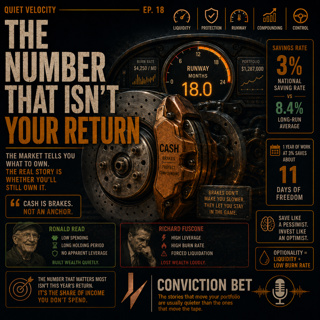
The Number That Isn't Your Return

A Vermont gas station attendant died in 2014 holding $8 million and a five-inch stack of stock certificates. That same year, a former Merrill Lynch executive who once ran the firm's Latin America arm ...

30 Juli 39min

He Knew Better. He Did It Anyway

He Knew Better. He Did It Anyway

In March 2000, Stanley Druckenmiller had the internet bubble exactly right. He had shorted it, written the thesis, and run money for two decades without a losing year. Then he watched two junior trade...

23 Juli 33min

Deferred Maintenance: Cash, Muscle, Sleep

Deferred Maintenance: Cash, Muscle, Sleep

The four biggest tech companies are planning as much as $725 billion of capital spending this year — up 77% in a single year — much of it on machines that never have to sleep. The people underwriting ...

16 Juli 39min

The Rulebook You Never Read

The Rulebook You Never Read

At Monday's close, funds tracking the Nasdaq-100 lined up to buy an estimated $4 billion of SpaceX stock. Nobody at those funds decided SpaceX was worth owning — a rulebook decided. And three weeks ea...

9 Juli 32min

The Four Cards You're Not Playing

The Four Cards You're Not Playing

79% of professional large-cap fund managers lost to the S&P 500 last year. Stretch the window to fifteen years and the failure rate hits roughly 90%. The internet's favorite conclusion: if the pros ca...

1 Juli 28min

Populärt inom Business & ekonomi

framgangspodden
varvet
rss-jossan-nina
rss-borsens-finest
24fragor
svd-tech-brief
avanzapodden
badfluence
uppgang-och-fall
lastbilspodden
fill-or-kill
rss-inga-dumma-fragor-om-pengar
rss-kort-lang-analyspodden-fran-di
tabberaset
rss-dagen-med-di
bathina-en-podcast
rikatillsammans-om-privatekonomi-rikedom-i-livet
kapitalet-en-podd-om-ekonomi
affarsvarlden
borsmorgon