The Oracle, Decoded: How They Reverse-Engineered Warren Buffett

The Oracle, Decoded: How They Reverse-Engineered Warren Buffett

For fifty years, Warren Buffett's record looked like magic — a once-in-a-century gift you either have or you don't. Then three quantitative researchers took that genius apart, piece by piece, and found that most of it could be copied. The part that couldn't is the part almost nobody wants.

This episode walks backstage on the famous "Buffett's Alpha" paper to ask the rudest question in investing: can the Oracle be reverse-engineered? The answer is humbling — and it changes what "be like Buffett" should mean for you.

In this episode:

The scoreboard everyone misreads. A dollar invested with Buffett in 1976 became more than $3,685 by 2017 — the best risk-adjusted record of any stock or fund that survived the stretch. The twist: he didn't take more risk. His market sensitivity (beta) was just 0.69. He got rich by being more efficient, not braver.

The trick explained. The standard four-factor model captured Buffett's style — cheap, big, steady, no chasing hot stocks — but left a giant pile of return unexplained. Add two more factors, "betting against beta" and "quality minus junk," and the magic shrinks to statistically indistinguishable from zero. Neither luck nor magic, the authors wrote, but a reward for leveraging cheap, safe, high-quality stocks.

The quiet half of the balance sheet. The part nobody discusses: financing. Roughly 1.6-to-1.7 leverage, funded by insurance float at about 1.72% a year — below what the US government paid to borrow — plus deferred taxes and the options he sold to investors who couldn't borrow. He wasn't just avoiding the crowd's mistake; he was getting paid by it.

The snow already skied. Those factors are now sold in low-cost funds. The edges crowded, Berkshire's size turned into an anchor, and a market carried by a handful of AI names is sprinting past exactly the strategy Buffett built to ignore. Even the greatest compounding machine ever built is sliding back toward the market's ordinary pace.

The strongest bear case — answered. If it's all factors and cheap leverage, was it ever genius, or just survivorship bias with a lab coat? Two answers: the "clone" only worked as a frictionless backtest, and the residual the equation couldn't explain — temperament — is the one thing survivorship bias can't manufacture. He sat through a 44% drawdown without flinching, and bought when everyone else was selling in 2008.

What it means for you. You can rent a rough version of the factor exposures today, for not very much. What you cannot rent is the float, the structure, or the temperament to do something boring, correctly, for half a century while everyone around you chases something shinier. That was never the part that looked like magic. It turns out it was the only real magic there ever was.

Read the written version at quietvelocity1.substack.com, the companion Substack to Conviction Bet.

New episodes weekly. Subscribe on Apple Podcasts, Spotify, YouTube, or Amazon Music.

Conviction Bet is independent investment commentary. Nothing in this episode is investment advice.

Det här avsnittet är hämtat från ett öppet RSS-flöde och publiceras inte av Podme. Det kan innehålla reklam.

Avsnitt(13)

The Quietest Edge

The Quietest Edge

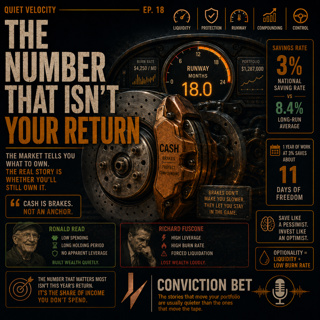
The Quietest Edge: Why Your Fund’s Return Isn’t Your ReturnPicture two people buying the same fund and holding it through the same market. On paper, they own the same investment. In practice, they can...

25 Juni 26min

Who Settles the Check: Who Really Pays for the AI Build-Out

Who Settles the Check: Who Really Pays for the AI Build-Out

Who Settles the Check: Who Really Pays for the AI Build-OutPicture the most expensive dinner ever ordered. The finest of everything, courses still arriving, nobody checking the price. The whole mood o...

19 Juni 27min

The Credit Card That Owns the Mint

The Credit Card That Owns the Mint

A US Treasury bond is the asset the whole financial system calls risk-free — the benchmark every other risk is measured against. This year, the most conservative institutions on earth started quietly ...

4 Juni 27min

Read the Label: What's Actually Inside the S&P 500

Read the Label: What's Actually Inside the S&P 500

Buying the S&P 500 feels like the most diversified decision in investing. It has quietly become one of the most concentrated.The index everyone owns hasn't changed — but the recipe underneath has. Sev...

1 Juni 23min

Dead Reckoning: What the 4% Rule Cannot See

Dead Reckoning: What the 4% Rule Cannot See

Most retirement planning math is correct. The problem is the question it's answering.The 4% rule was built for a 30-year retirement. An early retiree who leaves work at 35 and lives to 90 needs a port...

27 Maj 33min

The Ouroboros Quarter

The Ouroboros Quarter

In most earnings seasons, the profit reported is the profit earned. Q1 2026 was different. The most important number in Alphabet's results was not on the revenue line, not in the cloud segment, and no...

21 Maj 29min

Fluent in Money, Illiterate in Wealth

Fluent in Money, Illiterate in Wealth

In most languages, the word for wealth still carries traces of its origin — wellbeing, capability, the conditions of a good life. In English, that meaning was stripped out somewhere between the Champa...

14 Maj 31min

Populärt inom Business & ekonomi

badfluence
framgangspodden
varvet
rss-borsens-finest
avanzapodden
uppgang-och-fall
svd-tech-brief
rss-svart-marknad
bathina-en-podcast
lastbilspodden
rss-dagen-med-di
fill-or-kill
24fragor
rss-inga-dumma-fragor-om-pengar
borsmorgon
dynastin
rss-den-nya-ekonomin
rikatillsammans-om-privatekonomi-rikedom-i-livet
rss-kort-lang-analyspodden-fran-di
borslunch-2