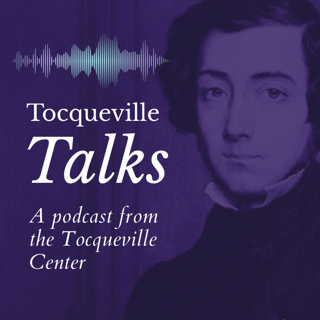
15. Who Really Wins in Trade Policy? — Scott Lincicome

15. Who Really Wins in Trade Policy? — Scott Lincicome

What if the policies designed to “protect” American workers are quietly doing the opposite?

In this episode of Tocqueville Talks, Brent Nelsen and Beth L’Arrivée sit down with Scott Lincicome of the Cato Institute—a trade lawyer turned policy expert—to unpack what actually happens when governments intervene in global markets.

Lincicome doesn’t deal in theory. He’s seen how trade policy is made in real time—inside agencies, inside lawsuits, inside the messy intersection of economics and politics. And his conclusion is blunt: most trade policy isn’t guided by precision or expertise—it’s shaped by incentives, lobbying, and uncertainty.

The conversation cuts through the rhetoric around tariffs, globalization, and industrial policy to expose the real trade-offs:

  • Tariffs don’t just raise prices for consumers—they increase costs for American producers

  • Policy instability discourages long-term investment and job creation

  • Political carve-outs turn “strategic policy” into fragmented, lobbyist-driven outcomes

  • Large firms adapt—small businesses often get squeezed out

As Lincicome explains, “this is not policy in a lab—it’s policy in the real world.”

And that reality changes everything.

The episode also connects directly to Tocqueville’s central concern: What does economic independence look like in a world dominated by global supply chains, massive firms, and centralized decision-making?

Key questions include:

  • Are tariffs actually protecting American workers—or raising their costs?

  • Why does policy uncertainty matter more than policy direction?

  • Who benefits most from regulation—and who gets left behind?

  • Can markets regulate themselves better than governments?

  • What role do citizens play in preserving economic independence today?

Lincicome offers a framework that is both practical and unsettling: Markets often regulate better than centralized systems—but only if individuals remain active, informed, and willing to exercise choice.

For students, policymakers, and anyone trying to understand the real mechanics of globalization, this episode reveals the gap between how policy is sold—and how it actually works.

Det här avsnittet är hämtat från ett öppet RSS-flöde och publiceras inte av Podme. Det kan innehålla reklam.

Avsnitt(28)

28. Why Americans Are So Patriotic | Tocqueville's Surprising Answer

28. Why Americans Are So Patriotic | Tocqueville's Surprising Answer

Why does patriotism seem so powerful in America—and what happens when it begins to disappear?As Americans celebrate the nation's 250th anniversary, Alexis de Tocqueville's reflections on patriotism ma...

10 Juli 23min

27. Why the Old Political Order Is Cracking | Populism, MAGA, and the Future of Democracy

27. Why the Old Political Order Is Cracking | Populism, MAGA, and the Future of Democracy

For generations, politics in Europe and America was dominated by large, stable political parties. Today, those old political alignments are breaking down.Why are voters abandoning established parties?...

3 Juli 35min

26. What Swimming Can Teach Us About Democracy | Tocqueville's Forgotten Insight

26. What Swimming Can Teach Us About Democracy | Tocqueville's Forgotten Insight

What can a neighborhood swim league teach us about democracy?More than you might think.When Alexis de Tocqueville visited America in 1831, he was astonished by what he called associations—ordinary cit...

25 Juni 41min

25. Is the Postwar Order Ending? Europe, Trump, Ukraine, and the Future of the West — Eleanor Beardsley

25. Is the Postwar Order Ending? Europe, Trump, Ukraine, and the Future of the West — Eleanor Beardsley

For eighty years, Europe and the United States built a common political, economic, and military order.Today, many Europeans wonder whether that world is ending.In this episode of Tocqueville Talks, Br...

18 Juni 27min

24. Why Everything Feels Increasingly Unreal — Beth and Rob L'Arrivée

24. Why Everything Feels Increasingly Unreal — Beth and Rob L'Arrivée

Why does everything feel increasingly unreal?The people most trapped in abstraction are often the people consuming the most information.Tocqueville saw this danger almost 200 years ago.In this episode...

11 Juni 22min

23. Can Europe Stay United? The EU, National Identity, and the Future of European Politics — On the Road with Dr. Nelsen

23. Can Europe Stay United? The EU, National Identity, and the Future of European Politics — On the Road with Dr. Nelsen

What does it mean to be European in the twenty-first century?In this episode of Tocqueville Talks, Brent Nelsen joins three Tocqueville Fellows—Madison (“Maddie”) Maddie, Zach LaComb, and Lane Lytle—f...

4 Juni 34min

22. Academic Freedom, Populism, and the Purpose of Higher Education — Reflections on a Year of Tocqueville Talks

22. Academic Freedom, Populism, and the Purpose of Higher Education — Reflections on a Year of Tocqueville Talks

What questions defined this year’s biggest conversations at the Tocqueville Center?In this special year-end reflection episode of Tocqueville Talks, Brent Nelsen, Beth L’Arrivée, and longtime Furman U...

28 Maj 23min

21. Why Students Still Read Books — Inside the Tocqueville Fellows Program at Furman University

21. Why Students Still Read Books — Inside the Tocqueville Fellows Program at Furman University

What does it take to build a community of students who still read books, ask difficult questions, and engage seriously with ideas?In this episode of Tocqueville Talks, Brent Nelsen sits down with Lucy...

21 Maj 21min
Populärt inom Politik & nyheter

aftonbladet-krim
svenska-fall
fordomspodden
p3-krim
rss-krimstad
en-runda-till
flashback-forever
aftonbladet-daily
politiken
rss-vad-fan-hande
rss-expressen-dok
rss-sanning-konsekvens
omni-podd
svd-ledarredaktionen
motiv
grans
kungligt
spar
rss-utopia-2
dagens-eko