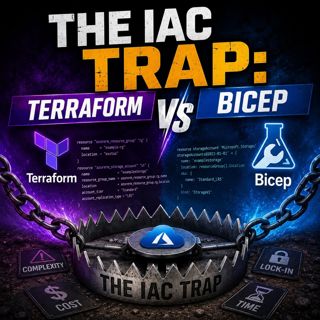

The IaC Trap:Terraform vs. Bicep – Which One Wins?

The IaC Trap:Terraform vs. Bicep – Which One Wins?

Infrastructure as Code has become one of the most important disciplines in modern cloud engineering. Whether you're deploying Azure landing zones, managing enterprise-scale infrastructure, implementing governance controls, or building platform engineering capabilities, Infrastructure as Code promises consistency, repeatability, and automation.Yet one of the biggest debates in the Azure ecosystem continues to divide architects, platform engineers, DevOps teams, and cloud administrators:Terraform or Bicep?At first glance, the answer appears simple. Terraform offers multi-cloud flexibility and a massive ecosystem. Bicep delivers native Azure integration, day-zero feature support, and seamless governance alignment.But the real story goes much deeper.In this episode, we explore the hidden architectural assumptions behind both tools and uncover what many organizations miss when evaluating Infrastructure as Code platforms. The discussion moves beyond syntax comparisons and feature checklists to examine operational models, governance implications, security considerations, platform engineering strategies, and long-term ownership costs.The real Infrastructure as Code trap isn't choosing Terraform or Bicep.The trap is choosing without understanding the operating model behind the tool.

WHY THE TOOL ISN'T THE MOST IMPORTANT DECISION

Most Infrastructure as Code discussions focus on technical features.People compare syntax, module ecosystems, deployment workflows, cloud support, and learning curves.While those factors matter, they often distract from the more important question:Where does the source of truth actually live?Terraform and Bicep answer this question very differently.Terraform relies on a persistent state file that acts as the memory of your infrastructure.Bicep relies on Azure Resource Manager itself as the source of truth.This single architectural difference influences almost every aspect of operations, governance, security, scalability, and platform engineering.

THE HIDDEN COST OF TERRAFORM STATE MANAGEMENT

One of the most overlooked topics in Infrastructure as Code is state management.Terraform's state file is effectively a database that tracks every resource, dependency, configuration, and relationship within your environment.That state must be stored somewhere.Organizations typically build:
  • Remote state backends
  • Storage accounts
  • Blob versioning
  • State locking mechanisms
  • Backup strategies
  • Access control models
Over time, teams discover they have created infrastructure whose sole purpose is managing the infrastructure management platform itself.As environments grow, state management becomes increasingly complex.Additional teams, environments, subscriptions, clouds, and deployment pipelines all introduce new coordination challenges.The conversation explores how operational overhead compounds over time and why many large Terraform environments eventually require dedicated platform engineering resources simply to manage Terraform itself.

THE SECURITY RISKS HIDING INSIDE STATE FILES

Security is often treated as a deployment concern.However, Terraform introduces an additional security consideration through its state architecture.State files frequently contain:
  • Database connection strings
  • API keys
  • Service credentials
  • Access tokens
  • Resource identifiers
  • Network topology information
Even when sensitive values are hidden from console output, they may still exist inside the state file itself.This transforms the state backend into one of the most valuable targets within an organization's infrastructure landscape.The episode explores why access control, encryption, auditing, and governance become critical requirements for any enterprise Terraform deployment and how security responsibilities expand beyond infrastructure resources themselves.

THE MULTI-CLOUD PROMISE AND THE REALITY

Terraform is often promoted as the ultimate multi-cloud solution.In theory, organizations can use a single language to manage Azure, AWS, Google Cloud, Kubernetes, and countless third-party platforms.The discussion explores whether this promise truly delivers the flexibility many organizations expect.While Terraform itself may be cloud agnostic, infrastructure architectures are not.Azure networking differs from AWS networking.Azure identity differs from AWS identity.Azure governance differs from AWS governance.As a result, organizations frequently discover that while the tooling remains portable, the actual infrastructure designs remain highly cloud-specific.This raises an important question:Are organizations gaining true portability, or are they simply creating additional abstraction layers that introduce complexity without delivering meaningful business value?

THE DAY-ZERO ADVANTAGE OF BICEP

Azure evolves rapidly.New services, APIs, AI capabilities, networking features, security controls, governance enhancements, and compliance features are released continuously.Bicep benefits directly from its native integration with Azure Resource Manager.When Azure introduces a new capability, Bicep users typically gain access immediately.Terraform users often depend on provider updates before new functionality becomes available.This creates what the episode calls the "Day-Zero Gap."For organizations adopting cutting-edge Azure services, this delay can have significant implications.Topics discussed include:
  • Azure AI services
  • Security enhancements
  • Compliance controls
  • Governance features
  • New Azure resource types
The conversation examines how platform alignment influences innovation speed and why native tooling often provides advantages beyond simple convenience.

STATELESS INFRASTRUCTURE AS CODE

One of the most significant architectural advantages of Bicep is its stateless deployment model.Instead of maintaining a separate state database, Bicep relies directly on Azure Resource Manager.ARM evaluates:
  • Desired state
  • Existing resources
  • Required changes
The platform performs reconciliation automatically.This eliminates the need for:
  • State backends
  • Locking systems
  • State recovery procedures
  • Backend governance infrastructure
  • State synchronization operations
The discussion explores how this architectural simplicity reduces operational overhead while allowing organizations to focus on infrastructure design rather than infrastructure orchestration.

DRIFT DETECTION AND INFRASTRUCTURE REALITY

Every organization experiences infrastructure drift.Emergency changes happen.Resources get modified manually.Policies remediate configurations automatically.Infrastructure evolves faster than documentation.Terraform and Bicep approach drift detection differently.Terraform continuously reconciles state files against deployed resources.Bicep continuously relies on Azure's live state as the source of truth.The episode explores how these models impact:
  • Operational visibility
  • Change management
  • Incident response
  • Infrastructure reliability
  • Governance workflows
Understanding drift becomes increasingly important as environments scale across teams, subscriptions, and business units.

AZURE POLICY AND GOVERNANCE INTEGRATION

Governance has become a critical pillar of cloud operations.Organizations need confidence that infrastructure deployments align with compliance, security, and operational standards.Bicep offers tight integration with:
  • Azure Policy
  • Azure RBAC
  • Management Groups
  • Landing Zones
  • Governance frameworks
Policy validation occurs directly within the deployment process.Terraform can achieve similar outcomes but often requires additional policy engines, governance frameworks, and operational layers.The discussion examines the differences between prevention-based governance and remediation-based governance and how deployment workflows influence compliance outcomes.

PLATFORM ENGINEERING AT ENTERPRISE SCALE

Modern enterprises increasingly rely on platform engineering teams to standardize infrastructure delivery.The conversation explores how Terraform and Bicep fit into enterprise platform engineering strategies.Terraform often becomes the orchestration layer for:
  • Multi-cloud environments
  • Shared infrastructure services
  • Cross-platform governance
  • Enterprise automation
Bicep often becomes the preferred choice for:
  • Azure Landing Zones
  • Azure-native architectures
  • Governance-first deployments
  • Subscription automation
  • Enterprise Azure foundations
The episode also discusses hybrid models where Terraform and Bicep coexist, each serving different architectural responsibilities within the same organization.

Become a supporter of this podcast: https://www.spreaker.com/podcast/m365-fm-modern-work-security-and-productivity-with-microsoft-365--6704921/support.

Det här avsnittet är hämtat från ett öppet RSS-flöde och publiceras inte av Podme. Det kan innehålla reklam.

Avsnitt(697)

The PowerShell Ceiling: Why You Need Bicep

The PowerShell Ceiling: Why You Need Bicep

Every IT professional eventually reaches a point where automation stops feeling like freedom and starts becoming a burden. What begins as a handful of PowerShell scripts quickly grows into dozens of a...

7 Juli 1h 9min

Beyond the Prompt: Architecting Multi-Agent AI Solutions with Microsoft Copilot & SharePoint with Reshmee Auckloo [MVP]

Beyond the Prompt: Architecting Multi-Agent AI Solutions with Microsoft Copilot & SharePoint with Reshmee Auckloo [MVP]

Artificial Intelligence is rapidly moving beyond simple chatbots and prompt engineering. Today's enterprise AI solutions must reason, collaborate, orchestrate multiple agents, securely access business...

6 Juli 1h

How To Trick Microsoft Graph Into Securing Your Entire Tenant

How To Trick Microsoft Graph Into Securing Your Entire Tenant

Most Microsoft 365 administrators believe their tenant is secure because every dashboard is green, policies are enabled, and alerts appear to be flowing normally. Unfortunately, modern security doesn'...

6 Juli 1h 12min
Microsoft Graph: The Enterprise Nervous System

Microsoft Graph: The Enterprise Nervous System

Enterprise IT has reached a tipping point. Organizations now manage millions of identities, files, applications, permissions, policies, and AI-powered workloads across Microsoft 365. Yet many IT depar...

5 Juli 1h 11min

Beyond the Script: The Architect's Guide to Microsoft Graph Platforms

Beyond the Script: The Architect's Guide to Microsoft Graph Platforms

Automation has become a cornerstone of digital transformation, yet many organizations unknowingly create more complexity than they eliminate. What starts as a simple PowerShell script or Power Automat...

5 Juli 1h 10min
The Architect's Guide to Graph-Powered Agents: Moving Beyond Chat

The Architect's Guide to Graph-Powered Agents: Moving Beyond Chat

Artificial Intelligence has rapidly evolved from simple chatbots into sophisticated enterprise agents capable of reasoning, orchestrating workflows, and executing business processes. Yet many organiza...

4 Juli 1h 20min
The Hidden Logic of Microsoft Graph

The Hidden Logic of Microsoft Graph

Most Microsoft 365 professionals know Microsoft Graph as the API behind users, groups, Teams, and SharePoint. But beneath those familiar endpoints lies a much larger reality. Microsoft Graph has evolv...

4 Juli 1h 11min

Everything Microsoft Didn't Tell You About Teams with Everything Microsoft Didn't Tell You About Teams with Josh Blalock [MVP]

Everything Microsoft Didn't Tell You About Teams with Everything Microsoft Didn't Tell You About Teams with Josh Blalock [MVP]

Microsoft Teams has evolved from a simple collaboration platform into the digital workplace at the heart of modern business. But behind every successful Teams meeting lies far more than software. In t...

3 Juli 45min

Populärt inom Politik & nyheter

svenska-fall
aftonbladet-krim
p3-krim
rss-krimstad
tv4-nyheterna-story
aftonbladet-daily
flashback-forever
motiv
de-fyras-gang
spar
rss-sanning-konsekvens
rss-krimreportrarna
rss-expressen-dok
rss-flodet
rss-vad-fan-hande
politiken
rss-frandfors-horna
kungligt
rss-aftonbladet-krim
krimmagasinet