Chokepoints, Economic Warfare and India's Strategic Options

Chokepoints, Economic Warfare and India's Strategic Options

Edward lays out three criteria for what makes something a genuine choke point: dominant market share, difficulty to substitute, and the ability to weaponize it with asymmetric impact, hurting the adversary far more than yourself. All three are needed.

The U.S. dollar is involved in 90% of foreign exchange transactions. China refines 90% of the global supply of rare earths. Nvidia designs 85% of advanced AI chips. These are all choke points. Canada's dependence on the U.S. market, on the other hand, is not, because imposing embargo-level tariffs on Canada would be just as damaging to the U.S. as to Canada. The distinction, he notes, is not between weaponizing interdependence but weaponizing dependence.

On the question of incremental versus decisive action when it comes to what nations can do in response to chokepoints, Edward's view is clear: when you ratchet up sanctions or export controls gradually, the adversary adapts the whole time. The pressure goes up a little, they find workarounds; the impact goes down, and you end up with a zigzagging pattern that is not particularly effective. On semiconductors, he pushes back on the argument that restricting chip exports to China simply incentivizes them to build their own, pointing out that Huawei's chip subsidiary currently holds around 1% of the advanced AI chip market. If the AI race could be decided in the next few years, giving China access to Nvidia chips in the interim would, in his view, be giving ammunition to an adversary in the middle of the most important technology race of our lifetimes.

On India, Edward's view is that India has more optionality than almost any other country outside the U.S. and China. He sees deeper economic integration with like-minded partners as the most promising path forward, and thinks India is well positioned to benefit from the current transition in the global economic order. He is also candid that both the U.S. and China use economic coercion, and that it is reasonable for countries like India to factor that in. But when stacking the two up, his view is that the U.S. legal system, with its checks and balances, offers more predictability than the alternative.

Every two weeks, Interpreting India brings you diverse voices from India and around the world to explore the critical questions shaping the nation's future. We delve into how technology, the economy, and foreign policy intertwine to influence India's relationship with the global stage.

As a Carnegie India production, hosted by Carnegie scholars, Interpreting India, a Carnegie India production, provides insightful perspectives and cutting-edge by tackling the defining questions that chart India's course through the next decade.

Stay tuned for thought-provoking discussions, expert insights, and a deeper understanding of India's place in the world.

Don't forget to subscribe, share, and leave a review to join the conversation and be part of Interpreting India's journey.

Det här avsnittet är hämtat från ett öppet RSS-flöde och publiceras inte av Podme. Det kan innehålla reklam.

Avsnitt(153)

India, Australia, and the Critical Minerals Opportunity

India, Australia, and the Critical Minerals Opportunity

The conversation opens with a useful baseline on both countries. Australia has world-class mining equipment, technology, and services capabilities, and its mining sector contributes roughly 10 to 15 p...

13 Aug 49min
India's AI Ambitions and the Road to Viksit Bharat | AI Summit Special

India's AI Ambitions and the Road to Viksit Bharat | AI Summit Special

This is the final episode of our special series on the India AI Impact Summit, examining the conversations, decisions, and debates that are shaping global AI governance. This episode explores: India...

2 Juli 33min
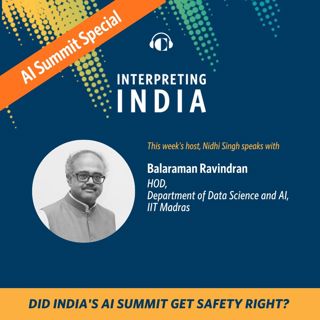
Did India's AI Summit Get Safety Right? AI Summit Special

Did India's AI Summit Get Safety Right? AI Summit Special

This episode is part of our special series on the India AI Impact Summit, examining the conversations, decisions, and debates that are shaping global AI governance. Professor Ravindran addresses early...

19 Juni 40min
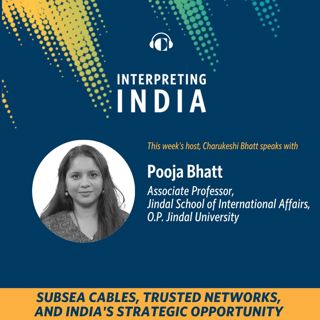
Subsea Cables, Trusted Networks, and India's Strategic Opportunity

Subsea Cables, Trusted Networks, and India's Strategic Opportunity

Pooja opens with a mismatch that frames the entire conversation. India consumes around 20% of global internet traffic but accounts for just 2% of global subsea cable infrastructure. Even with the expa...

4 Juni 46min
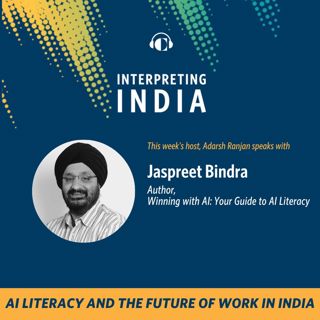
AI Literacy and the Future of Work in India

AI Literacy and the Future of Work in India

Jaspreet's framing for the AI and work debate is worth staying with. He is not dismissive of disruption: he thinks AI will destroy certain jobs, create new ones, and the rupture will be real. But he p...

26 Maj 44min
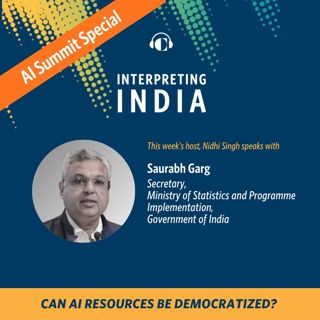
Can AI Resources Be Democratized? AI Summit Special

Can AI Resources Be Democratized? AI Summit Special

This episode is part of our special series on the India AI Impact Summit, examining the conversations, decisions, and debates that are shaping global AI governance. The working group was designed from...

15 Maj 28min

Space Security in the Age of AI

Space Security in the Age of AI

Almudena opens with a distinction that anchors the entire conversation: space security, unlike space safety, is about intentional harm. It concerns deliberate attempts to disrupt, deny, or destroy spa...

7 Maj 1h 7min

Populärt inom Politik & nyheter

aftonbladet-krim
p3-krim
aftonbladet-daily
svenska-fall
rss-krimstad
flashback-forever
rss-krimreportrarna
motiv
rss-sanning-konsekvens
svd-ledarredaktionen
spar
rss-flodet
politiken
rss-expressen-dok
rss-frandfors-horna
mannen-utan-spar
tv4-nyheterna-story
de-fyras-gang
rss-aftonbladet-krim
fordomspodden