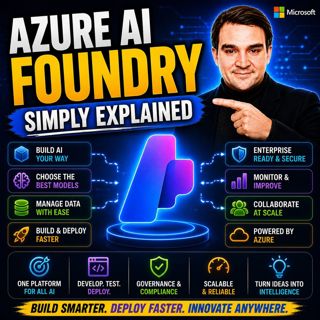
Azure AI Foundry - Simply Explained
Artificial Intelligence is evolving faster than almost any other technology, and with new models, frameworks, and AI services appearing almost every month, it's becoming increasingly difficult to know where to start. Microsoft has also renamed and expanded its AI platform several times—from Cognitive Services to Azure AI Services, Azure AI Studio, Azure AI Foundry, and now Microsoft Foundry—leaving many developers unsure what the platform actually does. In this episode of Microsoft Knowledge Nuggets, we explain Azure AI Foundry in simple terms and show how Microsoft's unified AI development platform brings together foundation models, AI agents, development tools, evaluation, security, and deployment into one enterprise-ready environment. Whether you're building AI copilots, autonomous agents, chatbots, or custom AI applications, Azure AI Foundry provides everything you need from development to production.

WHY AZURE AI FOUNDRY CHANGES HOW AI APPLICATIONS ARE BUILT
Before Azure AI Foundry, developers often had to provision Azure OpenAI, Azure AI Search, Azure Machine Learning, storage accounts, Key Vault, monitoring services, and networking individually before writing a single line of application code. Azure AI Foundry removes that complexity by providing a single, unified development platform where models, security, projects, evaluation tools, agent frameworks, and deployment services are already integrated. Instead of spending days configuring infrastructure, developers can immediately focus on building intelligent applications while Azure manages the underlying platform. We also explain the difference between the older hub-based architecture and the modern Foundry Project model, and why Microsoft recommends using the new project-based experience for all new AI solutions.

FOUNDRY PROJECTS, MODEL CATALOG, AND ENTERPRISE AI DEVELOPMENT
At the center of Azure AI Foundry are Foundry Projects—isolated workspaces that organize every AI solution independently while sharing centralized governance, billing, and security. Each project contains its own model deployments, AI agents, knowledge sources, evaluations, monitoring, and collaboration tools. We also explore the massive Model Catalog, which includes OpenAI models like GPT-4o and GPT-4.1, Microsoft's Phi family, Meta Llama, Mistral, DeepSeek, Claude, Cohere, and thousands of additional foundation models. You'll learn how developers can compare models based on quality, latency, cost, safety, and performance before deploying the best model for each specific business scenario.

BUILDING AI AGENTS WITH TOOLS, KNOWLEDGE, MEMORY, AND PLAYGROUNDS
One of Azure AI Foundry's most powerful capabilities is AI Agent development. This episode explains how developers create intelligent agents by combining five core building blocks: instructions that define behavior, foundation models that provide reasoning, tools such as web search and code interpreter, enterprise knowledge stored through Azure AI Search, and memory that allows conversations to continue across sessions. You'll also discover the Agent Playground, where developers can visually build, test, evaluate, and troubleshoot agents before deploying them through APIs or integrating them directly into Microsoft Teams and custom applications. Rather than simply creating chatbots, Azure AI Foundry enables developers to build AI systems that can reason, retrieve information, perform actions, and automate complex business workflows.

ENTERPRISE SECURITY, AZURE INTEGRATION, AND SCALABLE AI DEPLOYMENT
Azure AI Foundry is designed for enterprise production environments rather than experimental AI projects. We explain how it integrates with Microsoft Entra ID, Azure Key Vault, Azure Storage, Azure AI Search, managed identities, role-based access control (RBAC), private networking, monitoring, and built-in Content Safety services. The Foundry Agent Service automatically manages runtime execution, scalability, authentication, logging, and AI safety while Azure handles infrastructure behind the scenes. This allows organizations to deploy AI applications that meet enterprise governance, compliance, and security requirements without manually assembling dozens of Azure services.

GETTING STARTED WITH AZURE AI FOUNDRY
Getting started with Azure AI Foundry is surprisingly straightforward. This episode walks through creating your first Foundry resource, setting up a new project, deploying a foundation model, building your first AI agent, testing it inside the Agent Playground, connecting enterprise knowledge with Azure AI Search, and gradually expanding toward production-ready AI applications. Whether you're an Azure developer, AI engineer, software architect, or Microsoft partner exploring generative AI, Azure AI Foundry provides one of the most complete enterprise AI development platforms available today. After listening to this episode, you'll understand how Microsoft's AI ecosystem fits together and why Azure AI Foundry has become the foundation for building secure, scalable, and intelligent AI solutions on Azure.

Become a supporter of this podcast: https://www.spreaker.com/podcast/m365-fm-modern-work-security-and-productivity-with-microsoft-365--6704921/support.

Det här avsnittet är hämtat från ett öppet RSS-flöde och publiceras inte av Podme. Det kan innehålla reklam.

Avsnitt(775)

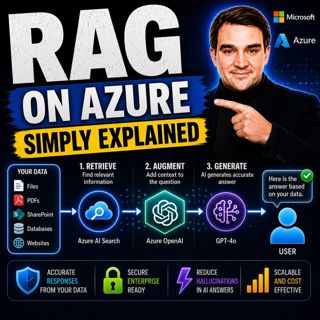
RAG on Azure — Simply Explained

RAG on Azure — Simply Explained

Large Language Models like GPT-4o are incredibly powerful, but they have two major limitations. First, their knowledge is frozen in time, meaning they don't automatically know about recent events, cha...

16 Juli 13min
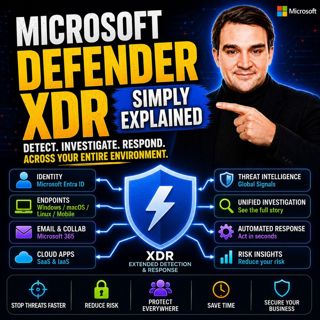
Microsoft Defender XDR - Simply Explained

Microsoft Defender XDR - Simply Explained

Modern cyberattacks rarely target a single system. An attack might begin with a phishing email, move to a compromised device, steal user credentials, access cloud applications, and finally exfiltrate ...

16 Juli 14min
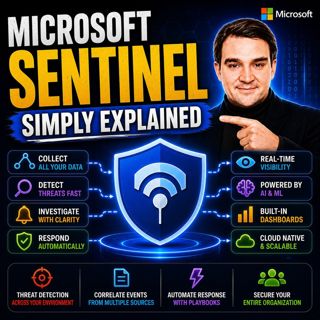
Microsoft Sentinel - Simply Explained

Microsoft Sentinel - Simply Explained

Modern cyberattacks rarely happen in a single moment. Attackers often move slowly, testing identities, exploring systems, downloading data, and establishing persistence over days, weeks, or even month...

16 Juli 14min
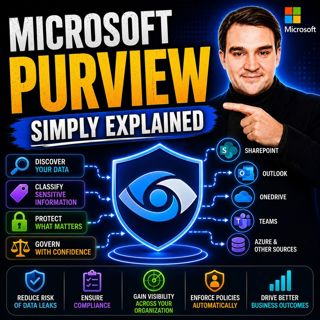
Microsoft Purview - Simply Explained

Microsoft Purview - Simply Explained

Protecting your network is no longer enough to protect your business. Modern organizations store sensitive information across Microsoft 365, Azure, SharePoint, OneDrive, Teams, Exchange, file servers,...

16 Juli 17min
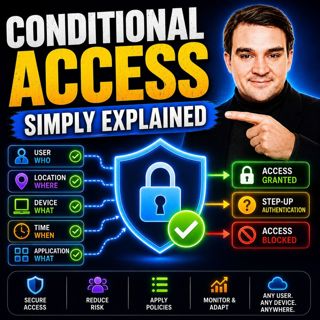
Conditional Access - Simply Explained

Conditional Access - Simply Explained

Every time you sign in to Microsoft 365, far more happens than simply checking your username and password. Behind the scenes, Microsoft evaluates dozens of signals before deciding whether you should b...

16 Juli 15min
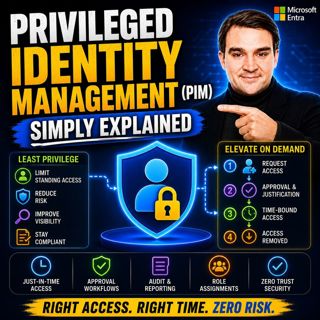
Privileged Identity Management (PIM) - Simply Explained

Privileged Identity Management (PIM) - Simply Explained

Administrator accounts are among the most valuable targets for cybercriminals. If an attacker compromises a Global Administrator or another privileged account, they can potentially reset passwords, ac...

16 Juli 16min

Building a Secure Microsoft-First MSP: Intune, Defender & Entra ID at Scale with Albin Klinaku [MVP]

Building a Secure Microsoft-First MSP: Intune, Defender & Entra ID at Scale with Albin Klinaku [MVP]

Building a successful Managed Service Provider today requires much more than managing devices and responding to support tickets. Modern MSPs must become trusted security partners, helping organization...

16 Juli 1h

Populärt inom Politik & nyheter

aftonbladet-krim
svenska-fall
p3-krim
rss-krimstad
tv4-nyheterna-story
aftonbladet-daily
flashback-forever
motiv
rss-sanning-konsekvens
de-fyras-gang
rss-krimreportrarna
rss-vad-fan-hande
mannen-utan-spar
spar
rss-frandfors-horna
rss-flodet
rss-aftonbladet-krim
krimmagasinet
politiken
olyckan-inifran