GitOps - Simply Explained
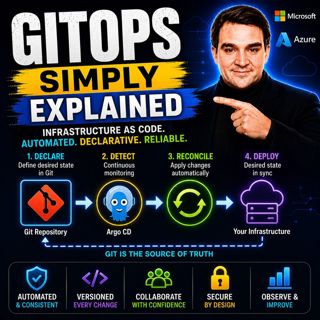
Managing Kubernetes manually quickly becomes a nightmare as environments grow. One engineer updates a deployment directly using kubectl, another changes a ConfigMap through the Azure portal, and suddenly your production cluster no longer matches the configuration stored in Git. This invisible problem is known as configuration drift, and it's one of the biggest challenges in modern cloud operations. In this episode of Microsoft Knowledge Nuggets, we explain GitOps in simple terms and show how it transforms Git into the single source of truth for your infrastructure. Instead of manually deploying changes, GitOps continuously ensures that your Kubernetes clusters always match the configuration stored in your Git repository, making deployments more secure, predictable, and completely auditable.

WHY CONFIGURATION DRIFT BREAKS MODERN CLOUD ENVIRONMENTS
Traditional Kubernetes deployments often rely on engineers manually applying manifests, making emergency fixes, or changing configurations directly inside running clusters. While these quick fixes may solve an immediate problem, they rarely make it back into source control. Over time, the cluster slowly drifts away from what's documented in Git, creating environments that nobody fully understands. The next deployment may overwrite critical changes, introduce unexpected behavior, or trigger outages that take hours to troubleshoot. GitOps eliminates configuration drift by ensuring every infrastructure change is version-controlled, reviewed through pull requests, and automatically synchronized back to the cluster. If someone changes the cluster manually, GitOps detects the difference and restores the desired state automatically.

HOW GITOPS WORKS: DECLARATIVE INFRASTRUCTURE AND CONTINUOUS RECONCILIATION
GitOps is not a product—it's an operating model built around four core principles: declarative infrastructure, version-controlled configuration, automated pull-based deployments, and continuous reconciliation. Infrastructure is described using Kubernetes manifests, Helm charts, or Kustomize rather than imperative deployment scripts. Every change becomes a Git commit with a complete history of who changed what and why. Instead of CI/CD pipelines pushing directly into production, GitOps operators running inside the cluster continuously monitor Git for changes, compare the desired state with the actual cluster state, and automatically reconcile any differences. This creates a self-healing Kubernetes platform where Git always remains the authoritative source of truth.

PULL-BASED DEPLOYMENTS, FLUX, ARGO CD, AND AZURE KUBERNETES SERVICE
One of the biggest architectural changes introduced by GitOps is the move from push-based to pull-based deployments. Traditional CI/CD pipelines require direct access to Kubernetes clusters, creating security risks if build pipelines become compromised. GitOps removes this dependency by allowing the cluster to securely pull configuration changes from Git instead. We compare the two leading GitOps platforms—Flux and Argo CD—and explain why Microsoft selected Flux as the native GitOps engine for Azure Kubernetes Service (AKS) and Azure Arc. You'll learn how Azure DevOps, GitHub Actions, Azure Container Registry, Azure Policy, Azure Key Vault, and Flux work together to create secure, automated deployment pipelines that separate application builds from infrastructure deployment.

GITOPS ON AZURE: BUILDING SECURE, SCALABLE KUBERNETES PLATFORMS
GitOps integrates seamlessly with Microsoft's cloud ecosystem. Azure Kubernetes Service includes built-in Flux support, making it easy to connect clusters directly to Git repositories. Azure Arc extends GitOps beyond Azure, enabling organizations to manage Kubernetes clusters running on-premises, at the edge, or across multiple cloud providers using the same deployment model. Combined with Azure DevOps, Azure Container Registry, Azure Policy, and Azure Key Vault, GitOps provides a secure, scalable foundation for managing dozens or even hundreds of Kubernetes clusters while maintaining consistent configurations across development, staging, and production environments. This approach significantly improves security, governance, and operational consistency for modern cloud-native applications.

WHY GITOPS HAS BECOME THE STANDARD FOR KUBERNETES OPERATIONS
GitOps offers far more than automated deployments. It provides complete audit trails, simple one-click rollbacks through Git commits, self-healing infrastructure, improved security through pull-based deployments, and standardized collaboration between development and operations teams. Every infrastructure change follows the same Git-based workflow as application code, making reviews, approvals, testing, and compliance significantly easier. Whether you're running a single AKS cluster or managing large enterprise Kubernetes environments across multiple regions, GitOps delivers a reliable operating model that improves deployment quality, reduces configuration drift, and accelerates recovery from failed releases. After listening to this episode, you'll understand why GitOps has become the preferred deployment model for Kubernetes on Microsoft Azure and why Git is now considered the foundation of modern cloud operations.

Become a supporter of this podcast: https://www.spreaker.com/podcast/m365-fm-modern-work-security-and-productivity-with-microsoft-365--6704921/support.

Det här avsnittet är hämtat från ett öppet RSS-flöde och publiceras inte av Podme. Det kan innehålla reklam.

Avsnitt(780)

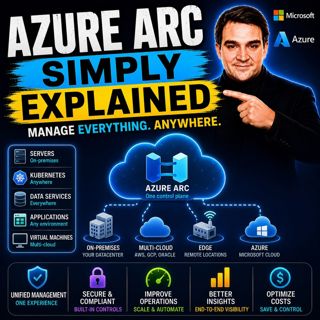
Azure Arc - Simply Explained

Azure Arc - Simply Explained

Modern IT environments rarely exist in a single cloud. Most organizations run Windows and Linux servers across on-premises data centers, Microsoft Azure, Amazon Web Services (AWS), Google Cloud Platfo...

17 Juli 17min
Microsoft AI Agent Harness - Simply Explained

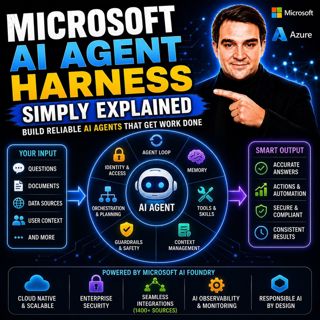
Microsoft AI Agent Harness - Simply Explained

Writing the perfect AI prompt used to be the goal of every AI developer. But as businesses began asking AI to perform increasingly complex tasks—analyzing code, researching topics, coordinating workfl...

17 Juli 16min
Platform Engineering - Simply Explained

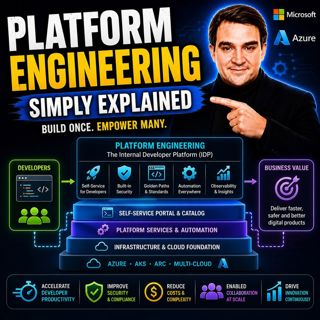
Platform Engineering - Simply Explained

For years, DevOps promised to break down the barriers between development and operations by giving teams greater ownership over the software they build. While the idea was powerful, reality became far...

16 Juli 16min
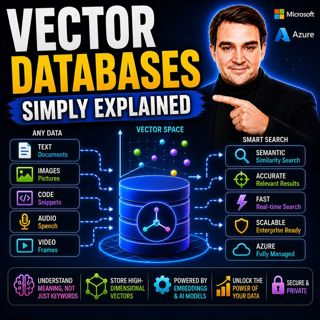
Vector Databases - Simply Explained

Vector Databases - Simply Explained

Large Language Models like GPT-4o, Microsoft Copilot, and ChatGPT are incredibly powerful, but they all depend on one critical technology that most people never hear about: vector databases. Tradition...

16 Juli 14min
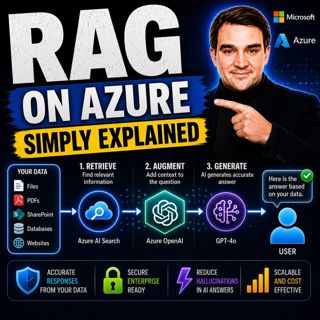
RAG on Azure — Simply Explained

RAG on Azure — Simply Explained

Large Language Models like GPT-4o are incredibly powerful, but they have two major limitations. First, their knowledge is frozen in time, meaning they don't automatically know about recent events, cha...

16 Juli 13min
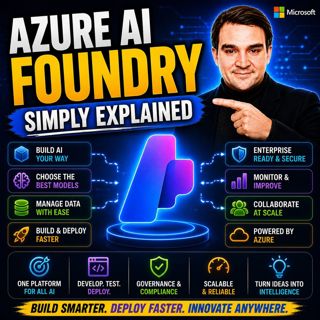
Azure AI Foundry - Simply Explained

Azure AI Foundry - Simply Explained

Artificial Intelligence is evolving faster than almost any other technology, and with new models, frameworks, and AI services appearing almost every month, it's becoming increasingly difficult to know...

16 Juli 14min
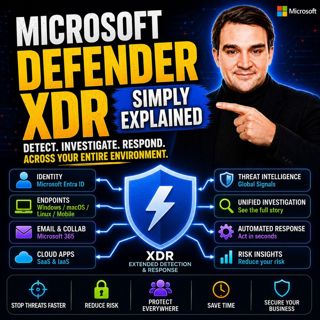
Microsoft Defender XDR - Simply Explained

Microsoft Defender XDR - Simply Explained

Modern cyberattacks rarely target a single system. An attack might begin with a phishing email, move to a compromised device, steal user credentials, access cloud applications, and finally exfiltrate ...

16 Juli 14min

Populärt inom Politik & nyheter

aftonbladet-krim
svenska-fall
p3-krim
rss-krimstad
tv4-nyheterna-story
aftonbladet-daily
flashback-forever
rss-sanning-konsekvens
motiv
de-fyras-gang
rss-krimreportrarna
mannen-utan-spar
rss-vad-fan-hande
rss-frandfors-horna
spar
rss-flodet
rss-aftonbladet-krim
politiken
olyckan-inifran
krimmagasinet