
Episode #001 - Anna Freud & The Architecture of Defense

Episode #001 - Anna Freud & The Architecture of Defense

Defense mechanisms, Anna Freud, and the philosophy of self-knowledge — that's the focus of our first episode of Philosophy for Lunch.

We start with Anna Freud’s life and work, from growing up as Sigmund Freud’s youngest daughter to publishing The Ego and the Mechanisms of Defense in 1936. Then we walk through some of the defense mechanisms you’ll recognize from everyday life: repression, projection, reaction formation, rationalization, sublimation, and displacement.

Along the way, we ask the philosophical questions her work raises:

  • How much of yourself can you really know if your mind is actively hiding things from you?
  • What happens to moral responsibility if our “reasons” are often after-the-fact stories?
  • Is the examined life always better, or do we also need a little healthy opacity to stay human?

At the end of the episode, we take listener questions about denial, whether defense mechanisms ever stop, what this looks like in children, and how to work on your own defenses without turning therapy into a perfection project.

Big ideas. Human conversations. About 30 minutes. Perfect for a lunch break, commute, or slow Sunday morning.

Sources & further reading:

  • Anna Freud, The Ego and the Mechanisms of Defense (1936/1966). The classic statement of her theory of defense mechanisms.
  • Anna Freud, Normality and Pathology in Childhood (1965). On development, resilience, and how defenses show up in children.
  • Anna Freud & Dorothy Burlingham, War and Children (1943). Clinical observations of children separated from parents during World War II and how they defended against trauma.
  • Ernst Kris, Anna Freud, & colleagues, The Hampstead War Nursery reports. Case material on children’s defenses under extreme stress.
  • Jonathan Haidt, The Righteous Mind: Why Good People Are Divided by Politics and Religion (2012). For the “press secretary” model of moral reasoning we discuss when talking about rationalization.
  • Daniel Kahneman, Thinking, Fast and Slow (2011). A broader look at intuition, reasoning, and why our explanations often come after the fact.
  • George E. Vaillant, Ego Mechanisms of Defense: A Guide for Clinicians and Researchers (1992). A modern clinical take on defense mechanisms and how they function in adult life.
  • Nancy McWilliams, Psychoanalytic Diagnosis (2nd ed., 2011). Accessible overview of personality structure and defenses from a contemporary psychoanalytic perspective.

Subscribe to Philosophy for Lunch wherever you listen to podcasts.

Det här avsnittet är hämtat från ett öppet RSS-flöde och publiceras inte av Podme. Det kan innehålla reklam.

Avsnitt(20)

Episode #020 - Was Mathematics Invented or Discovered?

Episode #020 - Was Mathematics Invented or Discovered?

Here is a question that sounds like it should have an obvious answer. Was mathematics invented or discovered? Did humans create the number two the way we created the word for it? Or did the number two...

24 Aug 40min
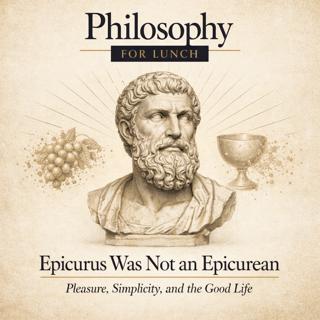
Episode #019 - Epicurus Was Not an Epicurean

Episode #019 - Epicurus Was Not an Epicurean

If someone described a philosophy whose central teachings were: live simply, eat bread and water, cultivate close friendships, manage your desires so they never exceed what is easily available, and sp...

17 Aug 18min
Episode #018 - Probability and Judgment: Why We Get Risk Wrong

Episode #018 - Probability and Judgment: Why We Get Risk Wrong

Here is a medical test scenario. A disease affects one in a thousand people. There is a test that is ninety-nine percent accurate. You take the test. It comes back positive. What is the probability th...

10 Aug 31min

Episode #017 - The Paradox of Tolerance: Can a Free Society Tolerate Intolerance?

Episode #017 - The Paradox of Tolerance: Can a Free Society Tolerate Intolerance?

Karl Popper wrote one of the most widely shared philosophical texts on the internet. It is also one of the most consistently misread.The argument is simple on its surface: a society that tolerates int...

3 Aug 31min

Episode #016 - Nietzsche: God Is Dead — Now What?

Episode #016 - Nietzsche: God Is Dead — Now What?

Nietzsche is probably the most misread philosopher in the Western tradition. He has been claimed by Nazis, nihilists, self-help gurus, and people who have read a sentence or two and decided they under...

27 Juli 31min

Episode #015 - William James and the Will to Believe

Episode #015 - William James and the Will to Believe

Imagine you are standing at the edge of a chasm. You need to get to the other side. The leap is possible — just barely — but you cannot know in advance whether you will make it. Does believing you can...

20 Juli 29min

Episode #014 - Viktor Frankl and the Meaning Made from Suffering

Episode #014 - Viktor Frankl and the Meaning Made from Suffering

There is a question that arrives most forcefully when circumstances are at their worst. Not why is this happening in the causal sense, but the question underneath that one: what does this mean? Is the...

13 Juli 30min

Episode #013 - What Does It Mean to Live Philosophically?

Episode #013 - What Does It Mean to Live Philosophically?

Socrates said the unexamined life is not worth living. That sentence is probably the most quoted in the history of philosophy. But the popular interpretation — that you should think more and be more s...

6 Juli 30min

Populärt inom Samhälle & Kultur

podme-dokumentar
gynning-berg
aftonbladet-krim
en-mork-historia
p3-dokumentar
aftonbladet-daily
hor-har
creepypodden-med-jack-werner
killradet
rss-schyffert-sundin-ar-det-har-nat
flashback-forever
kod-katastrof
rss-nemo-moter-en-van
svenska-fall
vad-blir-det-for-mord
mardromsgasten
rss-vill-du-veta-en-hemlis-2
rss-mer-an-bara-morsa
p3-historia
rss-vad-fan-hande