Podcast #637: Glasses-free 3D projector concept

Podcast #637: Glasses-free 3D projector concept

Glasses-free 3D projector concept

Nothing says “the future of display technology” like holograms. If you’re a Star Wars or a Star Trek fan, you know that someday we’ll have holograms for real, interacting with us. But until now that notion has existing only in science fiction and our imaginations. But fueled by the same dreams you have, over the past three years, researchers in the Camera Culture group at the MIT Media Lab have steadily refined a design for a 3D video technology that doesn’t require glasses at all.

The MIT group believes their concept has the potential to provide a cheaper, more practical alternative to holographic video. And they don’t think it’ll take decades to get there. They’re using a technique called multiperspective 3D, which is quite different from the stereoscopic 3D technology common in homes and movie theaters. So this isn’t stereoscopic 3D without glasses, which some of us have seen and not been impressed with. This is a completely different approach.

Watch the video

The MIT researchers have built a prototype of their system using off-the-shelf components. There’s nothing exotic about the system, so the cost shouldn’t be prohibitive in mass production. They also built a prototype of a new type of screen that widens the angle from which their projector’s images can be viewed. The technology will be unveiled at this year’s Siggraph conference in Vancouver this August (Aug. 10-14, 2014). Siggraph is the major international conference in computer graphics and interactive technologies.

Much like the holograms in your science fiction imagination, objects depicted by a multiperspective 3D display actually show different perspectives as the viewer moves about them, just as the objects would in the real world. While stereoscopic 3D tricks your brain into perceiving depth that isn’t there, multiperspective 3D draws a visual representation of the object from multiple angles, providing more of a “floating” image than a perceived depth. Next step: the Holodeck.

How it works

We encourage you to read the full news release at mit.edu for all the details. We’ll do our best to present a summary of what they have put together, but we certainly aren’t MIT researchers, nor do we try to play them on the podcast.

The projector uses two liquid-crystal modulators, which are essentially tiny LCD displays, positioned between the light source and the lens. The first LCD is used to adjust the angle of the light passing through it. So the video information (which is the the light passing through it) reaches the second modulator only at particular angles. The combinations of the patterns displayed by the two modulators enable a viewer to see slightly different images from different angles.

For every frame of video, each modulator displays six different patterns, which together produce eight different viewing angles: At high enough display rates, the human visual system will automatically combine information from different images. The modulators can refresh their patterns at 240 hertz, or 240 times a second, so even at six patterns per frame, the system could play video at a rate of 40 hertz, which, while below the refresh rate common in today’s TVs, is still higher than the 24 frames per second standard in film.”.


Added bonus: Better contrast and resolution

It turns out that passing the light through the two modulators can actually improve the contrast of ordinary 2D video as well. We all know about the challenges LCD displays have had representing true black, and one of the reasons we lament the loss of plasma as much as we do. The problem stems from the fact that a little bit of light always leaks through even the darkest regions of the display.

One of the MIT researchers, Gordon Wetzstein, explains it like this. “Normally you have contrast of, let’s say, values between 0 and 1. That’s the full contrast, but in practice, all modulators have something like 0.1 to 1. So you get this ‘black level.’ But if you multiply two optically together, the black level goes down to 0.01. If you show black on one, which is 10 percent, and black on the other, which is also 10 percent, what you get through is 1 percent. So it’s much more black.

Not only an improvement in contrast, but by changing the way the two modulators are used, you can actually heighten the resolution of the resulting image. If the patterns displayed on the modulators are slightly offset from each other, you can spread the pixels so that the the light passing through them will interfere with itself in ways that produce a higher resolution image. As you can imagine, the team at MIT has come up with a way to calculate the patterns needed on the modulators to produce that effect on the fly, in real time.

The MIT team believes these two factors could make the technology an excellent bridge for theater operators - even before there is content available to take advantage of the multiperspective 3D capabilities. They can install projection systems now that provide better contrast and add the ability to produce 4k images (using only two 1080p modulators) and then they’ll already have the multiperspective 3D technology sitting there. Sounds like a win-win.

Det här avsnittet är hämtat från ett öppet RSS-flöde och publiceras inte av Podme. Det kan innehålla reklam.

Avsnitt(841)

Podcast #1269: Is Your LG Smart TV Listening to You? and Dolby AC4

Podcast #1269: Is Your LG Smart TV Listening to You? and Dolby AC4

On this week's show we look into an article that alleges LG's Smart TVs are listening in on your conversations even when the screen is off. We also do a quick rundown on what Dolby's AC4 is and where ...

11 Sep 36min
Podcast #1268: Ara's New Setup First Impressions

Podcast #1268: Ara's New Setup First Impressions

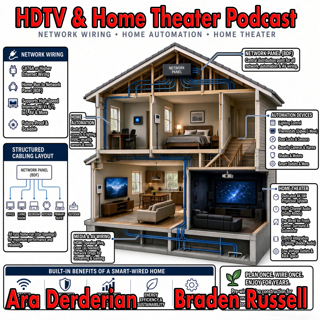
On this week's show Ara gives his impression of the new gear installed into his new home. We talk Internet, Home Networking, Automation, and Home Theater in an action packed show. We also read your em...

4 Sep 54min
Podcast #1267: Nick Brown and Smith Freeman of SVS Sound

Podcast #1267: Nick Brown and Smith Freeman of SVS Sound

Nick Brown and Smith Freeman of SVS Sound On today's show we have an interview with Nick Brown (VP of Marketing) and Smith Freeman (Senior Director of Product Management) at SVS Sound.  We discuss the...

28 Aug 40min
Podcast #1266: Ara's New Setup

Podcast #1266: Ara's New Setup

On today's show we discuss Ara's new family room TV and Audio setup and what his plans are for the future. We also read your emails and look at the week's news. News: Marantz Introduces The CINEMA S...

21 Aug 31min
Podcast #1265: Garage Doors - AV Receivers - Atmos in the Family Room

Podcast #1265: Garage Doors - AV Receivers - Atmos in the Family Room

On today's show we discuss Ara's garage door plan for integrating it into HomeKit, we help a listener decide on which receiver to buy, and we ask whether Atmos is worth it for a family room. We also r...

14 Aug 47min

Podcast #1264:  Family Room - 5.1 vs 7.2 what makes sense?

Podcast #1264: Family Room - 5.1 vs 7.2 what makes sense?

On today's show we take a look at your family room and decide whether a 7.2 system is worth it over 5.1. We also read your emails and catch up on the week's news. News:  How Valuable Is TV to Smalle...

7 Aug 20min

Podcast #1263: 2026 Value Electronics TV Shootout

Podcast #1263: 2026 Value Electronics TV Shootout

On this week's show we breakdown the Value Electronics 2026 TV Shootout and see who the new King TV is. We also read your emails and look at the week's news. News: LG is cracking down on smart TV ap...

31 Juli 35min

Podcast #1262: What is on the Home Theater Horizon

Podcast #1262: What is on the Home Theater Horizon

On this week's show we look into our crystal ball to see what is on the Home Theater Horizon. We also read your emails and take a look at the week's news. News: 2026 Value Electronics TV Shootout: S...

24 Juli 35min

Populärt inom Politik & nyheter

aftonbladet-krim
svenska-fall
p3-krim
fordomspodden
rss-krimstad
en-runda-till
politiken
aftonbladet-daily
flashback-forever
rss-vad-fan-hande
rss-sanning-konsekvens
svd-ledarredaktionen
rss-krimreportrarna
rss-flodet
motiv
rss-frandfors-horna
omni-podd
rss-expressen-dok
rss-utopia-2
rss-politikrummet