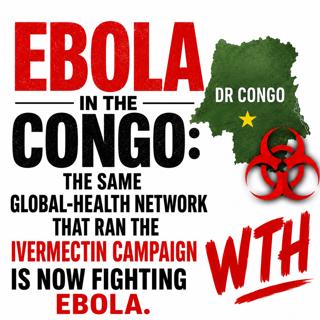

EBOLA in Congo: The Same Global-Health Network That Ran the Ivermectin Campaign Is Now Fighting Ebola. WTH

EBOLA in Congo: The Same Global-Health Network That Ran the Ivermectin Campaign Is Now Fighting Ebola. WTH

"Trust must be earned, it cannot be assumed. We have not always done things correctly."
— WHO Director-General Tedros Adhanom Ghebreyesus, message to the people of the Democratic Republic of the Congo, May 28, 2026

The Ebola crisis in the Democratic Republic of the Congo is part of a much longer history of international disease-control campaigns across Africa. Decades before Ebola became a global emergency, many of the same regions were already the focus of massive public-health programs targeting tropical diseases such as river blindness, also known as onchocerciasis. Those programs brought together the World Health Organization, World Bank, pharmaceutical companies, governments, nonprofit organizations and international health workers.

The connections are striking. The WHO-led Onchocerciasis Control Programme began in West Africa in 1974, followed by the African Programme for Onchocerciasis Control in 1995. Merck began its Mectizan Donation Program in 1987, supplying ivermectin for river blindness on an unprecedented scale. Over the following decades, international organizations developed extensive networks for delivering drugs, monitoring disease, training health workers and working with communities across Africa.

Then came Ebola. The catastrophic 2014–2016 West African Ebola epidemic transformed the disease into an international security and public-health emergency. President Barack Obama declared the outbreak a U.S. national-security priority, while the United States, WHO, CDC, military personnel, pharmaceutical companies and international aid organizations mobilized against the epidemic.

The Democratic Republic of the Congo presents an especially important case because it has experienced repeated Ebola outbreaks while also being deeply involved in decades of international tropical-disease programs. That raises an important historical question: how much institutional continuity exists between the organizations, personnel, infrastructure and public-health strategies developed during earlier campaigns such as the fight against river blindness and those later deployed against Ebola?

Trust is another central issue. During Ebola outbreaks in the Congo, health workers have confronted fear, resistance, attacks on treatment centers and communities suspicious of international health authorities. Ebola control depends heavily on cooperation: identifying cases, tracing contacts, isolating patients, conducting safe burials and administering vaccines and treatments. When communities do not trust the institutions delivering those interventions, disease control becomes dramatically more difficult.

This episode follows the timeline from ivermectin and river blindness programs to Ebola, examining the WHO, World Bank, pharmaceutical companies, international health organizations, the United States and the networks operating on the ground in Africa. Rather than looking at each outbreak or health campaign in isolation, the investigation asks what becomes visible when the people, organizations, geography and dates are placed on one timeline.

Topics covered: Ebola in the Congo, Democratic Republic of the Congo Ebola outbreak, Ebola virus disease, WHO Ebola response, CDC Ebola response, Barack Obama Ebola response, ivermectin in Africa, river blindness, onchocerciasis, Mectizan Donation Program, Merck ivermectin, World Health Organization, World Bank, African Programme for Onchocerciasis Control, global health in Africa, Ebola vaccines, Ebola treatments, public-health trust, international health organizations and African disease-control programs.

Music: Creedence Clearwater Revival - Who'll Stop The Rain (Official Audio)

JCDR - Ebola virus, Psychological impact, Stigma

Marburg and Ebola — Arming Ourselves against the Deadly Filoviruses | New England Journal of Medicine

Marburg Virus: What You Should Know About This Close Cousin of Ebola

What is Marburg virus? 5 things to know about the Ebola-like virus | Nebraska Medicine Omaha, NE

The Marburg "Virus:" Precursor to Ebola – ViroLIEgy

Marburg virus disease - Wikipedia

Ebola - Wikipedia

How hormones work to flip sexes: Hormones

Do you have a psychopath in your life? The best way to find out is read my book. BOOK *FREE* Download – Psychopath In Your Life4

Support is Appreciated: Support the Show – Psychopath In Your Life

Download Pods here: TOP PODS – Psychopath In Your Life

My old discussion forum with last 10 years of victim stories, is back online. Psychopath Victim Support Community | Forums powered by UBB.threads™

Google Maps My HOME Address: 309 E. Klug Avenue, Norfolk, NE 68701 SMART Meters & Timelines – Psychopath In Your Life

"Ebola is now an epidemic of the likes that we have not seen before. It's spiraling out of control. It is getting worse. It's spreading faster and exponentially. Today, thousands of people in West Africa are infected………That number could rapidly grow to tens of thousands. And if the outbreak is not stopped now, we could be looking at hundreds of thousands of people infected, with profound political and economic and security implications for all of us. And that's why, two months ago, I directed my team to make this a national security priority. We're working this across our entire government, which is why today I'm joined by leaders throughout my administration, including from my national security team."

– Obama in his speech at the Centre of Disease Control 16th of September, Atlanta Georgia, USA (emphasis added)

Japan: From Ivermectin to the Ebola Response in Africa

Japan needs to be included in the larger timeline. Its role does not establish that the same Japanese scientists who developed ivermectin later ran Ebola programs. What the record does establish is something more specific: Japan was important at the beginning of the ivermectin story and later became a substantial participant in the international Ebola-response system, including repeated work inside the Democratic Republic of the Congo.

1978 — Japan and the Beginning of Ivermectin

Japanese microbiologist Satoshi Ōmura, working at the Kitasato Institute, cultured microorganisms collected from soil in Japan. One strain ultimately produced avermectin. Working with William Campbell and Merck researchers in the United States, this discovery led to ivermectin.

The Nobel Prize organization says Ōmura cultured the critical strain in 1978, from which Campbell isolated avermectin; a chemically modified derivative became ivermectin and eventually a major treatment for river blindness. Ōmura and Campbell shared the 2015 Nobel Prize for this work.

So Japan wasn't a peripheral participant in the ivermectin story. One of the two scientists awarded the Nobel Prize for the discovery was Japanese, and the organism at the beginning of the discovery came from Japan.

2014 — Japan Enters the Major Ebola Response

Jump forward roughly three and a half decades.

During the enormous 2014 West African Ebola epidemic, Japan became an active participant in the international response.

Japanese infectious-disease specialists were dispatched to Africa through the World Health Organization. In October 2014, for example, two specialists from Japan's National Institute of Infectious Diseases were sent to Sierra Leone as part of a World Health Organization Ebola mission. By November, the Japanese government reported that 10 Japanese experts had participated or were participating in these missions.

Japan wasn't simply writing checks from Tokyo.

Japanese personnel were entering the international Ebola-response machinery.

By July 2015, Japan reported that 20 Japanese experts had been dispatched through World Health Organization missions during the West African Ebola response.

Japan Supplies 700,000 Sets of Protective Equipment

The material contribution was also substantial.

In November 2014, Japan announced that approximately 700,000 sets of personal protective equipment would be supplied to Guinea, Liberia, Sierra Leone and Mali.

Japan even used a Self-Defense Forces aircraft to transport an initial 20,000 sets to Ghana, where the United Nations Ebola emergency mission was headquartered.

By February 2015, Japan described its overall West African Ebola assistance as approximately $155 million, including experts, equipment and international assistance.

Japan Also Entered the Experimental-Treatment Story

There was another significant Japanese component.

During the West African epidemic, Japan announced that a drug developed by a Japanese company could be made available under certain conditions as a possible Ebola treatment. Japan also supported clinical testing involving the French Institute of Health and Medical Research, the government of Guinea and Doctors Without Borders.

That means Japan's Ebola involvement extended beyond funding and protective equipment into medical research and experimental treatment.

2015 — Ebola Produces a Permanent Japanese Outbreak Team

This is an important turning point.

After the West African Ebola crisis, Japan established the Japan Disaster Relief Infectious Diseases Response Team in 2015.

This gave Japan a specialized mechanism for sending infectious-disease experts overseas.

Japan's own development-cooperation history says that this team subsequently went to the Democratic Republic of the Congo for yellow fever in 2016 and for Ebola in 2018.

The sequence is therefore:

2014 Ebola crisis in West Africa

2015 Japan establishes a specialized international infectious-disease response team

2016 the team goes to the Congo

2018 the team returns to the Congo specifically for Ebola

That is an important institutional progression.

2018 — Japanese Ebola Specialists Enter the Congo

When Ebola broke out in the Democratic Republic of the Congo in 2018, the Congolese government requested Japanese assistance.

Japan first sent an assessment team containing infectious-disease specialists, Foreign Ministry officials and personnel from Japan's international development agency.

Japan then deployed its specialized infectious-disease response team beginning June 11.

Its mission was not merely observational.

The Japanese team worked with the Congolese government and international organizations to strengthen disease surveillance and laboratory confirmation of Ebola cases.

By the time the mission finished, Japanese personnel had helped establish a quarantine point, worked on data management, helped train 30 quarantine officers and 10 epidemiologists, and provided laboratory training at Congo's National Institute of Biomedical Research.

Japan also provided $3 million for the Congo Ebola response through the World Health Organization, United Nations Children's Fund and International Organization for Migration.

This puts Japan directly inside the Congo Ebola-response infrastructure.

2019 — Japan Returns During the Huge Congo Epidemic

The involvement didn't end with the 2018 outbreak.

During the much larger Ebola epidemic in eastern Congo, Japan again deployed its infectious-disease response team in August 2019 at the request of the Congolese government.

Japan sent one team and then dispatched a second group. Their mission included strengthening quarantine and other measures intended to prevent Ebola from spreading.

Japanese personnel subsequently worked in Kinshasa and Kisangani, providing training involving Ebola surveillance, quarantine, laboratory diagnosis, infection control and protective equipment.

Japan simultaneously provided another $5 million for quarantine, treatment, laboratory diagnosis, surveillance and contact tracing.

So by 2019 this was no longer a one-time Japanese appearance in the Congo.

Japan had become a repeat participant.

Another Important Connection: Japan, the World Health Organization and the World Bank

There is an additional institutional connection worth putting into the larger timeline.

Japan says that it contributed heavily to the World Health Organization's emergency-response programs after the West African Ebola epidemic.

Japan also supported creation of the World Bank's Pandemic Emergency Financing Facility and pledged $50 million, becoming the first country to announce a contribution.

When Ebola struck the Congo in 2018, that financing mechanism released money for the Ebola response.

That gives us another institutional chain:

Japan → World Health Organization emergency system

Japan → World Bank pandemic-financing system

World Health Organization + World Bank mechanisms → Congo Ebola response

2026 — Japan Is Still Involved

And Japan hasn't disappeared from the picture.

On June 22, 2026, Japan announced another $3.5 million emergency grant responding to Ebola outbreaks in the Democratic Republic of the Congo and Uganda.

Of that money, $3 million was designated for Congo: $1.5 million for health through the International Federation of Red Cross and Red Crescent Societies, $1 million for logistics through the World Food Programme and $500,000 for water and sanitation through the United Nations Children's Fund.

That extends the Japanese involvement from the 2014 West African epidemic right into the current Congo response.

The Timeline

1978: Satoshi Ōmura in Japan cultures the microorganism that leads to avermectin and ultimately ivermectin.

2014: Japanese infectious-disease specialists join World Health Organization Ebola missions in West Africa.

2014: Japan supplies approximately 700,000 sets of protective equipment and commits major financial assistance.

2014–2015: Japan becomes involved in research concerning a potential Japanese-developed Ebola treatment.

2015: Japan establishes a specialized international infectious-disease response team.

2016: That team deploys to the Democratic Republic of the Congo for a yellow-fever emergency.

2018: Japan sends infectious-disease specialists into the Congo for Ebola. They work on quarantine, surveillance, epidemiological training and laboratory diagnosis.

2018: Japan provides an additional $3 million for the Congo Ebola response.

2019: Japanese infectious-disease teams return to the Congo during the enormous eastern Congo Ebola epidemic.

2019: Japan provides another $5 million for treatment, quarantine, laboratory diagnosis, surveillance and contact tracing.

2026: Japan provides another $3 million specifically for the Ebola response in the Congo as part of a $3.5 million Congo-Uganda package.

What the Japan Connection Adds

Japan was central to the scientific origin of ivermectin.

Decades later, Japan became an important participant in the international Ebola response.

After the catastrophic 2014 Ebola epidemic, Japan institutionalized that experience by creating a permanent infectious-disease response team.

That team subsequently entered the Democratic Republic of the Congo, first for yellow fever and then repeatedly for Ebola, working in surveillance, quarantine, epidemiology and laboratory diagnosis.

And in 2026 Japan remains financially involved in the Congo Ebola response.

So on the network map we have been constructing, Japan belongs in the picture.

What the evidence does not yet show is that Ōmura, the Kitasato ivermectin researchers, or the original Japanese ivermectin program itself transitioned into the Ebola operations. That would require a person-by-person and institution-by-institution crossover analysis.

But at the country and global-health-institution level, the Japan connection is substantial and documented.

Ivermectin as a Training Ground: How the River-Blindness Campaign Built a Community-Health Model Later Used in African Epidemic Response

The enormous African ivermectin campaign did considerably more than distribute a drug for river blindness. Over several decades, the program helped international health organizations, African governments, NGOs and local communities develop and refine a system for reaching millions of people in remote areas where conventional health infrastructure was weak.

WHO's own historical documents make this point unusually clear.

The important distinction is this: there is no evidence that the ivermectin program was created in preparation for Ebola. But there is strong evidence that the ivermectin campaign became a large-scale laboratory for learning how community-directed health interventions could operate across Africa, and that WHO deliberately studied how the system could be expanded beyond ivermectin.

The Beginning: Ivermectin Changes the Strategy

Merck announced its ivermectin donation program in 1987, promising to provide Mectizan for river blindness for as long as necessary.

WHO says large-scale ivermectin distribution was incorporated into African onchocerciasis control beginning around 1989. The drug created a logistical problem very different from treating individual patients in hospitals.

Millions of people living in remote communities had to be identified, reached and treated repeatedly.

That required much more than ivermectin.

It required:

  • community mapping,
  • local health workers,
  • community leaders,
  • drug-distribution networks,
  • training,
  • record keeping,
  • population estimates,
  • monitoring,
  • surveillance,
  • communication with villages,
  • and mechanisms for determining whether populations were actually accepting and receiving treatment.

In other words, ivermectin required the construction of a community-level public-health delivery system.

WHO itself later described the collaboration surrounding mass ivermectin treatment as creating a "unique community-based distribution system."

1995: APOC Takes the Model Across Africa

In 1995, the African Programme for Onchocerciasis Control—APOC—was established.

This was not a small operation.

It brought together African governments, affected communities, NGOs, donors and international organizations. The World Bank served as fiscal agent and WHO as executing agency. Eventually approximately 20 African countries participated.

The central strategy became known as:

Community-Directed Treatment with Ivermectin (CDTI)

The idea was fairly simple: instead of international health workers repeatedly arriving in African villages and handing out ivermectin themselves, local communities were brought into the process and helped organize the distribution.

WHO's tropical-disease research program began developing this approach in 1995, and the African Programme for Onchocerciasis Control — APOC — adopted it in 1996.

This mattered because ivermectin wasn't a one-time treatment. People living in areas with river blindness needed to receive the drug again and again, year after year.

So the research was no longer simply:

Does ivermectin work against river blindness?

There was now another question:

How do you deliver a treatment repeatedly to people living in remote African communities — and build a system that can keep doing it for years?

It was also about learning how to build a long-term health-delivery system inside thousands of African communities.

They Learned From the Process

WHO documents show that researchers weren't only studying ivermectin. They were also studying how the entire delivery system worked.

They looked at how health workers communicated with communities, how much local people participated, and why some communities participated more successfully than others.

They measured how many people actually received treatment and studied what made the programs succeed or fail.

Researchers also experimented with bringing villagers, community organizations and health workers together to improve the process.

And there was another major question: Could this system last?

River blindness treatment wasn't something that could be done for a year or two and forgotten. The system might have to continue operating for 15 years or longer.

WHO's 2000 multi-country evaluation examined these questions as CDTI was being tested and refined.

So describing the ivermectin campaign as simply handing out a drug misses an important part of the history.

They were learning how to organize, operate and sustain a long-term health program inside remote African communities — and they learned from what worked and what didn't.

It was simultaneously producing practical knowledge about how to conduct enormous community-level health interventions in Africa.

Then Something Important Happened

Other health programs began noticing something: the ivermectin delivery system worked, and the same network could be used for much more than ivermectin.

By 2003, WHO was openly studying this possibility.

WHO reported:

"The success of CDTI in onchocerciasis control has caught the attention of other disease control programmes."

The community distributors who had originally been organized to deliver ivermectin were already becoming involved in other health programs, including vitamin A distribution, malaria control, polio immunization, Guinea worm eradication, nutrition programs, water protection and general community-health work.

In fact, an earlier investigation found that more than half of the community-directed ivermectin distributors studied were already participating in other health and development activities.

That is an important turning point in this history.

What began as a system for getting ivermectin into remote communities was becoming something much larger.

The ivermectin network was becoming multipurpose health infrastructure — a community-based delivery system that could be used for other diseases, treatments and public-health campaigns.

2005: WHO Formally Tests the Idea

Then WHO and APOC took the next step.

In 2005, they launched a three-year study to answer a straightforward question:

If communities had already learned how to organize and distribute ivermectin, could that same system be used to deliver other health programs?

This was not a small experiment. The study involved approximately 2.35 million people at seven research sites in Cameroon, Nigeria and Uganda.

There was a reason WHO wanted to test the idea.

Community-directed ivermectin treatment had already demonstrated that a health program could reach enormous numbers of people living in poor and remote African communities.

So researchers asked:

Could we use the same system for other health interventions?

The answer was yes.

And the terminology changed in an important way.

Community-Directed Treatment with Ivermectin (CDTI)

became the broader:

Community-Directed Interventions (CDI).

That change tells the story.

Ivermectin was no longer the defining feature of the model. The delivery system was.

The Scale Was Enormous

And this was already a very large network.

By 2000, APOC's community ivermectin program was reaching approximately 20 million people in 50,000 communities across 14 countries.

By the time the research was published in 2008, annual ivermectin treatment through CDTI was reaching nearly 60 million Africans.

By 2011, WHO's tropical-disease research program described the community-directed system as reaching approximately 98 million people in 24 sub-Saharan African countries.

And when APOC closed in 2015, WHO reported that community-directed ivermectin treatment was protecting more than 110 million people every year in 19 countries.

Think about what had been built.

This wasn't simply a drug being shipped into Africa.

It was a massive community-level public-health network reaching tens of millions of people year after year.

They Institutionalized What They Had Learned Then WHO took another important step. It developed a Community-Directed Intervention training curriculum for medical and health-science schools.

The lessons learned through ivermectin distribution were now being turned into something that could be taught to future health workers.

WHO explained that the ivermectin experience had demonstrated that communities themselves could help manage disease-prevention and treatment programs. The same approach could also be used to deliver multiple health interventions, particularly in poor and remote areas.

By 2009, 18 universities and nursing schools in 11 African countries had agreed to introduce the community-directed intervention strategy into their curricula.

  • So look at the progression:
  • It started with ivermectin.
  • Then communities were organized to distribute ivermectin themselves.
  • Researchers studied how that system worked, what failed and what could be improved.
  • Then they tested whether the same network could deliver other health interventions.

It could.

The model was expanded from CDTI to CDI.

And eventually the lessons from that system were incorporated into the education of future African health personnel.

That is a much bigger story than simply saying:

WHO distributed a lot of ivermectin in Africa.

What they actually developed over those years was a large, repeatable, community-based system for delivering public-health interventions across Africa.

Then Comes Ebola

Then comes Ebola.

During major Ebola outbreaks — particularly the enormous 2018–2020 outbreak in eastern Democratic Republic of Congo — health authorities faced many of the same practical problems that earlier programs had spent years trying to solve.

How do you reach remote communities?

  • How do you recognize a suspected case quickly?
  • Who reports it?
  • How do health authorities communicate with villages?
  • Who works with local chiefs and community leaders?
  • How do outside health organizations operate in communities where there may already be deep mistrust?
  • And how do you create a reporting system that connects an individual village to the larger health system?

The Ebola response relied heavily on community health workers and community-based surveillance.

One published account from the 2018–2020 DRC Ebola response describes a surveillance network built around community-elected health workers, supervised by more experienced health workers or local leaders.

In that program, 247 community health workers and supervisors were trained. The program reported very high retention and daily reporting, and local chiefs and community leaders were involved from the beginning.

Now look at the basic structure:

Community members select local workers.

  • Those workers are trained.
  • They are supervised.
  • They watch for possible cases.
  • They report what they find.
  • Local leaders are brought into the process.
  • And the community becomes connected to the formal public-health system.

But it does place Ebola within the same broader history of community-based public-health infrastructure in Africa.

For decades, international health organizations had been learning how to build systems that reached from remote communities into national and international health programs.

By the time Ebola arrived, they were not starting from scratch.

The African ivermectin campaign created and refined an enormous community-based health-delivery system. WHO and its partners deliberately studied what they learned from that system. They then explicitly tested whether the ivermectin infrastructure and its community distributors could deliver interventions unrelated to ivermectin. The successful concept was broadened into Community-Directed Interventions and incorporated into African medical and nursing education.

WHO itself described APOC-supported projects combining ivermectin delivery with bed nets, lymphatic-filariasis treatment, schistosomiasis treatment, Guinea-worm eradication, vitamin A, deworming, immunization and HIV/AIDS education.

So they absolutely learned from the ivermectin process and deliberately applied those lessons more broadly.

The Historical Question That Remains

This brings us back to the question that started this investigation.

Bottom Line

Ivermectin was not merely a medicine being handed out in Africa.

Beginning in the late 1980s and particularly through APOC after 1995, it became the centerpiece of one of the largest experiments in community-directed public-health delivery ever conducted in Africa.

WHO and its partners learned how to organize communities, select and train local distributors, maintain treatment programs for years, monitor populations, work through local leadership and connect remote communities with national and international health organizations.

They then studied those lessons deliberately.

  • They discovered that the ivermectin system could be used for other interventions.
  • They expanded it.
  • They taught it.

And by the time major Ebola emergencies arrived, Africa already possessed decades of accumulated experience with precisely this kind of community-level health organization.

That does not demonstrate that ivermectin and Ebola were parts of a predetermined plan.

But historically, it does mean that the ivermectin era helped build and test an African public-health infrastructure whose methods extended far beyond river blindness.

From Ivermectin to Ebola: How Africa's River-Blindness Campaign Built a Public-Health System That Could Be Used Again

The history of ivermectin in Africa is much larger than the history of a drug.

Beginning in the late 1980s and accelerating during the 1990s, the campaign against river blindness forced international health organizations, African governments, researchers and local communities to solve an enormous logistical problem: how do you repeatedly reach millions of people, including people living in remote areas where conventional medical systems have limited reach?

The answer became one of the largest community-directed public-health systems ever constructed in Africa.

And WHO's own historical record shows something important: they learned from the ivermectin experience.

They studied what worked. They studied what failed. They modified the system. They trained communities. They trained health workers. They developed mapping and reporting systems. And eventually they deliberately investigated whether the infrastructure developed around ivermectin could be used for completely different health interventions.

Decades later, some of the same institutional concepts—community surveillance, local health workers, community engagement, rapid reporting, research networks and trained in-country personnel—are central to Ebola response.

Ivermectin Created a Logistical Challenge

Once ivermectin became available for river blindness, possessing the medicine wasn't enough.

The affected population was enormous and geographically dispersed.

Successful control required people to receive treatment repeatedly over many years.

WHO/TDR's research therefore increasingly concentrated on delivery.

  • How could health organizations reach villages?
  • Who would distribute the medicine?
  • Who would keep records?
  • Who would identify eligible recipients?
  • Who would report problems?
  • How could treatment continue without requiring an international health worker to personally administer every dose?

And perhaps most importantly:

Could communities themselves operate the system?

That question produced Community-Directed Treatment with Ivermectin, or CDTI.

TDR says it pioneered CDTI in 1995, and the African Programme for Onchocerciasis Control—APOC—adopted it in 1996. Under the system, communities assumed responsibility for organizing ivermectin distribution themselves.

This was a major change in the public-health model.

The health intervention was moving outward from clinics and into communities.

They Didn't Just Operate the Program. They Studied It.

WHO/TDR conducted multi-country research specifically examining whether this system could remain operational for the many years required for onchocerciasis control.

  • Researchers studied communities in Ghana, Mali, Togo and Nigeria.
  • They examined communication between health workers and communities.
  • They examined community participation.
  • They brought community representatives, health workers and community organizations together.
  • They studied treatment coverage.
  • They examined reporting.

And they studied what would make the system sustainable.

WHO's 2000 report explains that ivermectin treatment would have to continue for at least 15 years in endemic communities, making long-term sustainability a fundamental part of the research.

This means the ivermectin campaign was simultaneously generating knowledge about how to maintain large-scale health interventions inside African communities for years at a time.

The Community Became Part of the Health Infrastructure

The community-directed model went considerably further than asking villagers to show up somewhere for medicine.

WHO/TDR's historical description says that communities could assume responsibility for obtaining the medicine, treating eligible members, referring severe adverse reactions and reporting what happened.

That reporting component is particularly important.

The system was developing a chain:

  • International health organization
  • National health system
  • District health system
  • Community
  • Local distributor
  • Individual resident

and then information traveled back through the system.

That is infrastructure.

Then Other Programs Noticed What Ivermectin Had Built

By 2003, WHO/TDR was documenting something extremely important.

The success of community-directed ivermectin treatment had attracted the attention of other health and development programs.

Organizations were already attempting to use the ivermectin structures and the community-directed distributors for other health interventions.

WHO researchers therefore began studying the consequences.

  • Could these workers perform additional functions?
  • Would adding other interventions strengthen the network?
  • Would it overwhelm the community distributors?
  • Could a disease-specific ivermectin system become something broader?

Those weren't hypothetical questions anymore.

The crossover was already occurring.

2005: They Formally Test the Ivermectin System for Other Diseases

The next development makes the historical progression particularly clear.

The governing board of APOC asked TDR to determine whether the successful ivermectin approach could be expanded into a system for delivering other health interventions.

A three-year study launched in 2005.

It involved approximately 2.35 million people at seven research sites in Cameroon, Nigeria and Uganda.

WHO explained that community-directed ivermectin treatment had already demonstrated an ability to reach poor rural populations successfully.

The researchers therefore tested whether the approach could deliver other interventions alongside ivermectin.

The terminology itself changed.

Instead of simply:

Community-Directed Treatment with Ivermectin — CDTI

the broader concept became:

Community-Directed Interventions — CDI.

That change is significant.

Ivermectin had provided the original operational model, but ivermectin was no longer the limit of the model.

The Ivermectin Network Becomes Multipurpose

This is where the story becomes particularly relevant to later epidemic response.

The people distributing ivermectin weren't necessarily limited to ivermectin.

WHO/TDR's 2003 investigation specifically examined community-directed ivermectin distributors who were participating in other health and development activities.

The study involved the entire local structure surrounding CDTI:

  • community members,
  • community leaders,
  • community-directed distributors,
  • health-facility staff,
  • district health officials,
  • and managers of other health programs.

WHO was effectively examining how a disease-specific delivery network could become a broader community-health platform.

They Eventually Began Teaching the Model

The accumulated experience didn't remain confined to the river-blindness program.

WHO/TDR subsequently developed a curriculum and training module on Community-Directed Intervention for faculties of medicine and health sciences.

The description of that curriculum is remarkably straightforward.

WHO says experience with community-directed ivermectin treatment demonstrated that communities, working with health professionals, could manage disease prevention and treatment.

WHO then states that this strategy could be applied to delivering multiple health interventions, particularly to poor populations in remote areas.

That broader approach became CDI.

In other words:

They took what had been learned through ivermectin and turned it into a generalized public-health methodology.

The Institutional Chain

This gives us a much clearer historical progression:

WHO/TDR

develops and studies the ivermectin delivery system.

APOC

takes community-directed ivermectin treatment to enormous scale.

CDTI

creates community-level distributors, reporting relationships and local health organization.

Researchers study how the system works.

Other health programs begin using the ivermectin infrastructure.

WHO/TDR investigates this crossover.

The model expands into:

Community-Directed Interventions — CDI.

  • The methodology is then incorporated into formal health-professional training.
  • The infrastructure and expertise become part of the larger African public-health system.
  • That process unfolded over decades.
And Then Comes Ebola

Ebola presents a different disease and a very different medical problem.

But look at the operational requirements.

An Ebola response needs people who can reach communities.

  • It needs local surveillance.
  • It needs rapid reporting.
  • It needs trained health personnel.
  • It needs community engagement.
  • It needs relationships with community leaders.
  • It needs researchers capable of conducting studies under difficult conditions.
  • It needs coordination between local, national and international organizations.

And it needs systems that already exist before the emergency begins.

That last point is exactly what WHO/TDR is emphasizing today.

2026: WHO/TDR Says the Earlier Investment Matters

During the current 2026 Ebola response in the Democratic Republic of Congo, TDR published an unusually revealing account of its role.

Its headline says it plainly:

"Ebola response effort benefits from TDR's long-term support for health systems strengthening."

TDR says Congolese public-health specialists it trained are now occupying important positions in Ebola clinical research and field response.

One is Dr. Thierry Kalonji, working with WHO's DRC office as a field coordinator for Ebola response activities in Ituri.

His work includes briefing community health workers involved in community-based Ebola surveillance.

Another is Dr. Jepsy Yango, working through DRC's Institut National de Recherche Biomédicale and coordinating Ebola therapeutic and post-exposure-prophylaxis trials.

His responsibilities include operational planning, regulatory work, field deployment and coordination among Congolese and international organizations.

TDR says these aren't isolated individuals.

They belong to a broader network of TDR-trained professionals involved in Ebola preparedness and response in DRC and neighboring countries.

The Most Important Sentence May Be TDR's Own

The 2026 TDR account describes the underlying philosophy very clearly:

"Preparation cannot start during an outbreak."

That observation gets directly to the historical significance of what happened during the preceding decades.

A country confronting Ebola cannot suddenly manufacture experienced researchers, community-health networks, laboratories, surveillance personnel and institutional relationships when the first Ebola patient appears.

Those capabilities have to exist beforehand.

The ivermectin/onchocerciasis period was one important part of the much longer process through which these capabilities were developed.

What They Learned From Ivermectin

The most important historical point isn't that exactly the same procedure was used against two different diseases.

It wasn't.

The important point is institutional learning.

Through ivermectin programs, health organizations gained extensive practical experience in:

  • operating outside traditional hospitals,
  • reaching remote populations,
  • organizing community participation,
  • selecting local distributors,
  • training local personnel,
  • maintaining programs over many years,
  • collecting information from communities,
  • reporting upward through health systems,
  • coordinating international organizations with national ministries,
  • evaluating whether programs were working,
  • and adapting successful systems for additional interventions.

WHO/TDR's documents demonstrate that this learning process wasn't accidental.

They studied it.

  • They evaluated it.
  • They changed the model based upon experience.
  • And then they deliberately asked whether the ivermectin system could be used for other health interventions.
The Bigger Historical Story

This changes the way the ivermectin campaign should be viewed.

It wasn't simply:

Merck develops ivermectin → medicine gets distributed in Africa.

The fuller history is:

Ivermectin becomes available.

  • Millions of people need repeated treatment.
  • Existing health services cannot accomplish that alone.
  • A community-distribution model develops.

WHO/TDR studies the model.

APOC expands it.

  • Communities become increasingly responsible for implementation.
  • Local distributors and health personnel gain experience.
  • Reporting and monitoring systems develop.
  • Researchers examine sustainability.
  • Other health programs begin using the network.

WHO formally studies whether the ivermectin model can deliver additional interventions.

CDTI evolves into the broader CDI concept.

  • The methodology enters health-professional training.
  • Decades of African public-health experience accumulate.
  • And when major epidemic emergencies such as Ebola occur, international and national health organizations are not starting from zero.
  • They have people.
  • They have institutions.
  • They have community relationships.
  • They have research capacity.
  • And most importantly, they have decades of experience learning what works and what doesn't.
Bottom Line

The ivermectin campaign against river blindness became something considerably larger than a pharmaceutical program.

It became an enormous exercise in building, testing and refining community-directed public-health infrastructure across Africa.

WHO/TDR's own records document the progression.

  • They developed community-directed ivermectin treatment.
  • They studied its sustainability.
  • They discovered that the infrastructure was already being used for other health activities.
  • They formally tested whether it could deliver additional interventions.
  • They broadened the concept from ivermectin treatment into Community-Directed Interventions.
The Papua New Guinea–Ebola Crossover: The Familiar People and Institutions

Once we start with Richard W. Ashford in Papua New Guinea, an interesting pattern becomes visible. Ashford himself does not appear to have become an Ebola researcher. But the tropical-medicine network around Papua New Guinea leads directly into several people and institutions that later became involved with Ebola, particularly the 2014–2016 West African epidemic.

The important point is not that one team moved intact from Papua New Guinea to Ebola. It didn't. The crossover is a professional network: tropical medicine, parasitology, mass-treatment programs, Liverpool, WHO, African disease-control programs and eventually outbreak response.

RICHARD W. ASHFORD — PAPUA NEW GUINEA

Richard William Ashford was a parasitologist associated with the Liverpool School of Tropical Medicine who spent important years working in Papua New Guinea.

By 1977, Ashford was listed as a senior lecturer in the Department of Pathology at the University of Papua New Guinea while on secondment from Liverpool.

In 1980, Ashford and D. Babona published a survey of parasites among the Purari people of Papua New Guinea. They found hookworm, Strongyloides, malaria and Wuchereria bancrofti, the parasite responsible for lymphatic filariasis.

Ashford remained involved in Papua New Guinea parasite research into the 1980s and early 1990s, including studies of Strongyloides fuelleborni kellyi, an unusual parasite associated with serious illness in infants.

So Ashford belongs squarely in the earlier Papua New Guinea tropical-parasitology world.

But I have not found evidence that Ashford himself subsequently became part of the Ebola response. That distinction matters.

What becomes much more interesting is what happens when we follow the people who came through the same PNG/Liverpool tropical-disease world. MOSES BOCKARIE — ONE OF THE STRONGEST CROSSOVERS

Moses J. Bockarie is probably the clearest person to put in this report.

Bockarie trained at the Liverpool School of Tropical Medicine, receiving his PhD in medical entomology in 1992. He subsequently moved to the Papua New Guinea Institute of Medical Research, becoming Principal Research Fellow and head of its Vector Borne Disease Unit in 1996.

This was not peripheral work.

Bockarie became deeply involved in lymphatic filariasis research and mass drug administration in Papua New Guinea.

A WHO scientific report identifies:

James W. Kazura and Moses J. Bockarie

as investigators studying mass drug administration against Wuchereria bancrofti in Dreikikir, Papua New Guinea.

From 1993 through 1998, their research compared annual doses of:

DEC alone with DEC plus ivermectin.

The WHO report states that the intervention reduced filariasis transmission dramatically in the study area.

That puts Bockarie directly into the PNG ivermectin/filariasis history we have already been examining.

Then Bockarie turns up again in a very different setting.

Sierra Leone. Ebola.

Bockarie himself was from Sierra Leone and eventually became director of Liverpool's Centre for Neglected Tropical Diseases.

When the West African Ebola epidemic exploded in 2014, he became a prominent participant in discussion of the international response.

On September 30, 2014, Bockarie appeared alongside:

David Nabarro — UN Special Envoy on Ebola

  • UK government officials,
  • Médecins Sans Frontières,
  • King's Sierra Leone Partnership personnel,
  • and the UK Sierra Leone Ebola Task Force

at an event titled:

"Ebola: What More Can Be Done?"

Bockarie discussed the catastrophic effect Ebola was having on Sierra Leone's health workers.

By 2015 he was also participating in a Liverpool conference debate titled:

"Conflict, environment & Ebola: Barriers to parasite control & elimination."

And his involvement with the consequences of Ebola did not simply disappear after 2015. In 2026, Bockarie coauthored an editorial about Sierra Leone's scientific and genomic response after the Ebola outbreak.

So Bockarie gives us a remarkable career arc:

Liverpool tropical medicine → Sierra Leone → Papua New Guinea Institute of Medical Research → filariasis and ivermectin mass-treatment research → Liverpool neglected-tropical-disease establishment → West African Ebola response.

That is a genuine crossover.

DAVID LALLOO — PAPUA NEW GUINEA TO EBOLA SAGE

Another particularly strong crossover is Professor David Lalloo.

Lalloo spent approximately three years in Papua New Guinea while training in tropical medicine and infectious diseases. His PNG work included clinical research, particularly snakebite and tropical medicine.

He subsequently joined the Liverpool School of Tropical Medicine in 1999.

Then comes the Ebola connection.

Lalloo later served as a member of the British government's Scientific Advisory Group for Emergencies — SAGE — for Ebola and Zika.

That is a much more direct Ebola-policy connection than simply attending a conference.

So again the path looks like:

Papua New Guinea field medicine → Liverpool School of Tropical Medicine → international tropical-disease establishment → government Ebola emergency advisory structure.

Lalloo eventually became director and then vice-chancellor of the Liverpool School of Tropical Medicine.

That makes him another important bridge between these worlds.

MOSES BOCKARIE AND THE WHO FILARIASIS NETWORK

Another document helps show just how interconnected this group had already become before Ebola.

A 2002 WHO meeting on lymphatic filariasis lists:

Moses Bockarie — Papua New Guinea Institute of Medical Research

David Molyneux — Liverpool LF Support Centre

Eric Ottesen — Emory LF Support Center

and other major filariasis figures participating in the same WHO network.

This is important because by then the infrastructure was no longer simply an isolated PNG research project.

It was an international disease-control system connecting:

  • WHO
  • Liverpool
  • Papua New Guinea
  • African disease programs
  • universities

and the organizations conducting mass treatment programs.

Ebola later drew heavily on precisely this broader global-health architecture.

LIVERPOOL SCHOOL OF TROPICAL MEDICINE IS THE INSTITUTIONAL BRIDGE

The name that keeps appearing behind these people is not coincidental:

Liverpool School of Tropical Medicine.

Ashford came from Liverpool.

Bockarie trained at Liverpool, worked for years in PNG and later directed Liverpool's Centre for Neglected Tropical Diseases.

Lalloo worked in PNG and later became Liverpool's director and vice-chancellor.

And during the West African Ebola crisis Liverpool personnel became involved in Ebola response, research, scientific advising and public-health discussion.

Even in contemporary descriptions of the school, its PNG and Ebola histories appear side by side. One Liverpool account describes students hearing Tim O'Dempsey, who had played an important role managing Ebola in Sierra Leone, while also hearing accounts of medical work in Papua New Guinea from Professor Peter Pharoah.

The countries and diseases change.

The professional institution does not.

THE TIMING IS ALSO INTERESTING

The chronology makes the continuity easier to see.

1970s–1980s

Richard Ashford is conducting parasite research in Papua New Guinea, including malaria, filariasis, hookworm and Strongyloides.

1990–1993

David Lalloo is doing medical research in Papua New Guinea.

1993–1998

James Kazura and Moses Bockarie conduct the Papua New Guinea filariasis mass-treatment research involving DEC and ivermectin.

1996

Bockarie becomes head of the Vector Borne Disease Unit at the Papua New Guinea Institute of Medical Research.

2002

Bockarie appears as a PNG researcher inside the WHO international lymphatic-filariasis network alongside Liverpool and other global-health figures.

2014

The enormous West African Ebola outbreak erupts.

Bockarie is now participating prominently in the Ebola discussion centered on Sierra Leone.

2014–2016

The wider Liverpool/global tropical-medicine network becomes heavily engaged with Ebola.

Later

David Lalloo, another former PNG tropical-medicine researcher, serves on Britain's SAGE for Ebola.

Ashford belonged to a PNG/Liverpool tropical-disease network that subsequently produced or included people who became directly involved with Ebola.

The standout names are:

Moses Bockarie — very strong crossover.

PNG Institute of Medical Research, filariasis, ivermectin/DEC mass-treatment studies, WHO disease-control network, Liverpool, Sierra Leone and then Ebola.

David Lalloo — very strong crossover.

Years of field research in Papua New Guinea, Liverpool tropical medicine, then membership on the official British SAGE Ebola advisory group.

Richard Ashford — important earlier link, but not an Ebola figure that I can document.

His importance is that he demonstrates that Liverpool's deep involvement in Papua New Guinea tropical-disease research was already established decades earlier.

Pharmaceutical Company Crossover: PNG, Tropical-Disease Programs and Ebola

Here are the pharmaceutical companies worth tracking for crossover between the tropical-disease/mass-treatment world we have been following and Ebola:

  1. Merck (MSD) — the strongest crossover. Merck developed and donated ivermectin/Mectizan for mass treatment of river blindness and lymphatic filariasis. Decades later, Merck obtained the Ebola vaccine rVSV-ZEBOV from NewLink Genetics in 2014, developed it as Ervebo, and became one of the central pharmaceutical companies in Ebola vaccination.
  2. Johnson & Johnson / Janssen — another major crossover. J&J became heavily involved in neglected tropical disease and mass-drug-administration programs, including donating mebendazole for intestinal worms. Janssen then developed the two-dose Zabdeno/Mvabea Ebola vaccine regimen, which received European authorization in 2020.
  3. GlaxoSmithKline (GSK) — deeply involved in the mass-treatment tropical-disease system. GSK has donated enormous quantities of albendazole for lymphatic filariasis, the same disease being studied in Papua New Guinea. During the West African Ebola epidemic, GSK developed the experimental ChAd3-EBO-Z Ebola vaccine with the U.S. National Institute of Allergy and Infectious Diseases. It reached clinical trials but did not become the principal licensed Ebola vaccine.
  4. Pfizer — appears in the broader neglected-tropical-disease donation structure through its enormous azithromycin/Zithromax donation program for trachoma. Pfizer is therefore part of the same pharmaceutical/public-health mass-treatment architecture, although its Ebola connection is considerably weaker than Merck, J&J or GSK. I would classify this as institutional crossover rather than a major Ebola-product crossover.
  5. Sanofi — another large pharmaceutical company with longstanding tropical-disease partnerships, particularly involving sleeping sickness and other neglected tropical diseases. Sanofi also participated in Ebola-related research efforts during the West African crisis, but again this is a weaker connection than Merck, J&J and GSK.
  6. Bayer — has participated in WHO neglected-tropical-disease programs and drug donations, particularly involving African sleeping sickness and Chagas disease. Its Ebola connection is much weaker, so I would keep Bayer in the secondary category rather than presenting it as a central Ebola company.

EBOLA: Back in the Congo — The Global-Health Network Behind the Ivermectin Campaigns

The Ebola outbreak now spreading through the Democratic Republic of the Congo is not simply another recurrence of a familiar African disease. It is also bringing many of the institutions involved in decades of mass public-health interventions in Africa back into view.

The overlap with the ivermectin story is real. But it needs to be described accurately. It is not literally every organization and every individual from the ivermectin campaigns returning for Ebola. Rather, the same core international public-health infrastructure is operating in the same region again, joined by organizations, pharmaceutical companies and research institutions specific to Ebola.

At the center of both stories is the World Health Organization.

THE IVERMECTIN NETWORK

The mass distribution of ivermectin for river blindness, or onchocerciasis, became one of the largest and longest-running pharmaceutical interventions in Africa.

Merck began donating Mectizan, its brand of ivermectin, in 1987. WHO says population-wide ivermectin treatment remains the central strategy for eliminating onchocerciasis and that Merck continues to donate the drug.

This was not simply a Merck program.

WHO was the executing agency for the African Programme for Onchocerciasis Control, or APOC, which began in 1995. WHO describes APOC as a global partnership involving African governments, donors, NGOs, private industry and affected communities. Its principal strategy became community-directed treatment with ivermectin.

The broader ivermectin/onchocerciasis network included organizations such as WHO, Merck and the Mectizan Donation Program, the World Bank, Carter Center, CDC, USAID, Bill & Melinda Gates Foundation, Lions Clubs and numerous NGOs and national health ministries.

WHO itself has described the Merck-Mectizan-WHO-APOC structure as an early model for the public-private global-health partnerships that followed.

That history becomes important when we look at what is happening in Congo today.

EBOLA RETURNS TO CONGO

The current outbreak is different from many previous Congo Ebola outbreaks because it is being caused by Bundibugyo virus, rather than the better-known Zaire ebolavirus.

By August 12, 2026, WHO reported 4,665 confirmed cases and 2,184 deaths in the Democratic Republic of the Congo, a case-fatality ratio of 46.8%. The outbreak had reached six provinces and 54 health zones. WHO said it had become the largest Ebola outbreak ever documented in the DRC by case count.

The response is taking place amid warfare, displacement and attacks on health facilities. WHO acknowledges that insecurity has discouraged some potential patients from seeking care and interfered with surveillance and response operations.

That helps explain why "trust" has become one of WHO's dominant themes.

WHO says it is conducting community assessments and working with local populations to increase acceptance of the response. Tedros said on August 18 that WHO and its partners were "working with communities to build trust and ownership."

But while that trust campaign is underway, Congo is simultaneously becoming the site of major vaccine and therapeutic research.

THERE WAS NO LICENSED BUNDIBUGYO VACCINE

When this outbreak began, there was no licensed vaccine specifically targeting Bundibugyo virus and no approved specific treatment for it.

That created an unusual situation.

Instead of simply distributing an already proven Bundibugyo vaccine, international health organizations began rapidly evaluating experimental products and determining whether vaccines developed for other Ebola viruses might provide protection.

Gavi committed as much as $50 million to the Bundibugyo response, including up to $40 million intended to accelerate access to investigational and eventually approved vaccines.

Then another familiar name appeared.

Merck.

MERCK: FROM IVERMECTIN TO EBOLA

Merck manufactured and donated the ivermectin used in the enormous river-blindness campaigns.

Merck also developed Ervebo, the Ebola vaccine now being deployed in Congo.

There is an important complication.

Ervebo is licensed and recommended against Zaire ebolavirus disease.

The present Congo outbreak is Bundibugyo virus disease.

WHO states plainly that:

It is not known whether Ervebo protects humans against Bundibugyo virus.

Laboratory and animal evidence suggests possible cross-protection, but human effectiveness remains unknown.

Nevertheless, on August 20 WHO and Africa CDC announced that Congo would receive an initial allocation of 70,000 Ervebo doses.

And those doses have two very different purposes.

20,000 doses are allocated to a Phase 3 clinical trial designed to determine Ervebo's effect against Bundibugyo virus.

Another 50,000 doses are allocated to frontline and health workers under WHO recommendations.

WHO specifically says people offered the vaccine must be informed about its risks, potential benefits and limitations and must be able to provide informed consent.

That qualification matters.

This isn't simply a conventional vaccination campaign against a virus for which the vaccine has already demonstrated human efficacy.

Part of the Congo deployment is explicitly a Phase 3 clinical trial designed to determine whether this existing Ebola vaccine works against Bundibugyo virus in humans.

The international stockpile itself demonstrates the larger network.

WHO says the International Coordinating Group controlling the stockpile consists of WHO, UNICEF, Médecins Sans Frontières and the International Federation of Red Cross and Red Crescent Societies, while Gavi finances the stockpile.

CONGO IS ALSO HOSTING DRUG TRIALS

Vaccines are only one component.

On July 2, the WHO-sponsored PARTNERS clinical trial began enrolling Ebola patients in Congo.

WHO says the trial is testing two potential treatments:

MBP134, a monoclonal antibody treatment.

Remdesivir, an antiviral drug.

They are being tested separately and in combination.

By August 18, Tedros reported that the PARTNERS trial had enrolled 100 patients.

Another antiviral has entered the picture as well.

WHO reported in July that partners led by Congo's National Institute for Biomedical Research had launched a trial of obeldesivir as post-exposure prophylaxis.

That means the drug is being studied in people who have been exposed to confirmed Ebola cases but have not yet developed the disease.

Meanwhile, a Bundibugyo-specific vaccine developed through Oxford's ChAdOx1 platform entered its first human safety trial in July.

By August 18, WHO said two vaccines designed specifically for Bundibugyo had entered human trials, while the separate vaccine showing cross-protection in animal studies was moving toward the Phase 3 trial.

So Congo is simultaneously dealing with an enormous Ebola epidemic and serving as a location where vaccines and therapeutics are being clinically evaluated.

THE NETWORK COMPARISON

The ivermectin story involved a recognizable operating structure:

WHO + pharmaceutical industry + international financing organizations + Western governments + NGOs + African governments + local communities.

The Ebola response has essentially the same institutional architecture:

WHO + pharmaceutical and biotechnology companies + Gavi and other international financing mechanisms + Western governments and research institutions + NGOs + Africa CDC + Congo's government and research institutions + local communities.

The individual participants aren't completely identical.

For example, the Carter Center was enormously important to ivermectin distribution but is not running the present WHO Ebola treatment trial.

Likewise, organizations involved in experimental Ebola therapeutics weren't necessarily part of the original ivermectin program.

But several important institutional bridges are unmistakable.

WHO is central to both.

Merck is central to both.

Mass international public-health intervention in Africa is central to both.

African national health systems and local communities are central to both.

And the public-private partnership model pioneered during the ivermectin era is very much present again.

AND THEN THERE IS TRUST

This may be the most revealing part of the current story.

WHO isn't hiding the trust problem.

Its own August reporting says insecurity and attacks on medical facilities have discouraged potential patients from seeking treatment.

WHO and Africa CDC are explicitly calling for a community-led response.

WHO has created programs specifically devoted to collecting community feedback and studying what people are saying about the outbreak and response.

That mistrust should not automatically be interpreted as proof that the vaccines or drugs are dangerous, nor does institutional overlap establish improper conduct.

But neither should the mistrust simply be dismissed as irrational.

People living through an epidemic, armed conflict, displacement and repeated international health interventions are now being asked to cooperate with an emergency response that includes experimental therapeutics, experimental vaccines and a Phase 3 trial of an existing vaccine whose effectiveness against the virus currently killing people in Congo remains unknown.

WHO's own language recognizes that informed consent and clear communication about those uncertainties are essential.

That puts the word TRUST at the center of the story.

Not because outsiders have decided that trust is a problem.

Because WHO itself says it is.

And that creates the question worth investigating:

After decades of international disease programs in Central Africa—from mass ivermectin administration to repeated Ebola interventions—why do international health organizations still have to fight so hard to persuade some of the people living there to trust them?

That is the thread connecting the ivermectin story to the Ebola story.

The strongest documented conclusion isn't that every participant is exactly the same.

It is that the same global-health system has returned to the same region, some of its most important institutional players are the same, and once again one of its biggest obstacles is convincing the people on the ground to trust it. Current Congo Ebola Treatments: None Are Proven for Bundibugyo Ebola

The simplest way to understand the current Ebola treatment situation in the Democratic Republic of the Congo is this:

There is presently no approved drug that has been shown to treat the Bundibugyo Ebola virus causing this outbreak.

WHO states that directly. When the outbreak was confirmed in May 2026, it said there was "no currently approved therapeutics or vaccines against Bundibugyo virus."

That is why clinical trials are taking place during the outbreak.

REMDESIVIR

Remdesivir is not an entirely untested drug. This distinction is important.

It has previously been given to humans and was tested against Zaire Ebola during the large 2018–2019 Congo outbreak. In that PALM clinical trial, 175 Ebola patients received remdesivir. It did not perform as well as the two antibody treatments that ultimately became preferred therapies.

But that previous trial involved a different Ebola virus species.

The present outbreak is caused by Bundibugyo virus.

There was no clinical evidence establishing that remdesivir saves people with Bundibugyo Ebola when WHO selected it for the current trial.

WHO therefore began a new clinical trial on July 2, 2026, specifically to find out whether remdesivir works against Bundibugyo Ebola.

So the accurate statement is:

Remdesivir has been tested in humans before, including against Zaire Ebola, but it had not been clinically proven effective against Bundibugyo Ebola when WHO began giving it to patients in this trial.

MBP134

MBP134 is a monoclonal-antibody treatment.

Before the current Congo trial, WHO's assessment relied substantially on laboratory research, animal evidence, pharmacological information and available safety information.

WHO described MBP134 as having broad virus-neutralizing activity and promising efficacy in animal models.

That is very different from having demonstrated that it saves humans suffering from Bundibugyo Ebola.

The current Congo PARTNERS trial is specifically attempting to answer that question.

WHO says the trial is testing whether MBP134:

improves survival among people diagnosed with Bundibugyo virus disease.

In other words, that answer was not known beforehand.

REMDESIVIR + MBP134

They are also testing the two drugs together.

Again, WHO does not know whether that combination improves survival from Bundibugyo Ebola.

That is another question the clinical trial is designed to answer.

OBELDESIVIR

Obeldesivir is another antiviral.

This one is particularly noteworthy because it is being tested as post-exposure prophylaxis.

That means some participants have been exposed to Ebola but have not yet developed Ebola disease.

WHO announced that trial in July.

WHO's technical advisers had reviewed preclinical evidence and antiviral activity and concluded that obeldesivir was promising enough to justify clinical evaluation.

But again:

Promising enough to test is not the same thing as proven to work.

WHO itself called it a candidate requiring clinical evaluation.

THE VACCINES ARE IN THE SAME POSITION

The same basic problem exists with vaccination.

There was no licensed Bundibugyo vaccine when this outbreak started.

A Bundibugyo-specific Oxford ChAdOx1 vaccine only entered its first safety trial in July 2026.

WHO is also moving toward a randomized trial of Ervebo, Merck's licensed Ebola vaccine.

But Ervebo was developed and licensed for Zaire Ebola, not Bundibugyo Ebola.

WHO's own advisers recommended putting it into a randomized clinical trial precisely because its effectiveness against the virus causing the present outbreak remains uncertain.

SO WHAT IS ACTUALLY PROVEN?

The established part of treatment is principally supportive medical care.

That means identifying Ebola quickly, replacing fluids and electrolytes, maintaining blood pressure and oxygenation, treating complications and providing intensive nursing and medical support.

WHO specifically said in May:

"early supportive care is lifesaving."

That is different from claiming that one of these experimental drugs cures Bundibugyo Ebola.

WHO itself noted in July that hundreds of patients had recovered even without approved vaccines or treatments.

THE BOTTOM LINE

The current situation can be stated very simply.

There is no proven, approved Bundibugyo-specific Ebola drug.

Remdesivir has previously been tested in humans and against another Ebola species, but it has not been established as an effective Bundibugyo treatment.

MBP134 has encouraging laboratory and animal evidence, but its ability to save humans with Bundibugyo Ebola is what the current Congo trial is trying to discover.

The MBP134-remdesivir combination is also experimental.

Obeldesivir is experimental for preventing disease after Bundibugyo exposure.

And Bundibugyo-specific vaccines are only now entering human trials.

WHO made the status unusually clear on May 28:

All of the candidate products it selected should be used exclusively within clinical trials so that evidence about their safety and effectiveness can actually be generated.

For the Bundibugyo virus spreading through Congo today, these interventions are experimental. The patients being treated in the trials are helping researchers determine whether they work.

Crossover Organizations: Papua New Guinea, Tropical-Disease Programs and Ebola

If we expand beyond pharmaceutical companies, the organizational crossover becomes much clearer. These are the groups I would track:

  1. World Health Organization (WHO)major crossover. WHO was deeply involved in malaria, lymphatic filariasis, neglected tropical diseases, ivermectin programs and mass drug administration. It also became the central international health organization coordinating Ebola outbreaks.
  2. Liverpool School of Tropical Medicine (LSTM)major crossover. Long history in Papua New Guinea and tropical-disease research. Richard Ashford, Moses Bockarie and David Lalloo all connect to Liverpool. Liverpool personnel later became involved in the West African Ebola response and Ebola scientific advising.
  3. Papua New Guinea Institute of Medical Research (PNGIMR) — central to the earlier PNG side. It conducted malaria, filariasis and other infectious-disease research, including the work involving Moses Bockarie. Its direct Ebola role is much weaker, but it connects personnel who later appear in Ebola work.
  4. U.S. Centers for Disease Control and Prevention (CDC)major crossover. CDC has long worked internationally on malaria, parasitic diseases, neglected tropical diseases and mass-treatment programs. It became one of the principal U.S. institutions deployed during the 2014–2016 Ebola epidemic and subsequent outbreaks.
  5. National Institutes of Health / NIAIDmajor crossover. NIAID has funded and conducted tropical infectious-disease research for decades and became heavily involved in Ebola vaccines, therapeutics and clinical trials.
  6. Médecins Sans Frontières (Doctors Without Borders)major Ebola organization with substantial tropical-disease crossover. MSF had decades of experience treating malaria, sleeping sickness and other infectious diseases before becoming one of the most visible organizations treating Ebola patients in West Africa.
  7. Wellcome Trustimportant research-funding crossover. Wellcome has financed tropical medicine and infectious-disease research for decades and subsequently became a significant funder of Ebola research and emergency scientific work.
  8. Bill & Melinda Gates Foundationimportant later crossover. The foundation became one of the largest private funders of malaria, neglected tropical diseases, mass drug administration, vaccines and African public health. It also committed substantial funding to the West African Ebola response and subsequent epidemic preparedness.
  9. World Bankmajor institutional crossover. The World Bank was central to the African Onchocerciasis Control Programme infrastructure and later the African Programme for Onchocerciasis Control. During the West African Ebola epidemic, the World Bank committed major financing to Guinea, Liberia and Sierra Leone.
  10. UNICEF — longstanding participant in vaccination, infectious-disease control, sanitation and public-health programs throughout Africa and the Pacific. UNICEF subsequently became heavily involved in Ebola vaccination, community engagement, communications and outbreak response.
  11. United Nations — Ebola eventually moved beyond ordinary public-health management. During the 2014 crisis the UN created the United Nations Mission for Ebola Emergency Response (UNMEER), making Ebola the subject of a dedicated UN emergency mission.
  12. U.S. Department of Defense — another important crossover once Ebola became framed as a security emergency. The Pentagon had already funded infectious-disease and tropical-disease research. During the West African epidemic the United States deployed thousands of military personnel under Operation United Assistance.
  13. U.S. Army Medical Research Institute of Infectious Diseases (USAMRIID) — particularly important. USAMRIID had studied Ebola and other hemorrhagic-fever viruses for decades before the 2014 outbreak and became part of the research and diagnostic infrastructure surrounding Ebola.
  14. The Carter Center — important on the tropical-disease side because of its enormous involvement in river blindness, Guinea worm, trachoma and other African disease-control programs. Its direct operational Ebola role was much smaller than WHO, CDC or MSF, so I would classify this as a network crossover rather than a central Ebola-response organization.
The strongest crossover group

If we strip this down to the organizations that repeatedly appear across the different parts of our research, I would keep these names at the top:

WHO

CDC

NIH/NIAID

Liverpool School of Tropical Medicine

World Bank

Wellcome

Médecins Sans Frontières

United Nations

U.S. military infectious-disease establishment

Then there is a second layer containing organizations such as the Gates Foundation, UNICEF and Carter Center.

The important distinction is that their presence in multiple disease programs does not by itself establish that the programs were connected or coordinated for some undisclosed purpose. These are institutions specifically built to work across infectious diseases, so some crossover is expected.

But for tracing the institutional history, the crossover is real and worth documenting: the same relatively small global-health establishment repeatedly appears in malaria, filariasis, river blindness, neglected tropical diseases, mass drug administration and eventually Ebola response and vaccination.

2009
  • Financial/banking crisis: Obama inherited the financial collapse and Bush-era TARP, while his administration launched its own Financial Stability Plan, continued stabilization of the banking system, supported GM and Chrysler, and enacted the $787 billion American Recovery and Reinvestment Act.
  • Foreclosure crisis: The administration launched Making Home Affordable amid the housing collapse.
  • Afghanistan surge: Obama substantially escalated the Afghanistan war, announcing another major troop increase in December. U.S. troop strength went from about 32,800 in 2009 to roughly 100,000 in 2010.
  • Pakistan: Drone strikes and counterterrorism operations in Pakistan expanded during his presidency.
  • Iraq: Obama announced a timetable for reducing the large U.S. military presence inherited from George W. Bush.
  • Guantánamo: Obama ordered the detention facility closed within a year. It ultimately remained open when he left office.
  • H1N1/swine flu: Obama declared the H1N1 influenza outbreak a national emergency in October.
  • Nobel Peace Prize: On October 9, 2009, less than nine months after Obama became president, the Norwegian Nobel Committee announced that he would receive the 2009 Nobel Peace Prize for his efforts to strengthen international diplomacy and cooperation. He formally accepted the prize in Oslo on December 10, 2009, while serving as commander in chief during the wars in Afghanistan and Iraq.
  • Nobel Prize and Afghanistan overlap: The timing was particularly striking: nine days before Obama accepted the Nobel Peace Prize, he announced that an additional 30,000 U.S. troops would be sent to Afghanistan.
2010
  • Affordable Care Act/Obamacare: Obama signed the ACA, producing the largest restructuring of the American health-insurance system in decades.
  • Dodd-Frank: Major post-financial-crisis overhaul of banking and financial regulation.
  • Deepwater Horizon: The BP drilling-rig explosion produced the enormous Gulf of Mexico oil spill.
  • Haiti earthquake: The United States mounted a major humanitarian and military-supported response after the catastrophic January earthquake.
  • WikiLeaks: Massive releases of classified U.S. military and diplomatic material became an international controversy.
  • Drone warfare: Targeted killings remained an increasingly important part of U.S. counterterrorism policy.
  • Arab Spring begins: Mohamed Bouazizi's self-immolation in Tunisia in December 2010 helped trigger the uprising that toppled Tunisia's government and spread across the Arab world.
2011
  • Arab Spring: Revolts spread through Tunisia, Egypt, Libya, Bahrain, Yemen and Syria, among other countries.
  • Egypt: Longtime U.S.-aligned President Hosni Mubarak was forced from power.
  • Libya: Obama authorized U.S. military action against Muammar Gaddafi's forces in March.
  • NATO Libya campaign: The United States initially played a leading military role before NATO assumed operational command.
  • Gaddafi overthrown and killed: Rebel forces toppled his government; Gaddafi was captured and killed in October.
  • Libyan aftermath: Libya subsequently fragmented, with militias, rival governments and eventually renewed civil war.
  • Syria: The Syrian uprising began and evolved into a catastrophic civil war.
  • Yemen: The uprising against President Ali Abdullah Saleh intensified.
  • Bahrain: Protests were suppressed with assistance from Saudi and Gulf forces while the United States maintained its strategically important relationship with Bahrain.
  • Osama bin Laden: U.S. forces killed bin Laden in Pakistan in May.
  • Anwar al-Awlaki: A U.S. drone strike in Yemen killed the American-born cleric in September, creating a major controversy over the government's power to deliberately kill a U.S. citizen without a criminal trial.
  • Iraq withdrawal: Most remaining U.S. troops departed Iraq at the end of 2011.
2012
  • Arab Spring aftermath: Egypt, Libya, Syria and Yemen remained deeply unstable.
  • Syria: The civil war expanded dramatically.
  • Benghazi: On September 11, 2012, militants attacked the U.S. diplomatic compound and nearby CIA annex in Benghazi, Libya. Ambassador Christopher Stevens and three other Americans were killed.
  • Yemen: The United States continued extensive counterterrorism operations and drone strikes.
  • Somalia: U.S. counterterrorism operations against al-Shabaab continued.
  • Obama reelected: Obama defeated Mitt Romney in November.
2013
  • Edward Snowden/NSA: Snowden's disclosures exposed extensive U.S. surveillance programs, including bulk telephone-metadata collection and international electronic surveillance.
  • Syria chemical-weapons crisis: Following the Ghouta chemical attack, Obama considered military strikes after previously describing chemical-weapons use as a "red line." The administration ultimately accepted a Russian-brokered agreement for Syria to surrender its declared chemical-weapons stockpile.
  • CIA/drone program: Questions about targeted killing, secrecy and executive authority became major controversies.
  • Egypt: The Egyptian military removed President Mohamed Morsi following enormous demonstrations. General Abdel Fattah el-Sisi emerged as Egypt's dominant political figure and later became president.
  • Boston Marathon bombing: The United States experienced another major domestic terrorist attack.
  • Government surveillance versus civil liberties: The Snowden revelations made this one of the defining political controversies of Obama's second term.
2014
  • Ukraine: President Viktor Yanukovych fled following the Maidan uprising.
  • Crimea: Russia seized and annexed Crimea.
  • Donbas war: Fighting began in eastern Ukraine between Ukrainian forces and Russian-backed separatists.
  • Russia sanctions: Obama imposed economic sanctions on Russia.
  • ISIS: ISIS captured huge areas of Iraq and Syria, including Mosul.
  • U.S. returns militarily to Iraq: Obama authorized airstrikes against ISIS.
  • Syria air war: The United States began bombing ISIS targets inside Syria.
  • American troops returned to Iraq: U.S. personnel returned in advisory, training and other military roles.
  • Ebola: The enormous West African epidemic centered on Guinea, Liberia and Sierra Leone.
  • Obama makes Ebola a national-security priority: On September 16, 2014, Obama went to the CDC in Atlanta and declared that combating Ebola was a "national security priority."
  • National Security Council involvement: Obama explicitly described the Ebola response as operating across the entire federal government and appeared at the CDC alongside members of his national-security team.
  • U.S. military and Ebola: Obama announced a major military-supported response centered on Liberia. Approximately 3,000 U.S. military personnel were initially planned, with the deployment ultimately rising above that level, to provide logistics, laboratories, treatment-unit construction and other infrastructure.
  • Ferguson: Michael Brown's killing and the resulting protests became a major national political event.
  • Cuba: Obama announced a historic move toward normalization of relations with Cuba.

This is the pivotal year for the Ebola show: Ukraine/Russia, ISIS, renewed American military operations in Iraq, airstrikes in Syria and the enormous Ebola epidemic were all confronting the Obama administration simultaneously. Ebola itself was explicitly elevated to a national-security priority.

2015
  • Yemen war: A Saudi-led coalition intervened militarily against the Houthis in March.
  • Obama administration supports Saudi campaign: The United States provided intelligence, logistical assistance and weapons and established a planning cell with Saudi Arabia. Aerial refueling subsequently became another significant element of U.S. support.
  • Yemen humanitarian catastrophe: The conflict developed into one of the world's gravest humanitarian crises.
  • Iran nuclear deal: The United States and other powers reached the JCPOA with Iran.
  • ISIS: U.S. air operations continued in Iraq and Syria.
  • Syria: Russia directly entered the Syrian war militarily in September.
  • Refugee crisis: Huge numbers of refugees and migrants from Syria and elsewhere entered Europe.
  • Paris attacks: ISIS-linked terrorists killed 130 people in November.
  • San Bernardino: Fourteen people were killed in an ISIS-inspired terrorist attack in California.
  • Paris climate agreement: Obama made climate diplomacy a major international priority.
2016
  • ISIS war continues: U.S. military operations continued across Iraq and Syria.
  • Mosul campaign: Iraqi forces, supported heavily by the U.S.-led coalition, began the battle to retake Mosul.
  • Libya again: The United States launched an extended air campaign against ISIS targets around Sirte, Libya.
  • Yemen: U.S. support for the Saudi-led coalition continued alongside direct American counterterrorism operations.
  • Drone warfare: Operations continued in Yemen, Somalia and other theaters.
  • Russia/U.S. election interference: U.S. intelligence agencies publicly accused Russia of interfering in the presidential election.
  • DNC hacking/WikiLeaks: Democratic Party emails stolen by hackers were published by WikiLeaks during the election campaign. U.S. intelligence subsequently attributed the hacking operation to Russia.
  • Standing Rock/Dakota Access Pipeline: The pipeline protests became a major confrontation involving Native American sovereignty, energy infrastructure and federal policy.
  • Orlando Pulse nightclub attack: 49 victims were killed in what was then the deadliest mass shooting in modern U.S. history.
  • Cuba: Obama became the first sitting U.S. president to visit Cuba since Calvin Coolidge's 1928 visit.
  • Flint water crisis: Although the decisions that created the crisis were primarily state and local, Flint became a major national issue during Obama's final years.
  • Zika: The administration confronted another international infectious-disease emergency, this time the Zika virus and its association with severe congenital abnormalities.
January 2017 — Obama Leaves Office

Obama left office on January 20, 2017, exactly eight years after becoming president.

Across those eight years came the financial and foreclosure crisis, Afghanistan surge, H1N1 pandemic, Nobel Peace Prize, Obamacare, expansion of drone warfare, Arab Spring, overthrow of Mubarak, Libya intervention and overthrow of Gaddafi, Libyan collapse, Syrian civil war, Yemen upheaval, killing of bin Laden, targeted killing of American citizen Anwar al-Awlaki, Benghazi, Snowden/NSA revelations, Ukraine revolution, Russian annexation of Crimea, Donbas war, rise of ISIS, renewed U.S. military intervention in Iraq, U.S. bombing in Syria, Ebola elevated to a national-security priority, U.S. military deployment for Ebola, Saudi-led Yemen war with American support, Iran nuclear agreement, European refugee crisis, renewed American bombing in Libya, Zika and escalating confrontation with Russia.

And the striking bookend comes almost immediately:

January 20, 2009 — Obama becomes president.

October 9, 2009 — Obama is awarded the Nobel Peace Prize.

December 1, 2009 — Obama announces another 30,000 troops for Afghanistan.

December 10, 2009 — Obama accepts the Nobel Peace Prize.

That last sequence is especially useful because it doesn't require editorializing. The dates themselves tell the story.

Ivermectin and Ebola in the Congo: Familiar Territory for International Public Health

There is a significant geographic and institutional overlap between the decades-long campaign to distribute ivermectin for river blindness in the Democratic Republic of the Congo and the areas that have subsequently experienced major Ebola outbreaks. That overlap does not demonstrate that ivermectin caused Ebola or that the programs themselves are connected. What it does demonstrate is that international public-health organizations were operating extensively in the Congo long before some of the country's largest Ebola responses began.

Ivermectin Arrived in Congo Decades Ago

River blindness, or onchocerciasis, has an unusually long history in the Democratic Republic of the Congo. A review of the country's National Program for Onchocerciasis Control reports that the disease was first identified there in 1903 and is endemic in all provinces of the country.

Ivermectin entered this picture in 1987, initially as a clinical treatment. Mass treatment began in 1989.

The Congolese government created its National Program for Onchocerciasis Control in 1996. Beginning in 1999, health authorities conducted large-scale epidemiological mapping to identify populations that should receive ivermectin.

In 2001, the country began what became known as community-directed treatment with ivermectin, or CDTI. Under this model, ivermectin wasn't simply dispensed through hospitals or doctors. Treatment was organized at the community level, requiring local distributors, population mapping, repeated treatment campaigns and extensive interaction between public-health programs and individual communities.

Some projects were halted in 2005 because of serious adverse events associated with treatment in areas where Loa loa was also present. Additional mapping was undertaken to distinguish onchocerciasis and loiasis risk areas. Community-directed ivermectin treatment resumed in 2006.

The WHO-sponsored African Programme for Onchocerciasis Control, APOC, remained involved until the program closed in 2015.

That means Congo had already experienced roughly three decades of ivermectin use by the time of the enormous 2018 Ebola outbreak in eastern Congo.

Then Ebola Hits North Kivu and Ituri

On August 1, 2018, the Democratic Republic of the Congo declared an Ebola outbreak in North Kivu Province.

It subsequently spread through North Kivu, Ituri and South Kivu.

This became an extraordinary international public-health operation. According to WHO, during the nearly two-year response authorities and international partners:

  • registered approximately 250,000 contacts;
  • tested approximately 220,000 samples;
  • vaccinated more than 303,000 people;
  • trained thousands of health workers;

and constructed an extensive surveillance and laboratory network.

By the time the outbreak ended in June 2020, there had been 3,470 reported Ebola cases and 2,287 deaths.

So these weren't occasional visits by international health organizations. By this point eastern Congo had experienced enormous, sustained public-health operations involving surveillance, laboratories, vaccination, contact tracing and direct interaction with hundreds of thousands of people.

The Earlier Ivermectin Infrastructure Matters

This is where the history becomes particularly interesting.

Long before that Ebola response, Congo's river-blindness programs had already required public-health organizations to learn how to operate in remote communities, identify populations at risk, map disease geographically, recruit community health workers, distribute medication repeatedly and monitor treatment.

That is what makes the phrase "familiar territory" reasonable.

It does not necessarily mean that the same individuals who distributed ivermectin later ran Ebola treatment centers. Nor does it establish that the two programs had some common purpose.

But institutionally, Congo was certainly not unexplored territory for the international public-health establishment.

There had already been decades of experience working with the Congolese Ministry of Health and local communities.

And Now Ituri and North Kivu Appear Again

The geographic overlap becomes even more noticeable in 2026.

The current Ebola epidemic is centered heavily in eastern and northeastern Congo. As of August 20, 2026, the DRC had reported 5,290 confirmed cases and 2,516 deaths. On just the preceding day, 81 additional confirmed cases were reported, including 56 in Ituri and 18 in North Kivu.

Those names should sound familiar.

Ituri. North Kivu.

They were central to the massive 2018–2020 Ebola outbreak as well.

The current epidemic has now become the largest and deadliest Ebola outbreak in the history of the Democratic Republic of the Congo. Reuters reported on August 23 that more than 2,500 people have died, making this the country's 17th Ebola epidemic.

The CDC describes the current epidemic as spreading substantially faster than previous Ebola outbreaks and says cases have been confirmed in Haut-Uele, Ituri, North Kivu, South Kivu and Tshopo.

Once again, international organizations are deploying disease surveillance, isolation facilities, epidemiologists, laboratories and experimental medical interventions into territory where international disease-control programs have operated for decades.

The Important Distinction

There are two different conclusions that can be drawn from this history, and they shouldn't be confused.

The first is well documented:

The Congo, including portions of eastern Congo, has been the site of extensive international disease-control programs for decades. Ivermectin distribution for river blindness was one of the largest of those programs. Later, some of these same regions became centers of enormous Ebola-response operations.

The second proposition would be much stronger:

That ivermectin programs somehow caused, facilitated or were intentionally connected with subsequent Ebola outbreaks.

I have not found evidence establishing that.

Geographic overlap alone cannot demonstrate it. There is also a straightforward epidemiological reason why several disease programs would operate in the same country: the DRC has environmental conditions favorable to multiple tropical diseases, large rural populations, limited medical infrastructure, extensive population movement and, particularly in eastern Congo, prolonged armed conflict.

But that explanation doesn't make the historical overlap disappear.

What the Timeline Shows

Put the events in chronological order and the continuity becomes much easier to see.

  • 1903: Onchocerciasis documented in Congo.
  • 1987: Ivermectin introduced for clinical treatment.
  • 1989: Mass ivermectin treatment begins.
  • 1996: Congo establishes its National Program for Onchocerciasis Control.
  • 1999: Large-scale mapping begins to identify mass-treatment areas.
  • 2001: Community-directed mass ivermectin distribution begins.
  • 2006: CDTI resumes following additional mapping concerning Loa loa risks.
  • 2015: WHO's African Programme for Onchocerciasis Control closes.
  • 2018: Major Ebola epidemic begins in North Kivu and spreads into Ituri and South Kivu.
  • 2020: That epidemic ends after nearly two years, 3,470 reported cases, 2,287 deaths, 250,000 registered contacts and more than 303,000 vaccinations.
  • 2026: Another enormous Ebola epidemic develops, with Ituri and North Kivu again among the principal affected areas. By August it has become the worst Ebola outbreak in Congo's recorded history.
Familiar Territory

The significant story here isn't that the presence of ivermectin proves something about Ebola. It doesn't.

The significant story is continuity.

For decades, Congo has been the location of enormous international disease-control projects. The river-blindness campaign established community-based treatment systems reaching deeply into Congolese communities. Later Ebola responses brought still larger surveillance, vaccination, laboratory and contact-tracing operations into some of the same broad regions.

So when international organizations arrived in eastern Congo to fight Ebola, they were not entering a country with which the international public-health system had little experience.

They were returning to territory in which international disease-control organizations had already been working for decades.

That is the documented connection. What, if anything, should be inferred beyond that requires additional evidence rather than geography alone.

The chronology is:

1967 — Marburg virus discovered. African green monkeys imported from Uganda for laboratory work in Germany and Yugoslavia were associated with the first recognized Marburg virus disease outbreaks.

1967–1976 — Marburg is essentially the prototype. Scientists now knew there was an extraordinarily lethal African hemorrhagic-fever virus with this distinctive morphology and disease pattern.

1976 — Ebola appears as a newly recognized disease. Separate outbreaks occurred in Sudan and Zaire (now DRC). Investigators initially had to determine whether the new disease was Marburg virus.

Laboratory examination showed that the new virus resembled Marburg morphologically but was antigenically distinct. It was therefore identified as a new virus and named Ebola virus.

The relationship is quite close biologically. Today both are classified in the same virus family:

Filoviridae

Within that family:

Marburg virus belongs to Orthomarburgvirus.

Ebola viruses belong to Orthoebolavirus.

So for our master timeline, 1967 belongs at the very beginning, before the 1974 WHO/World Bank river-blindness program:

1967 — Marburg: African monkeys imported from Uganda for laboratory research are associated with outbreaks in European laboratory workers.

1974 — WHO/World Bank: Onchocerciasis Control Programme begins in West Africa.

1976 — Ebola: first recognized Ebola outbreaks; investigators distinguish the new virus from the already-known Marburg virus.

That actually makes the beginning of the timeline considerably more interesting: Marburg 1967, major African tropical-disease program 1974, Ebola 1976, ivermectin research 1978–81.

Ebola Virus — History, 2014 Outbreak and What We Know Today Ebola and Marburg

Marburg virus was discovered before Ebola.

In 1967, outbreaks of a severe hemorrhagic fever occurred among laboratory workers in Marburg and Frankfurt, Germany, and Belgrade, Yugoslavia (now Serbia). The outbreaks were associated with laboratory work involving African green monkeys imported from Uganda.

Workers became infected while handling infected monkeys or their tissues. The outbreak led to the identification of a previously unknown virus, which became known as Marburg virus.

African green monkeys are not considered the natural reservoir of Marburg virus. The Egyptian fruit bat (Rousettus aegyptiacus) is now recognized as its natural reservoir.

Marburg would become particularly important when another severe African hemorrhagic fever appeared nine years later.

1976 — Ebola Is Identified

The first recognized Ebola outbreaks occurred in 1976, in what were then Zaire, now the Democratic Republic of the Congo, and Sudan, now South Sudan.

Because the disease resembled Marburg hemorrhagic fever, investigators initially considered whether they were dealing with Marburg virus.

Laboratory testing demonstrated that the virus was related to Marburg but antigenically distinct.

A new virus had been identified: Ebola virus.

Today Marburg viruses and Ebola viruses are classified within the same virus family, Filoviridae.

How Ebola Spreads

Ebola virus disease is a severe infectious disease that can have a very high fatality rate.

Human outbreaks are believed to begin when a virus crosses from an infected animal into a person.

Once Ebola enters the human population, it spreads principally through direct contact with the blood or other bodily fluids of an infected person, or through materials contaminated with those fluids.

People caring for Ebola patients and health-care workers without adequate protective equipment are therefore at particularly high risk.

Ebola is not considered an ordinarily airborne human disease in the manner of measles or influenza.

Experimental research has demonstrated that transmission between certain infected animals can occur without direct physical contact under particular laboratory conditions. Those experiments, however, did not demonstrate routine airborne human-to-human transmission during the 2014 West African epidemic.

March 2014 — Ebola Appears in Guinea

On March 22, 2014, Guinea announced an Ebola epidemic following cases of a mysterious hemorrhagic illness in the country's southeast.

Médecins Sans Frontières deployed doctors, nurses, logisticians and sanitation specialists along with medical supplies.

The outbreak soon crossed national borders.

By the end of March, Ebola had been confirmed in Liberia.

In May, cases were confirmed in Sierra Leone.

What had initially appeared to be another localized African Ebola outbreak was developing into something unprecedented.

June 2014 — Largest Ebola Epidemic Yet Recorded

By mid-June, hundreds of people had died.

The epidemic had already exceeded previous Ebola outbreaks and was spreading through communities in several West African countries.

Unlike many earlier Ebola outbreaks occurring in relatively isolated locations, this epidemic reached densely populated areas and crossed international borders.

July 2014 — WHO Establishes Regional Coordination

On July 2–3, 2014, WHO convened an emergency ministerial meeting in Accra, Ghana, involving health ministers and international organizations.

Countries agreed to strengthen:

  • surveillance
  • case detection
  • contact tracing
  • community involvement
  • cross-border cooperation
  • deployment of health personnel
  • national and international financing

WHO established a Sub-regional Ebola Outbreak Coordination Centre in Guinea to coordinate international assistance.

By this stage the response involved national governments, WHO, NGOs, international donors, laboratories, health-care workers and community organizations.

August 2014 — International Emergency

By August 6, 2014, WHO reported:

1,711 cases

932 deaths

Cases had been reported in Guinea, Liberia, Sierra Leone and Nigeria.

On August 8, 2014, WHO declared the outbreak a Public Health Emergency of International Concern.

The declaration greatly intensified international coordination of the response.

Experimental Treatments

There was no licensed Ebola-specific treatment or vaccine when the West African epidemic began.

That fact became enormously important as the number of patients increased.

Experimental treatments, including ZMapp, were used during the emergency.

Two American aid workers infected in Liberia were evacuated to Emory University Hospital in Atlanta in August 2014.

ZMapp was still experimental and had not completed the normal clinical-development process.

The emergency therefore generated an international debate over when experimental medicines could ethically be administered during a deadly epidemic for which no approved specific treatment existed.

2014–2016 — An Unprecedented Epidemic

The West African epidemic eventually became vastly larger than the numbers being reported during the summer of 2014.

According to WHO, the epidemic ultimately resulted in more than:

28,600 reported cases

11,300 deaths

The overwhelming majority occurred in Guinea, Liberia and Sierra Leone.

It remains the largest Ebola epidemic ever recorded globally.

The Ebola Vaccine

The 2014 epidemic also accelerated development of Ebola vaccines.

One of the leading candidates had originally been developed by scientists working for the Public Health Agency of Canada.

The technology was subsequently licensed to NewLink Genetics.

In November 2014, Merck obtained worldwide rights to develop, manufacture and distribute the vaccine.

Large-scale evaluation followed during the West African epidemic, including an important WHO-coordinated trial in Guinea.

The vaccine eventually became ERVEBO.

In 2019, European regulators authorized it, WHO prequalified it, and the FDA approved it for prevention of disease caused by Zaire ebolavirus.

Ebola Treatment Today

The statement that Ebola has no approved treatment is no longer accurate.

Specific monoclonal-antibody treatments are now available for Ebola virus disease caused by Zaire ebolavirus, including Inmazeb (REGN-EB3) and Ebanga (ansuvimab/mAb114).

Likewise, ERVEBO provides a licensed vaccine against disease caused by Zaire ebolavirus.

That distinction matters because Ebola is not a single virus.

Different members of the Ebola-virus group can cause human disease, and a vaccine or treatment demonstrated to work against one does not automatically work against all of them.

What the 2014 Record Establishes

The 2014 outbreak provides a remarkably detailed record of how the international response developed.

By July, WHO was coordinating governments and international organizations and establishing a regional control center.

By August, the outbreak had become an international public-health emergency.

Experimental drugs were being administered because no approved Ebola-specific therapy existed at the time.

And during the same emergency, development of vaccines and treatments accelerated dramatically.

The history therefore runs from the 1967 laboratory-associated Marburg outbreak, to the discovery of Ebola in 1976, to the unprecedented 2014–2016 West African epidemic, and ultimately to the development of approved Ebola vaccines and treatments.

The working map now looks like this:

Institution / player Ivermectin / river blindness Ebola WHO Executing agency for APOC; ran the earlier West African Onchocerciasis Control Programme; ivermectin became central to control/elimination International coordination, surveillance, treatment guidance, vaccine trials and outbreak response World Bank Founding/sponsoring institution in the large African onchocerciasis programs Major Ebola-response financing in West Africa; also administered later Ebola-recovery funding Merck Created the Mectizan Donation Program in 1987 and supplied ivermectin Acquired worldwide rights to the Canadian-developed Ebola vaccine candidate in 2014; ultimately produced ERVEBO Carter Center Major ivermectin distribution/elimination organization; executed the Americas onchocerciasis partnership Existing Liberia operation shifted resources toward Ebola; Carter-trained clinicians worked in Ebola Treatment Units and with affected communities African ministries of health National partners implementing mass ivermectin programs Central national partners implementing Ebola surveillance, isolation, treatment and vaccination Community health networks Community-directed ivermectin distribution Community education, case identification, contact work and later vaccination/outbreak response NGOs / international donors Drug distribution, financing, logistics, surveillance Treatment centers, personnel, logistics, surveillance, recovery programs Pharmaceutical industry Mass donated-drug model Experimental therapeutics and vaccines; eventually licensed Ebola vaccine West Africa OCP operated across West Africa beginning in 1974 Guinea, Liberia and Sierra Leone became the center of the enormous 2014–2016 Ebola epidemic

There is one particularly good documented crossover that strengthens the map. The Carter Center says its Liberia clinicians worked in Ebola Treatment Units and provided psychosocial support to Ebola victims. Even more interesting, a subsequent Carter Center Ebola-recovery project was funded through the Japan Social Development Fund, a trust fund administered by the World Bank. So there we have Carter Center + World Bank + Liberia + Ebola operating together, not merely appearing independently in the same general field.

And on the ivermectin side, WHO itself describes the institutional structure: WHO was the executing agency for APOC, while the Carter Center executed the Americas partnership; WHO also identifies the World Bank among its onchocerciasis partners. Merck still describes its 1987 Mectizan program as the longest-running disease-specific drug-donation/public-private partnership of its kind.

ONE MASTER TIMELINE — IVERMECTIN, AFRICAN DISEASE PROGRAMS AND EBOLA, 1974–2026

1974 — WHO / World Bank / West African governments

WHO's Onchocerciasis Control Programme (OCP) begins in West Africa. The World Bank is one of the sponsoring agencies. Eleven West African countries eventually participate. Initially the principal intervention is aerial control of the blackfly vector.

This establishes a large international African disease-control structure involving WHO, World Bank, African governments, international donors and local health systems.

1976 — Ebola identified

The first recognized Ebola outbreaks occur in what are now South Sudan and the Democratic Republic of the Congo.

Ebola is therefore already a known African infectious disease while the international onchocerciasis program is operating.

1978–1981 — Merck / WHO / ivermectin

Merck researchers identify ivermectin's potential against Onchocerca volvulus, the parasite responsible for river blindness.

Human ivermectin trials begin in Senegal in 1981. Merck and WHO are now working within the existing African tropical-disease system.

1985–1987 — Ivermectin moves toward mass use

Large field trials demonstrate ivermectin's usefulness against onchocerciasis.

In 1987, Merck announces that it will donate Mectizan, its brand of ivermectin, for river blindness for as long as necessary and establishes the Mectizan Donation Program.

The network now prominently includes WHO, World Bank, Merck, African governments, NGOs and community health systems.

1989–1990 — Mass ivermectin distribution begins

WHO's West African program incorporates large-scale ivermectin distribution.

The international program now has a drug that can be repeatedly administered to entire populations living in endemic areas.

1991 — NGOs formally integrated into ivermectin distribution

The NGDO Coordination Group for Onchocerciasis Control is established.

International NGOs work with WHO, Merck's Mectizan program, African governments and local health systems to distribute ivermectin.

The institutional network is becoming increasingly interconnected:

WHO · World Bank · Merck · African governments · NGOs · communities

1992 — Carter Center joins the ivermectin network

The Carter Center becomes a major participant through the Onchocerciasis Elimination Program for the Americas and subsequently extensive African river-blindness programs.

By the early 1990s virtually our entire recurring group is visible:

WHO · World Bank · Merck · Carter Center · African governments · NGOs · community health systems

1995 — African Programme for Onchocerciasis Control

WHO launches the African Programme for Onchocerciasis Control (APOC), with the World Bank serving as fiscal agent.

Its signature strategy becomes community-directed treatment with ivermectin.

Communities themselves select distributors and participate in repeated treatment. This builds an enormous community-level system for delivering health interventions across endemic African regions.

1998 — Ivermectin network expands to another disease

Merck expands its Mectizan donation to include lymphatic filariasis elimination in African countries where it overlaps with river blindness.

GlaxoSmithKline contributes albendazole for combination treatment.

The same international and community infrastructure is now being used against multiple tropical diseases.

2002 — Original West African OCP ends, but the system continues

The original Onchocerciasis Control Programme closes after 28 years.

APOC, national ivermectin programs, pharmaceutical donation programs, NGOs and community-directed treatment continue.

The African disease-control infrastructure established beginning in 1974 has evolved rather than disappeared.

2000s–2013 — Community-directed programs continue across Africa

WHO, African governments, NGOs, pharmaceutical donation programs and community distributors continue tropical-disease programs across Africa.

The Carter Center remains heavily involved in African disease elimination.

Merck continues donating ivermectin through the Mectizan Donation Program.

By the time the enormous Ebola epidemic arrives, many of these institutions have already spent decades working through African governments, health systems and individual communities.

2014 — Massive West African Ebola epidemic

Ebola spreads through Guinea, Liberia and Sierra Leone.

Many organizations already familiar from the ivermectin era are prominent again:

WHO · World Bank · African governments · NGOs · community health systems

The World Bank commits major financing. WHO coordinates international health activities. NGOs operate treatment and community programs. African ministries and local health workers provide much of the national and local infrastructure.

2014 — Carter Center / Liberia / Ebola

The Carter Center already has substantial operations in Liberia when Ebola strikes.

Existing Carter Center personnel and programs are redirected in part toward the Ebola emergency, including mental-health personnel and community activities.

The Carter Center therefore moves from decades of African disease-control work into the Ebola response while already operating on the ground.

November 2014 — Merck enters the Ebola-vaccine program

Merck acquires worldwide rights from NewLink Genetics to develop, manufacture and distribute the experimental Canadian-developed rVSV-ZEBOV Ebola vaccine.

The same company that established the enormous Mectizan ivermectin donation program in 1987 is now a major pharmaceutical participant in the Ebola response.

2014–2015 — WHO / Merck / African governments / Ebola vaccine trials

The vaccine is rapidly evaluated during the West African epidemic, including the major WHO-coordinated trial in Guinea.

Once again the operating structure includes international health organizations, pharmaceutical companies, African governments, researchers, health workers and local communities.

2015 — The ivermectin and Ebola programs directly overlap

WHO's African Programme for Onchocerciasis Control remains in operation throughout the West African Ebola emergency and closes at the end of 2015.

This is an important point in the master timeline.

The huge WHO/World Bank African ivermectin program and the WHO-led Ebola response are operating at the same time.

There is no institutional gap between the two periods.

2015–2016 — Ebola response and recovery

WHO, World Bank, Carter Center, African governments, NGOs and community organizations remain involved in Ebola control and recovery.

At the same time, ivermectin distribution and onchocerciasis-elimination programs continue beyond the closure of APOC.

2018–2020 — Massive Democratic Republic of the Congo Ebola epidemic

Another enormous Ebola epidemic occurs in eastern DRC.

It ultimately records approximately 3,300 cases and 2,300 deaths.

WHO, the Congolese government, international organizations, NGOs and community health workers conduct the response.

Merck's experimental Ebola vaccine is extensively deployed.

2019 — Merck's ERVEBO approved

European regulators authorize Merck's Ebola vaccine, WHO prequalifies it, and the FDA approves ERVEBO in December 2019 for prevention of disease caused by Zaire ebolavirus.

Merck now occupies both sides of the master timeline:

1987 — Mectizan / ivermectin mass-donation program

2019 — ERVEBO / Ebola vaccine

2020s — The ivermectin infrastructure continues

The end of APOC did not end Merck's Mectizan Donation Program or African ivermectin treatment.

Countries continue mass drug administration and elimination programs for onchocerciasis and lymphatic filariasis.

So the institutions at the center of the earlier timeline remain active:

WHO · Merck · African governments · NGOs · community health systems

2021–2025 — Ebola surveillance and outbreaks continue

Additional Ebola outbreaks occur in the Democratic Republic of the Congo and elsewhere in Africa.

WHO, African governments, Africa CDC, NGOs, laboratories and international partners maintain Ebola surveillance and emergency-response capacity.

At the same time, ivermectin programs continue operating.

The two histories are now running simultaneously rather than sequentially.

May 15, 2026 — New Ebola outbreak declared in the Democratic Republic of the Congo

DRC declares a major outbreak of Ebola disease caused by Bundibugyo virus, centered initially in Ituri Province.

The international response again involves the institutional network that has developed across decades of African disease programs.

WHO · African governments · Africa CDC · international organizations · NGOs · health workers · community health systems

May 17, 2026 — WHO declares an international emergency

WHO determines that the Ebola outbreak constitutes a Public Health Emergency of International Concern.

Surveillance, laboratories, contact tracing, treatment centers and community health systems are mobilized.

June 2026 — Ebola spreads beyond Congo

By June 17, DRC has reported approximately 896 confirmed cases and 232 deaths.

Uganda also reports cases associated with transmission originating in Congo.

WHO, national governments, laboratories, health workers and community networks operate across borders.

July 2026 — Congo outbreak accelerates

By July 1:

1,460 confirmed cases
452 deaths

By July 15:

2,124 confirmed cases
828 deaths

By July 30:

3,605 confirmed cases
1,587 deaths

The outbreak surpasses the case count of the enormous 2018–2020 DRC Ebola epidemic.

August 2026 — WHO / Africa CDC / Congo government

WHO, Africa CDC and the Congolese government intensify the response.

The operating structure emphasizes:

community involvement · contact tracing · surveillance · treatment centers · frontline health workers · national government · international health organizations

The same community-level health infrastructure that appears throughout this master timeline remains central.

August 12, 2026 — Six Congolese provinces affected

Reported totals reach approximately:

4,665 confirmed cases
2,184 deaths
54 health zones
6 provinces

The affected provinces include Ituri, North Kivu, South Kivu, Haut-Uélé, Tshopo and Bas-Uélé.

The epidemic is now described as the largest Ebola outbreak recorded in the Democratic Republic of the Congo.

August 20, 2026 — More than 5,000 confirmed cases

Reported totals reach approximately:

5,290 confirmed cases
2,516 deaths

Ituri remains the center of the epidemic.

The outbreak continues.

August 2026 — Merck appears again

Congo receives supplies of Merck's ERVEBO Ebola vaccine through WHO and international partners.

This outbreak involves Bundibugyo virus, whereas ERVEBO is licensed against Zaire ebolavirus, making vaccine research and response strategy particularly important during the current outbreak.

Merck therefore remains present at the current end of a timeline that began with its ivermectin work almost half a century earlier.

THE 52-YEAR CONTINUITY — 1974–2026

1974 — WHO + World Bank + African governments: major international African river-blindness program begins.

1976 — Ebola: first recognized African outbreaks.

1981 — Ivermectin: human trials in Senegal.

1987 — Merck: Mectizan Donation Program begins.

1989 — WHO: large-scale ivermectin distribution.

1991 — NGOs: formally coordinated with the ivermectin program.

1992 — Carter Center: becomes part of the ivermectin/onchocerciasis network.

1995 — WHO + World Bank: APOC expands community-directed ivermectin treatment across Africa.

1998 — Merck: ivermectin network expands into lymphatic filariasis.

2000s — WHO + Merck + Carter Center + governments + NGOs: mass treatment and community disease-control programs continue.

2014 — Ebola: enormous West African epidemic brings WHO, World Bank, African governments, NGOs and community health networks into the response.

2014 — Merck: acquires worldwide development rights to the Ebola vaccine.

2015 — DIRECT OVERLAP: WHO's massive African ivermectin program is still operating while the West African Ebola emergency and Ebola-vaccine trials are underway.

2018–2020 — Congo Ebola: WHO, African governments, NGOs and community systems respond; Merck vaccine extensively deployed.

2019 — Merck: ERVEBO approved.

2020s — Ivermectin continues: Merck's Mectizan donation and African elimination programs remain active.

2021–2025 — Ebola continues: surveillance and additional African outbreaks keep the Ebola infrastructure active.

2026 — Congo Ebola: largest recorded Ebola outbreak in DRC history.

August 2026 — WHO + Africa CDC + Congo government + NGOs + community health systems: massive response underway.

August 2026 — Merck: ERVEBO vaccine supplies again appear in the Congo response.

1974–2026

For more than five decades, the master timeline repeatedly contains many of the same institutional participants:

WHO · World Bank · Merck · Carter Center · African governments · NGOs · international donors · community health systems

The timeline begins with the massive international effort against river blindness, incorporates the introduction and mass distribution of ivermectin, continues through the development of community-directed African disease programs, overlaps directly with the 2014–2016 Ebola emergency, continues through the 2018–2020 Congo Ebola epidemic, and reaches the enormous 2026 Congo Ebola outbreak underway today.

References

Centers for Disease Control and Prevention. "History of Ebola Outbreaks." Last reviewed May 29, 2026. CDC – History of Ebola Outbreaks.

World Health Organization. "Ebola Disease." April 24, 2025. WHO – Ebola Disease.

World Health Organization. "Ebola Outbreak 2018–2020: North Kivu-Ituri." World Health Organization. WHO – North Kivu/Ituri Ebola Outbreak.

World Health Organization. "Ebola Then and Now: Eight Lessons from West Africa That Were Applied in the Democratic Republic of the Congo." World Health Organization. WHO – Ebola Then and Now.

World Health Organization. Risk Communication and Community Engagement (RCCE) Considerations: Ebola Response in the Democratic Republic of the Congo. Geneva: World Health Organization, July 3, 2018. WHO – RCCE Considerations.

World Health Organization, UNICEF, and International Federation of Red Cross and Red Crescent Societies. Risk Communication and Community Engagement Preparedness and Readiness Framework: Ebola Response in the Democratic Republic of the Congo in North Kivu. Geneva: World Health Organization, September 2018. WHO – North Kivu RCCE Framework.

World Health Organization International Study Team. "Ebola Haemorrhagic Fever in Sudan, 1976." Bulletin of the World Health Organization 56, no. 2 (1978): 247–270.

International Commission. "Ebola Haemorrhagic Fever in Zaire, 1976." Bulletin of the World Health Organization 56, no. 2 (1978): 271–293.

Det här avsnittet är hämtat från ett öppet RSS-flöde och publiceras inte av Podme. Det kan innehålla reklam.

Avsnitt(576)

Eugenics and Silicon Valley: The Gates Family, Stanford University and William Shockley, Father of Silicon Valley, PROMOTED Eugenics.

Eugenics and Silicon Valley: The Gates Family, Stanford University and William Shockley, Father of Silicon Valley, PROMOTED Eugenics.

"Before you trust someone with the future, look at what they did with the power they already had." - Dianne Emerson   Eugenics and Silicon Valley: The Gates Family, Stanford University and William Sho...

22 Aug 1h 41min
Walter Rodney Exposed How America and Europe Looted Africa. Then He Was Murdered by a Car Bomb.

Walter Rodney Exposed How America and Europe Looted Africa. Then He Was Murdered by a Car Bomb.

"The question as to who and what is responsible for African underdevelopment can be answered at two levels. First, the operation of the imperialist system bears major responsibility for African econom...

13 Aug 35min
Is Ivermectin a BioWeapon from Unit 731? Hundreds of Millions of People. 38 Years in Africa. Over 5 billion Treatments. Merck USA's Largest Drug Donation Program.

Is Ivermectin a BioWeapon from Unit 731? Hundreds of Millions of People. 38 Years in Africa. Over 5 billion Treatments. Merck USA's Largest Drug Donation Program.

"Are we allowing the entire world to become a kill box—where governments can identify, track, and strike people anywhere with little public oversight?"  Ivermectin: 38 Years in Africa. Over 5 Billion ...

7 Aug 4h 2min
Human Feces Spread on Crops Worldwide. But not in Switzerland or Netherlands. Biosolids Means Human Feces in Fertilizer. Was Cyclospora CREATED in a lab?

Human Feces Spread on Crops Worldwide. But not in Switzerland or Netherlands. Biosolids Means Human Feces in Fertilizer. Was Cyclospora CREATED in a lab?

Why Is Everyone Getting Explosive Diarrhea?  The Answer Isn't What Most People Think. The Story Begins Decades Before Cyclospora—with The United States, Nazi Germany, Sanitation, And the Long History...

2 Aug 4h 52min
A Curious Detail About My LinkedIn Account Hacking

A Curious Detail About My LinkedIn Account Hacking

"Most people follow the story. I look for what the story left behind." Do you have a psychopath in your life? The best way to find out is read my book.  BOOK *FREE* Download – Psychopath In Your Life4...

23 Juli 6min
My LinkedIn Account Has Been Hacked by a Gang from Germany Belgium Amsterdam and Montreal WTH

My LinkedIn Account Has Been Hacked by a Gang from Germany Belgium Amsterdam and Montreal WTH

"The further a society drifts from the truth, the more it will hate those who speak it." I don't say this because I want this to happen to anyone else. I hope it doesn't. But at some point, all of us ...

18 Juli 19min
The LIES of The Nuremberg Trial. Many escaped Justice. Why Was Josef Mengele's Mentor Otmar von Verschuer Never Charged.

The LIES of The Nuremberg Trial. Many escaped Justice. Why Was Josef Mengele's Mentor Otmar von Verschuer Never Charged.

"After all, the victor will not be asked whether he told the truth or not." — Adolf Hitler, remarks to German military commanders on August 22, 1939, as quoted from the Nuremberg documentary record by...

11 Juli 3h 56min
Populärt inom Utbildning

historiepodden-se
det-skaver
rss-bara-en-till-om-beroende-medberoende
nu-blir-det-historia
harrisons-dramatiska-historia
rss-viktmedicinpodden
not-fanny-anymore
johannes-hansen-podcast
roda-vita-rosen
allt-du-velat-veta
i-vantan-pa-katastrofen
rss-max-tant-med-max-villman
rikatillsammans-om-privatekonomi-rikedom-i-livet
sektledare
rss-basta-livet
rss-traningsklubben
sa-in-i-sjalen
rss-foraldramotet-bring-lagercrantz
rss-ar-det-rimligt
sex-pa-riktigt-med-marika-smith