297 -Train The Trainer In The Jungle TCCC For A Resistance Force

297 -Train The Trainer In The Jungle TCCC For A Resistance Force

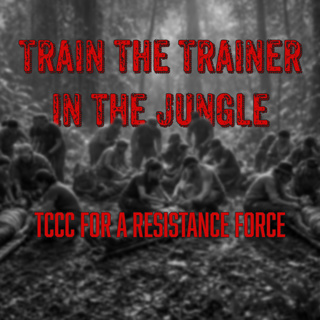
Ben walks Dennis through a six-month plan that became a jungle course for about 200 unpaid resistance volunteers. Vic built the curriculum from TCCC, the Ranger Medic Handbook, and what that force actually needed — then wrote it to their education level, culture, and organization. Supplies moved through the existing network. The first four days were not student training. They were instructor train-up. Then the locals taught. Interpreters shrank. Force multiplication went up. Chiefs owned the schedule because they knew the logistics better than the foreigners.


The five-day basic block — Ranger First Responder flavor, ~150 students, three languages — ran cleaner than the ten-day advanced course. Around day six, the instructors sat in a hut wondering if anyone could action the material. The FTX answered it: recovery mission, collect, treat, triage, evacuate. When words failed, Ben inserted himself into the lane. Watch me. Do as I do.

Then the punchline he brought home to NATO partners in four and a half days: stop making this more complicated than the environment allows. Basics save lives. Teaching is a hard skill and a soft skill. Ego gets you ignored — or worse. Likability moves supplies. Medics still have to influence commanders so casualties do not bog down the assault.

Listen, then steal the method. Not the ego.

⁠prolongedfieldcare.org⁠ | ⁠@prolonged_field_care⁠ | PFC Podcast

Top 5 takeaways:

  1. Build a local instructor cadre first. Four days of train-the-trainer, then hand the blocks to them. Less interpreter drag. Real force multiplication.
  2. Write the course to the force in front of you. TCCC + Ranger Medic Handbook as the spine. Education level, culture, and org constraints as the cut line. Chiefs own the schedule.
  3. Basics scale. Abstraction does not. The 5-day / 150-student / 3-language block worked because it was see-do-act. The 10-day advanced block created the “do they actually get this?” crisis.
  4. When comprehension is in doubt, stop talking and enter the lane. Insert yourself. Narrate while you do the work. Show shock. Do not lecture shock.
  5. Teaching is an act of love plus influence. Humble competence beats the alpha brief. Medics still owe commanders a clear recommendation — even if the answer is “we’re doing it anyway, figure it out.”

Chapters:

  • 00:00 Cold open + why this trip
  • 01:08 Six months of planning — you do not show up on a whim
  • 01:59 Vic Nigo’s curriculum: TCCC, Ranger Medic Handbook, culture, org
  • 02:51 Supply network for ~200 students
  • 03:20 Plan vs jungle reality
  • 04:01 Four-day instructor train-up and handing the class off
  • 04:56 Volunteers, buy-in, and a culture that does not like quitters
  • 06:24 Motivation that costs a patch and a thumbs-up
  • 07:29 Ukraine militia hunger vs professional-military spoiling
  • 08:26 Why train-the-trainer beats you plus an interpreter
  • 09:00 What actually broke: hours, land nav, competing requirements
  • 09:54 5-day basic / ~150 / 3 languages — the block that worked
  • 10:53 10-day advanced — day 6 doubt in the hut
  • 11:41 The FTX: recover, collect, treat, triage, evacuate
  • 12:30 Teaching tactic: insert yourself, watch me, do as I do
  • 13:14 Show them shock. Do not define it.
  • 14:13 SOCM lesson: you do not know the job until you see the job
  • 34:54 The course continues — Vic takes it deeper / SOCM Light
  • 35:37 The West overcomplicates TCCC
  • 36:10 Basics save lives
  • 37:11 NATO partners in 4.5 days: trenches, physical exam, pain, cheat cards
  • 39:17 Advice for the first overseas class
  • 40:06 Know the audience — products change with the culture
  • 40:39 Ego is a teaching failure and a survival failure
  • 41:24 All teaching is an act of love
  • 42:03 Likability as a core attribute
  • 43:09 The medic as SME: influence, battlefield clearance, buy-in
  • 44:56 Be ready for the unexpected — and try to enjoy it

Det här avsnittet är hämtat från ett öppet RSS-flöde och publiceras inte av Podme. Det kan innehålla reklam.

Avsnitt(630)

Pack to the Vessel: Hemorrhage Control Is Not a Mind-less Skill

Pack to the Vessel: Hemorrhage Control Is Not a Mind-less Skill

Mike Weisman — 25 years as a Navy Corpsman and SARC, 27 years on a busy Vegas fire department, now clinical education at Celox — does not sell magic dust. He sells a hydraulic problem.A femoral-rate b...

17 Sep 38min
296 - Mission Capable Pain Control: The TCCC Analgesia Update Explained

296 - Mission Capable Pain Control: The TCCC Analgesia Update Explained

OTFC is gone. That was not a small supply hiccup. It punched a hole in the old TCCC pain plan.George Barbee, a PA and co-author of TCCC Guideline Change 25-03, walks Dennis through why the committee r...

14 Sep 39min
SOMA 26' - Ultrasound-Augmented Triage A Proposal To Refine Field Decision Making In Tactical Combat Casualty Care

SOMA 26' - Ultrasound-Augmented Triage A Proposal To Refine Field Decision Making In Tactical Combat Casualty Care

Recorded live at SOMA 26In a near-peer MASCAL, one medic and one junior medic may face twenty penetrating torso casualties, one unit of blood, and no time to empirically needle or finger-decompress ev...

10 Sep 26min
295- Logistics For LSCO: Why SOF Med Supplies Fail When The War Changes

295- Logistics For LSCO: Why SOF Med Supplies Fail When The War Changes

Medical logistics was an afterthought for a lot of us in GWOT. You submitted a request, something showed up, and everyone joked that the warehouse never read the order. That model does not survive lar...

7 Sep 35min
SOMA 26' - Role 1.5: Fighting Tourniquet Syndrome at the Forefront

SOMA 26' - Role 1.5: Fighting Tourniquet Syndrome at the Forefront

Ukrainian orthopedic and reconstructive surgeon describes what prolonged field care actually looks like when evacuation from the front line to Role 2 takes three to four days, and sometimes longer. Af...

3 Sep 21min

294 - Do Antibiotics Really Reduce Mortality in Trauma? Wound Care First in Prolonged Field Care

294 - Do Antibiotics Really Reduce Mortality in Trauma? Wound Care First in Prolonged Field Care

Antibiotics are not magic. In this episode of the PFC Podcast, Dennis sits down with Ryan to cut through the common myth that “I’ve given antibiotics, so the wound is protected.” They unpack why vigor...

31 Aug 36min
SOMA 26' - Fresh Whole Blood is Not The Answer: It's Still a Question

SOMA 26' - Fresh Whole Blood is Not The Answer: It's Still a Question

Whole Blood Is Not a Solution (Until Conventional Forces Can Deliver It)Recorded live at SOMA 26Dr. Vanessa Hanick (emergency physician, former active-duty Army, now National Guard) and 1SG Cy Clayton...

27 Aug 28min

Populärt inom Utbildning

historiepodden-se
rss-bara-en-till-om-beroende-medberoende
det-skaver
nu-blir-det-historia
harrisons-dramatiska-historia
not-fanny-anymore
roda-vita-rosen
johannes-hansen-podcast
rss-viktmedicinpodden
allt-du-velat-veta
rikatillsammans-om-privatekonomi-rikedom-i-livet
sa-in-i-sjalen
rss-foraldramotet-bring-lagercrantz
rss-traningsklubben
rss-basta-livet
rss-max-tant-med-max-villman
sektledare
rss-autismandan
polisutbildningspodden
rss-sjalsligt-avkladd