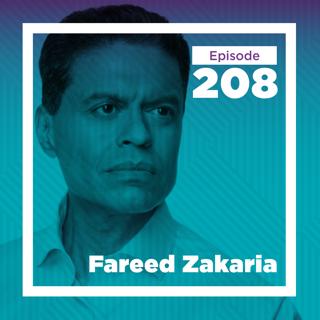
Fareed Zakaria on the Age of Revolutions, the Power of Ideas, and the Rewards of Intellectual Curiosity

Fareed Zakaria on the Age of Revolutions, the Power of Ideas, and the Rewards of Intellectual Curiosity

Those who know Fareed Zakaria through his weekly column or CNN show may be surprised to learn he considers books the important way he can put new ideas in the world. But Fareed's original aspiration was to be an academic, and it was a chance lunch with Walter Isaacson that convinced him to apply for a job as editor of Foreign Affairs instead of accepting an assistant professorship at Harvard. His latest book, Age of Revolutions: Progress and Backlash from 1600 to the Present is a testament to his enduring passion for ideas and his belief in the importance of classical liberalism in an age of increasing populism and authoritarianism.

Tyler sat down with Fareed to discuss what he learned from Khushwant Singh as a boy, what made his father lean towards socialism, why the Bengali intelligentsia is so left-wing, what's stuck with him from his time at an Anglican school, what's so special about visiting Amritsar, why he misses a more syncretic India, how his time at the Yale Political Union dissuaded him from politics, what he learned from Walter Isaacson and Sam Huntington, what put him off academia, how well some of his earlier writing as held up, why he's become focused on classical liberal values, whether he had reservations about becoming a TV journalist, how he's maintained a rich personal life, and more.

Read a full transcript enhanced with helpful links, or watch the full video.

Recorded March 8th, 2024.

Other ways to connect

Photo Credit: Jeremy P. Freeman, CNN

Avsnitt(275)

Luigi Zingales on Italy, Google and Conglomeration, and Donald Trump (Live at Mason)

Luigi Zingales on Italy, Google and Conglomeration, and Donald Trump (Live at Mason)

In the third event of this series, Tyler and Luigi Zingales discuss Italy, Donald Trump, Antonio Gramsci, Google and conglomeration, Luchino Visconti, Starbucks, and the surprisingly high productivity of Italian cafés. Read a full transcript enhanced with helpful links, or watch the full video. Other ways to connect Follow us on Twitter and Instagram Follow Tyler on Twitter Email us: cowenconvos@mercatus.gmu.edu Subscribe at our newsletter page to have the latest Conversations with Tyler news sent straight to your inbox.

16 Sep 20151h 16min

Jeffrey Sachs on Charter Cities and How to Reform Graduate Economics Education (Live at Mason)

Jeffrey Sachs on Charter Cities and How to Reform Graduate Economics Education (Live at Mason)

Tyler Cowen and Jeffrey Sachs discuss the resource curse, why Russia failed and Poland succeeded, charter cities, Sach's China optimism, JFK, Paul Rosenstein-Rodan, whether Africa will be able to overcome the middle income trap, Paul Krugman, Sach's favorite novel, premature deindustrialization, and how to reform graduate economics education. Read a full transcript enhanced with helpful links, or watch the full video. Other ways to connect Follow us on Twitter and Instagram Follow Tyler on Twitter Follow Jeff on Twitter Email us: cowenconvos@mercatus.gmu.edu Subscribe at our newsletter page to have the latest Conversations with Tyler news sent straight to your inbox.

31 Mars 20151h 32min

Peter Thiel on Stagnation, Innovation, and What Not to Call your Company (Live at Mason)

Peter Thiel on Stagnation, Innovation, and What Not to Call your Company (Live at Mason)

Peter Thiel and Tyler Cowen, both New York Times bestselling authors, are among today's top global thought leaders and influential innovators. Listen as these two engage in a serious dialogue on the ideas and policies that will shape the future of innovation and progress in the coming years and decades. Peter Thiel is among the most impressive innovators of the past two decades. As co-founder of Paypal and seed-funder for Facebook, Thiel has been instrumental in the conception and growth of some of today's most entrepreneurial and innovative companies. In his latest best-selling book, Zero to One, Thiel explains how to build a better future by capitalizing on innovation. A staunch optimist, he maintains that progress can be achieved anywhere the human mind is able to think creatively. Thiel describes how entrepreneurial thinking leads to innovation, which builds something new and moves the mark from zero to one. Note: Due to a technical malfunction, the audio quality briefly drops from 11:15 - 13:30. Read a full transcript enhanced with helpful links, or watch the full video. Other ways to connect Follow us on Twitter and Instagram Follow Tyler on Twitter Follow Peter on Twitter Email us: cowenconvos@mercatus.gmu.edu Subscribe at our newsletter page to have the latest Conversations with Tyler news sent straight to your inbox.

25 Mars 20151h 20min

Populärt inom Utbildning

rss-bara-en-till-om-missbruk-medberoende-2
historiepodden-se
det-skaver
alska-oss
johannes-hansen-podcast
nu-blir-det-historia
allt-du-velat-veta
harrisons-dramatiska-historia
sektledare
roda-vita-rosen
rss-makabert
rss-sjalsligt-avkladd
not-fanny-anymore
rikatillsammans-om-privatekonomi-rikedom-i-livet
rss-max-tant-med-max-villman
sa-in-i-sjalen
dumforklarat
rss-npf-podden
efterlevandepodden
vi-gar-till-historien