Episode 39 - General Buller defeats the Boers at Allemansnek and enters the Transvaal
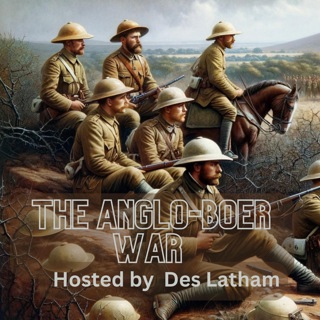
The Anglo-Boer War17 Juni 2018

Episode 39 - General Buller defeats the Boers at Allemansnek and enters the Transvaal

We’re up to episode 39, and we’re concentrating on the Natal front - or what was known as the Eastern Front. The Natal town of Ladysmith was relieved by General Sir Redvers Buller on 28 February 1900, following the battle of the Thukela Heights. Buller rode into the town on 1 March 1900 and if you’ll remember, made movie history by being the first general filmed entering a town to relieve a siege. On 19 May, Buller planned the next stage. The Boers had crossed the Drakensberg at Lang's Nek and those who could be persuaded to remain had established well concealed trenches on either side of the pass. Realizing this, Buller decided to create the impression that Lang's Nek was his target, rather than his true objective which was actually Botha's Pass named after the Boer Leader, Louis Botha. The 4th Brigade and the 1st West Surrey Regiment were ordered to form the advance guard. They marched to Ingogo or what the Boers called Schuinshoogte where they bivouacked for nine days. Their camp could be clearly observed as usual by the burghers from their positions at Lang's Nek. Lyttelton's division commenced clearing the Doornberg to the south-east near Landman's Drift, while general Hildyard reached Utrecht on 29 May. After a considerable amount of discussion, the landdrost or magistrate formally surrendered the town of Utrecht and the Boers retreated, taking up a position on the hills above in return for the assurance by the British that Utrecht would not be shelled if they remained there. The Transvaal flag and six rifles were taken away as a sign of submission and Buller's proclamation of surrender by the town was posted up on its notice boards. But Hildyard had hardly left Utrecht before the Boers returned, re-occupied the town, tore down the proclamation and arrested the landdrost who had surrendered. Despite the comical aspect of this incident, it proved once again how adept Buller's commanders were at wasting time. He had halted in Newcastle for no less than sixteen days and had failed to move further than Ingogo and Utrecht. Meanwhile Lyttelton moved his division northwards having cleared Christiaan Botha's force from the Doornberg, and advanced as Wakkerstroom in the eastern Traasvaal which he captured on 13 June. So at this stage that we shall leave Lyttelton and return to Buller and the remainder of the Natal Army. It may be recalled that during the vacillation following the relief of Ladysmith, Lord Roberts eventually gave up any hope of co-operation from Buller and informed him by telegram on 25 May that he could manage without him.

Avsnitt(143)

Episode 7 - General Buller splits his force

Episode 7 - General Buller splits his force

General Redvers Buller, the commander of British forces in South Africa, is in Cape Town having arrived in late October 1899 and walked off the ship and into a firestorm. His orders to General White in Natal had been ignored, White had allowed Colonel Penn Symons to move north of the Tugela river to Dundee where he’d been killed in action. Now General White himself was holed up in Ladysmith, surrounded by two large Boer Commandoes, the Free Staters under General Steyn and the Transvalers under General Joubert.

5 Nov 201717min

Episode 6 - "Mournful Monday" as the British suffer a major defeat

Episode 6 - "Mournful Monday" as the British suffer a major defeat

Sir Redvers Buller the commander in chief of British Forces in South Africa, sailed into the harbour on the Dunottar Castle on 31st October 1899, with his warhorses, polo sticks and a bicycle, and Winston Churchill the young war reporter in tow. He was to arrive as the British experienced a major defeat and the most men taken prisoner in a single battle since the Napoleonic Wars almost a century before.

29 Okt 201718min

Episode 5 - Retreat from Dundee and the siege of Mafeking and Kimberley

Episode 5 - Retreat from Dundee and the siege of Mafeking and Kimberley

In October 1899 the Boers have begun to invade Natal and are about to threaten Ladysmith. It’s only two weeks after the war began on 10th October and at first the British believed they’d won two small battles at Talana Hill overlooking Dundee and Elandslaagte station north of Ladysmith.

22 Okt 201718min

Episode 4 - Talana Hill & Elandslaagte

Episode 4 - Talana Hill & Elandslaagte

In this episode we’ll learn about the first battle of Dundee or what’s known as Talana Hill, and Elandslaagte a day later. Both appeared at first to be British victories .. but appearances can be deceptive.

15 Okt 201718min

Episode 3 - Troops on the move and its war

Episode 3 - Troops on the move and its war

This week we’ll hear about the start of the war in October 1899 and hear about the structure of both the British and Boer armies. We’ll also find out just how unprepared the British were for this conflict and learn a little about how mobile the Boers really were in this first war of the modern era.

8 Okt 201718min

Episode 2 - Negotiations Fail

Episode 2 - Negotiations Fail

In this episode we’ll learn about the attempts by Kruger and the Free State leadership to avoid war while continuing to deny English speakers the vote in the two Boer Republics, the Transvaal and Free State. At the same time, Sir Alfred Milner, the governor of the Cape, pushes for intervention. We’ll take a closer look at how the two sides shaped up and what happened at the Bloemfontein Convention and ultimately, the failure of talks.

30 Sep 201721min

Anglo Boer War Episode 1

Anglo Boer War Episode 1

The Anglo-Boer war which began in 1899 and ended in 1902 was the culmination of more than 250 years of Boer expansion into Africa and conflict with blacks as well as a century of conflict with the British Empire. Some of the most famous names of the 20th Century were involved including Mahatma Gandhi as a stretcher bearer and Winston Churchill as a war correspondent. It was a war that the British expected to wrap up in a few months but ended up costing tens of thousands of lives over three years. It started with lofty ideals and ended with the British throwing Boer women and children into concentration camps where they died in their hundreds.

24 Sep 201722min

Populärt inom Utbildning

rss-bara-en-till-om-missbruk-medberoende-2
historiepodden-se
det-skaver
nu-blir-det-historia
harrisons-dramatiska-historia
johannes-hansen-podcast
alska-oss
sektledare
allt-du-velat-veta
roda-vita-rosen
not-fanny-anymore
rss-sjalsligt-avkladd
sa-in-i-sjalen
vi-gar-till-historien
rss-npf-podden
rss-relationsrevolutionen
polisutbildningspodden
rss-max-tant-med-max-villman
rss-om-vi-ska-vara-arliga
psykologsnack