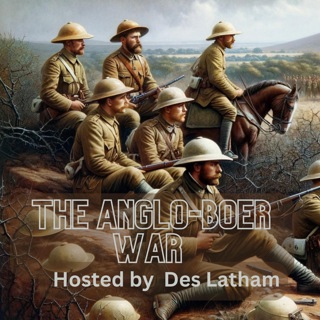
Episode 75 - Cowboys, Theodore Roosevelt & Americans in the Anglo-Boer War

Episode 75 - Cowboys, Theodore Roosevelt & Americans in the Anglo-Boer War

This week I'm focusing on America and Americans who fought in the war. What made Americans travel half way around the world to fight for both the Boers and the English? The initial answer is obvious - given the Boer’s attempts at forging independence from the British Empire, something the Americans had done one hundred and 30 years before. “I have been absorbed in interest in the Boer War,” wrote Theodore Roosevelt to his friend Cecil Spring Rice in 1899. “The Boers are belated Cromwellians, with many fine traits. They deeply and earnestly believe in their cause, and they attract the sympathy which always goes to the small nation. … But it would be for the advantage of mankind to have English spoken south of the Zambesi just as in New York; and as I told one of my fellow Knickerbockers the other day, as we let the Uhlanders of old in here, I do not see why the same rule is not good enough in the Transvaal.” He was not alone. Most Americans took a keen interest in this remote conflict, many espoused the same belief in what they earnestly believed was the British civilising influence in Southern Africa. Two years later later, though the former Senator and now president Roosevelt wrote: “I am not an Anglomaniac any more than I am an Anglophobe … but I am keenly alive to the friendly countenance England gave us in 1898. … I have been uncomfortable about the Boer War, and notably in reference to certain details of the way it was brought on; but I have far too lively a knowledge of our national shortcomings to wish to say anything publicly that would hamper or excite feeling against a friendly nation for which I have a hearty admiration and respect.” That contradiction was played out across the USA. Leading newspapers sent their correspondents to the front; the war was debated in Congress and discussed in Cabinet meetings; private organisations sprang up to help one side or the other; a surprising number of Americans actually made their way to South Africa and joined the fight; and toy stores stocked up on two new games, one called “Boer and Briton” and the other “The War in South Africa”. In addition, the United States sold the British tens of thousands of tons of preserved meat, hay, and oats as well as horses, mules and oxen. Boers and their friends in America tried to prevent such sales, and the Chicago branch of the American Transvaal League and the Boer Legislative Committee of Philadelphia lodged formal protests with Washington. Although publishing legend and businessman William Randolph Hearst thought Britain should win—because as he put it “civilization and progress demand it”—most American publishers and their newspapers were pro-Boer. For Example, the man who gave us the Pulitzer prize, Joseph Pulitzer’s New York World sided with the Boers and favoured American mediation. It even worked up a petition to the President urging this which was signed by 19 bishops and archbishops, 104 out of 442 members of Congress, 89 college presidents, 13 mayors of important cities, and many distinguished judges, editors, and businessmen.

Avsnitt(143)

Episode 7 - General Buller splits his force

Episode 7 - General Buller splits his force

General Redvers Buller, the commander of British forces in South Africa, is in Cape Town having arrived in late October 1899 and walked off the ship and into a firestorm. His orders to General White in Natal had been ignored, White had allowed Colonel Penn Symons to move north of the Tugela river to Dundee where he’d been killed in action. Now General White himself was holed up in Ladysmith, surrounded by two large Boer Commandoes, the Free Staters under General Steyn and the Transvalers under General Joubert.

5 Nov 201717min

Episode 6 - "Mournful Monday" as the British suffer a major defeat

Episode 6 - "Mournful Monday" as the British suffer a major defeat

Sir Redvers Buller the commander in chief of British Forces in South Africa, sailed into the harbour on the Dunottar Castle on 31st October 1899, with his warhorses, polo sticks and a bicycle, and Winston Churchill the young war reporter in tow. He was to arrive as the British experienced a major defeat and the most men taken prisoner in a single battle since the Napoleonic Wars almost a century before.

29 Okt 201718min

Episode 5 - Retreat from Dundee and the siege of Mafeking and Kimberley

Episode 5 - Retreat from Dundee and the siege of Mafeking and Kimberley

In October 1899 the Boers have begun to invade Natal and are about to threaten Ladysmith. It’s only two weeks after the war began on 10th October and at first the British believed they’d won two small battles at Talana Hill overlooking Dundee and Elandslaagte station north of Ladysmith.

22 Okt 201718min

Episode 4 - Talana Hill & Elandslaagte

Episode 4 - Talana Hill & Elandslaagte

In this episode we’ll learn about the first battle of Dundee or what’s known as Talana Hill, and Elandslaagte a day later. Both appeared at first to be British victories .. but appearances can be deceptive.

15 Okt 201718min

Episode 3 - Troops on the move and its war

Episode 3 - Troops on the move and its war

This week we’ll hear about the start of the war in October 1899 and hear about the structure of both the British and Boer armies. We’ll also find out just how unprepared the British were for this conflict and learn a little about how mobile the Boers really were in this first war of the modern era.

8 Okt 201718min

Episode 2 - Negotiations Fail

Episode 2 - Negotiations Fail

In this episode we’ll learn about the attempts by Kruger and the Free State leadership to avoid war while continuing to deny English speakers the vote in the two Boer Republics, the Transvaal and Free State. At the same time, Sir Alfred Milner, the governor of the Cape, pushes for intervention. We’ll take a closer look at how the two sides shaped up and what happened at the Bloemfontein Convention and ultimately, the failure of talks.

30 Sep 201721min

Anglo Boer War Episode 1

Anglo Boer War Episode 1

The Anglo-Boer war which began in 1899 and ended in 1902 was the culmination of more than 250 years of Boer expansion into Africa and conflict with blacks as well as a century of conflict with the British Empire. Some of the most famous names of the 20th Century were involved including Mahatma Gandhi as a stretcher bearer and Winston Churchill as a war correspondent. It was a war that the British expected to wrap up in a few months but ended up costing tens of thousands of lives over three years. It started with lofty ideals and ended with the British throwing Boer women and children into concentration camps where they died in their hundreds.

24 Sep 201722min

Populärt inom Utbildning

rss-bara-en-till-om-missbruk-medberoende-2
historiepodden-se
det-skaver
alska-oss
nu-blir-det-historia
johannes-hansen-podcast
sektledare
allt-du-velat-veta
roda-vita-rosen
harrisons-dramatiska-historia
not-fanny-anymore
rss-sjalsligt-avkladd
sa-in-i-sjalen
polisutbildningspodden
vi-gar-till-historien
rss-npf-podden
rss-relationsrevolutionen
rss-basta-livet
psykologsnack
rss-max-tant-med-max-villman