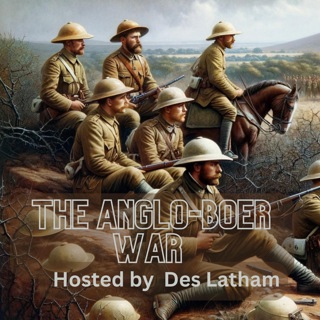
Episode 99 - A Devil's Gorge, an executed priest, and the madness of Breaker Morant

Episode 99 - A Devil's Gorge, an executed priest, and the madness of Breaker Morant

It’s early August 1901 and a series of events in a far off corner of the war would end up resonating internationally for the next one hundred and 18 years. These involved the Bushveld Carbineers, the unit of irregular troops from Australia that was eventually disbanded. I covered part of this story in an earlier podcast, Episode 72. Because most of these events happened in August 1901, and that's where we are in our podcast series, we must reconsider the story of Breaker Morant. The events that led to the Morant and his partner in crime, Lieutenant Handcock, are still clouded in controversy. Very few stories resonate so continuously as this. We need to take a closer look once more. By February 1901 a 320-man regiment had been formed by Australian colonel Robert Lenehan which was based in Pietersburg 180 miles north of Pretoria. It was called the Bushveld Carbineers As I’ve described, the northern Transvaal area where they were based is largely lowveld, extremely hot and dry, dusty in summer, warmer than the high veld where Pretoria is based. There’s a slow descent from Pretoria to the low veld town of Pietersburg which is known as Polokwane today. It was also a slow descent into the madness of war for the Bushveld Carbineers and their officers as we will hear. By the summer of 1901, rumours had reached the Officer Commanding at Pietersburg "of poor discipline, unconfirmed murders, drunkenness, and general lawlessness in the Spelonken.” That was the name of the region - Spelonken which itself has a discordant feel. Spelonken means caves in Dutch. The main example of indiscipline was rape. A local woman had accused British Army Officer James Robertson, the officer commanding of the Bushveldt Carbineers A Squadron of sexual assault. In response, Robertson was recalled to HQ and given an ultimatum. Court Martial, or resign his commission. He submitted his resignation and quit the British Army. Modern organisational planning includes what’s known as the culture of organisations. And alas, the culture of the the Bushveld Carbineers was steeped in abuse. Former Kitchener Fighting Scout Lieutenant Percy Frederick Hunt was ordered to the northern Transvaal and given command of the Bushveld Carbineers B Squadron. Before leaving Pietersburg in July 1901, the newly promoted Captain Hunt asked for a number of officers to be transferred with him to his new field of command. These officers were Lieutenant’s Morant, Charles Hannam and Harry Picton. An emblematic moment as we'll see. The Bushveld Carbineers were building a name for themselves in this region and it wasn't positive. With Hunt officer commanding the detachment at Fort Edward in Spelonken, both lieutenant Morant and Handcock began to reimpose discipline which had been lacking. They would take the concept of retribution far beyond what is acceptable in war.

Avsnitt(143)

Episode 7 - General Buller splits his force

Episode 7 - General Buller splits his force

General Redvers Buller, the commander of British forces in South Africa, is in Cape Town having arrived in late October 1899 and walked off the ship and into a firestorm. His orders to General White in Natal had been ignored, White had allowed Colonel Penn Symons to move north of the Tugela river to Dundee where he’d been killed in action. Now General White himself was holed up in Ladysmith, surrounded by two large Boer Commandoes, the Free Staters under General Steyn and the Transvalers under General Joubert.

5 Nov 201717min

Episode 6 - "Mournful Monday" as the British suffer a major defeat

Episode 6 - "Mournful Monday" as the British suffer a major defeat

Sir Redvers Buller the commander in chief of British Forces in South Africa, sailed into the harbour on the Dunottar Castle on 31st October 1899, with his warhorses, polo sticks and a bicycle, and Winston Churchill the young war reporter in tow. He was to arrive as the British experienced a major defeat and the most men taken prisoner in a single battle since the Napoleonic Wars almost a century before.

29 Okt 201718min

Episode 5 - Retreat from Dundee and the siege of Mafeking and Kimberley

Episode 5 - Retreat from Dundee and the siege of Mafeking and Kimberley

In October 1899 the Boers have begun to invade Natal and are about to threaten Ladysmith. It’s only two weeks after the war began on 10th October and at first the British believed they’d won two small battles at Talana Hill overlooking Dundee and Elandslaagte station north of Ladysmith.

22 Okt 201718min

Episode 4 - Talana Hill & Elandslaagte

Episode 4 - Talana Hill & Elandslaagte

In this episode we’ll learn about the first battle of Dundee or what’s known as Talana Hill, and Elandslaagte a day later. Both appeared at first to be British victories .. but appearances can be deceptive.

15 Okt 201718min

Episode 3 - Troops on the move and its war

Episode 3 - Troops on the move and its war

This week we’ll hear about the start of the war in October 1899 and hear about the structure of both the British and Boer armies. We’ll also find out just how unprepared the British were for this conflict and learn a little about how mobile the Boers really were in this first war of the modern era.

8 Okt 201718min

Episode 2 - Negotiations Fail

Episode 2 - Negotiations Fail

In this episode we’ll learn about the attempts by Kruger and the Free State leadership to avoid war while continuing to deny English speakers the vote in the two Boer Republics, the Transvaal and Free State. At the same time, Sir Alfred Milner, the governor of the Cape, pushes for intervention. We’ll take a closer look at how the two sides shaped up and what happened at the Bloemfontein Convention and ultimately, the failure of talks.

30 Sep 201721min

Anglo Boer War Episode 1

Anglo Boer War Episode 1

The Anglo-Boer war which began in 1899 and ended in 1902 was the culmination of more than 250 years of Boer expansion into Africa and conflict with blacks as well as a century of conflict with the British Empire. Some of the most famous names of the 20th Century were involved including Mahatma Gandhi as a stretcher bearer and Winston Churchill as a war correspondent. It was a war that the British expected to wrap up in a few months but ended up costing tens of thousands of lives over three years. It started with lofty ideals and ended with the British throwing Boer women and children into concentration camps where they died in their hundreds.

24 Sep 201722min

Populärt inom Utbildning

rss-bara-en-till-om-missbruk-medberoende-2
historiepodden-se
det-skaver
nu-blir-det-historia
harrisons-dramatiska-historia
johannes-hansen-podcast
alska-oss
sektledare
allt-du-velat-veta
roda-vita-rosen
not-fanny-anymore
rss-sjalsligt-avkladd
sa-in-i-sjalen
vi-gar-till-historien
rss-npf-podden
rss-relationsrevolutionen
polisutbildningspodden
rss-max-tant-med-max-villman
rss-om-vi-ska-vara-arliga
psykologsnack