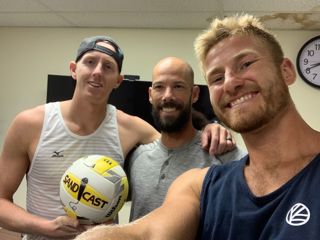
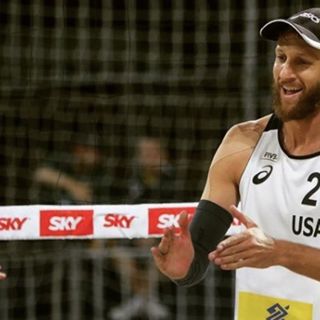
Reid Priddy is going for "double-black belt status"

Reid Priddy is going for "double-black belt status"

Two years ago, maybe it would have worked. Maybe, when Miles Evans put a ball away, looked directly at Reid Priddy and Trevor Crabb, flexed and yelled with everything he had, “C’mon!” it would have done the trick. Thrown Priddy off.

It had worked two years ago, from the guy who was now on the same side of the net as him. Crabb, in the semifinals of the Manhattan Beach Open, had famously run his mouth. It did a number on Priddy, then, though he couldn’t fully understand why. He didn’t understand where all that talk was coming from.

Hadn’t all their previous interactions been cordial? Polite? Even friendly? Priddy didn’t know, at the time, that was just what Crabb does on the court. He talks trash. Doesn’t matter if you’re out of the qualifier or out of four quads with the indoor national team: You’re going to hear him.

Afterwards, Priddy broke it down.

“‘Why was I so mad?’” he wondered.

“And it was ‘Well, he showed you disrespect,’” Priddy recalled on SANDCAST: Beach Volleyball with Tri Bourne and Travis Mewhirter. “But why should I have the expectation that somebody should respect me? So it was almost really great because I let go of that expectation at all, even if I subconsciously had it. It was probably that moment, that interchange, that I let it all go.”

So when Evans buried the ball to close out the first set, and piled a little talk on top of it, Priddy didn’t mind. He’d been there before. He’d learned from it. And then he gave it right back.

“From that moment on,” Priddy said, “it was just ‘All right, now we’re in it. Let’s battle.’”

Let’s battle. If there are two words that could accurately summarize the mindset of William Reid Priddy for these past 41 years, those may be the ones to do it. He’s a self-proclaimed underdog story, but unlike a number of athletes who like to push that sometimes-false narrative, his is rather genuine. Raised on a steady diet of soccer, Priddy is the son of Ken and Sharon Priddy, who thought it was funny that, after 11 years of soccer, Priddy was going to try volleyball.

“They were like, ‘All right, we’ll just come watch. We have nothing to offer,’” Priddy said. He was athletic enough to help Mountain Pointe High in Phoenix, Arizona, to the school’s first state title, in 1995. Still, the sport was so new to the state, in just its second year as a varsity sport, that Priddy was no blue-chip prospect or can’t-miss recruit. He was still the blue-collar kid who had played mostly soccer his entire life.

It was enough, however, for LMU to offer him a spot on a team that recruited seven outside hitters and hadn’t yet developed a single All-American.

In 2000, Priddy would become that All-American. Years later, after the program was shuttered, he’d become the first volleyball player to enter the LMU Hall of Fame.

That was, in the grand scheme of his career, the easy part. At 6-foot-4, even by the standards of the early 2000s, he was undersized for an outside. Now he was set not to compete against of diamonds in the rough at LMU, but against the best in the country for a spot on the national team. It is that exact environment, though, where the kid who wasn’t the biggest, the one relegated to the “sandlot teams” growing up, the one who only got in fights with bullies because he just couldn’t see the bigger kids picking on the smaller ones, thrives.

He didn’t spurn the odds but embraced them, clutched them to his chest.

“Nobody ever looked at me and was like ‘That guy’s going to be great.’ I was never the blue-chip guy,” Priddy said. “Now I purposefully channel that. A lot of us, we could have these mental lapses of confidence, ‘Oh man, can I do this?’ Once I learned to channel the competitiveness, how I felt about myself was no longer relevant, because a job had to be done, I gotta put this ball away.”

Oh, he would put balls away, all right. For 16 years, he’d represent the United States. He’d play in four Olympics, win a gold and a bronze. His tenure with Zenit-Kazan would be so wildly successful, in fact, that it almost felt weird, how expected it was to win.

“That was a strange feeling,” he said. It went against everything his underdog upraising had fostered.

If the expectation was to win then where did the satisfaction come from? It seemed, at times, that there was no real reward: Win and it’s what you were supposed to do; lose and what just happened?

He’s not a fan of expectations, Priddy. Steals not only a lot of the joy of playing this game but from the purpose of it all.

“I have tremendous self-belief but I don’t like expectations,” he said. “In my best years in indoor, my mental routine was do whatever I wanted to do. We could play cards on the bus and we’d be betting but there was always a moment in the locker room where it was ‘Ok, now it’s go time.’

“The shift that took place when my generation came in and with all of our coaches, it was very focused. We’re here, so let’s be here. All in. I really love that stuff.”

But expectations, from the outside, anyway, are inevitable when one has had the success Priddy has enjoyed.

Unless, of course, you switch sports. Change settings. Do something totally radical that nobody could have ever expected him to really make the Tokyo Olympics on a different surface, right?

That, in a way, is what happened when, in 2017, Priddy took to the beach.

Hacking the beach. That’s what Priddy called his strategy to transfer his indoor skillset to the beach. He gently kicks himself for the name now. He never meant it to imply there were shortcuts to success in the beach game, but optimizations.

How could he make those proverbial 10,000 hours as efficient and effective as possible, so as to rapidly expedite the improvement of his skillset to the point that Tokyo 2020 really wasn’t out of the question?

He brought an entirely new developmental strategy to the beach. He had statisticians at practice, charting serves, both location and speed. He had trainers. He had coaches ranging from Marcio Sicoli to Rich Lambourne. He fostered a community in Huntington Beach, where the training was no longer separate, just a bunch of teams meeting and winging it, to a full-on program of hundreds of reps in a compact, 90-minute training session, where teams weren’t pitted against one another, but worked alongside one another.

“There’s no shortcuts to skill acquisition,” he said. Which is how, after two years of reps reps reps reps reps, he found himself down one set to none to Evans and Doherty at the Manhattan Beach Open. A loss would leave him and Crabb in ninth. But this wasn’t the Priddy Evans would have faced two years prior. This was a different Priddy, one who had grown in abundance from the previous edition.

“I have no expectation of how people should treat me, how they should interact with me,” he said. “I don’t feel 41 in my brain, I don’t feel like a gold medalist. I don’t go into matches thinking ‘Oh, I’m a gold medalist.’ I’m super aware of my deficiencies.”

Which is why he’s able to shore them up so quickly. And with each match, those deficiencies became harder and harder to find. They came back to beat Evans and Doherty, 15-13 in the third set. Then they knocked out Tim Bomgren and Troy Field, Phil Dalhausser and Nick Lucena, and, in the finals, Chase Budinger and Casey Patterson.

In winning the Manhattan Beach Open, Priddy hadn’t hacked the beach. He had simply out-worked a lot of people on it. No learning opportunities went to waste, something he refers to as “double-black belt status.”

“When I think about volleyball, and anything, I like to channel martial arts,” he said. “The sensei did not get there thinking ‘I’m 21-0.’ Martial artists, it’s about proficiency. It’s about competence. The way I like to look at it is: ‘Here’s my end goal. This is what I think is possible for me as a player or us as a team. What are the behaviors to display, what are the feathers I need in my cap to be that player?’

“And then you work towards that. It’s kind of like a street fight. Now you’re in Manhattan, you’re playing in a match, you are who you are. It’s not like being 1-0 or 0-1 has somehow changed your proficiency, so it’s always about trying to level up to the next level. That comes not from wins and losses, you can learn from both, but it comes from ‘How good can you guys get as a team?’ That’s what’s important. It’s hard to do that when it’s your profession. I want to get to that double-black belt status.”

Not that Jose Loiola would ever let him think he has that. No, the coach of Priddy and Crabb during Manhattan Beach had them back on the sand two days later. He wasn’t full of congratulations. He didn’t take it easy.

“Nobody cares,” he told them.

Priddy loved it.

“The ultimate is when you can win but you treat wins as losses,” he said. “When you can take just as much from a win as from a loss, to me, that’s double black-belt, like legendary status. I think that’s the goal for all of us. How can we not let all of the little things go just because we won? Once that little euphoria dies down and we think we’re on top of the world, how can we look back and say ‘I could have done this better.’”


Hosted by Simplecast, an AdsWizz company. See pcm.adswizz.com for information about our collection and use of personal data for advertising.

Avsnitt(517)

Breaking down the Fort Lauderdale Major with Theo Brunner

Breaking down the Fort Lauderdale Major with Theo Brunner

Fifth place? Had you told Theo Brunner, prior to the Fort Lauderdale Major this past weekend, that he’d take fifth place, in a field featuring every top beach volleyball team in the world, after being...

5 Mars 20181h 5min
One and done volleyball with Sam Schachter and Sam Pedlow

One and done volleyball with Sam Schachter and Sam Pedlow

April is when the full-time volleyball begins. But the real battle annually begins in late January and early February, when Canadians Sam Schachter and Sam Pedlow stop by Hermosa Beach for a few weeks...

28 Feb 201842min
Can p1440 change the landscape of beach volleyball?

Can p1440 change the landscape of beach volleyball?

It’s not a tour. That’s the first thing that Dave Mays, this week’s guest on SANDCAST: Beach Volleyball with Tri Bourne and Travis Mewhirter, wants you to know about p1440, of which he is a founding p...

21 Feb 20181h 4min
From Australia with gold, with Avery Drost and Amanda Dowdy

From Australia with gold, with Avery Drost and Amanda Dowdy

Contrary to popular belief, the first gold medal of the winter was not, in fact, won by 17-year-old snowboarder Red Gerard, who snatched the slopestyle gold medal in the 2018 Olympic Games from Canadi...

14 Feb 201856min
At age 36, Brittany Hochevar is only just arriving

At age 36, Brittany Hochevar is only just arriving

Forget daggers. The look that Brittany Hochevar gave on SANDCAST: Beach Volleyball with Tri Bourne and Travis Mewhirter could bore a hole straight through a human soul. The discussion had turned to pa...

7 Feb 201859min
Sara Hughes: Beach volleyball's next top role model, part 2

Sara Hughes: Beach volleyball's next top role model, part 2

Perhaps you needed proof. Proof that Sara Hughes is, indeed, the one to fit the headline of this very podcast: That she is fit to become the next face of beach volleyball. Had you stopped by Huntingto...

31 Jan 201843min
Sara Hughes: Beach volleyball's next top role model, part 1

Sara Hughes: Beach volleyball's next top role model, part 1

On one of the walls in Sara Hughes’ bedroom is a poster of Misty May-Treanor. It’s been there since she was little, when Hughes began getting into volleyball, serving as a reminder of what she might b...

24 Jan 201840min
BONUS: Bourne is (almost) back on the beach, with Murphy Troy

BONUS: Bourne is (almost) back on the beach, with Murphy Troy

In this episode of SANDCAST: Beach Volleyball with Tri Bourne and Travis Mewhirter, we discuss SANDCAST host Tri Bourne's current health situation as he continues to wait patiently for the doctors to ...

22 Jan 201829min

Populärt inom Politik & nyheter

svenska-fall
p3-krim
rss-krimstad
fordomspodden
aftonbladet-krim
spar
flashback-forever
rss-sanning-konsekvens
aftonbladet-daily
rss-vad-fan-hande
motiv
rss-krimreportrarna
politiken
rss-klubbland-en-podd-mest-om-frolunda
rss-frandfors-horna
rss-aftonbladet-krim
krimmagasinet
dagens-eko
rss-flodet
blenda-2