#10 - Nick Beckstead on how to spend billions of dollars preventing human extinction

#10 - Nick Beckstead on how to spend billions of dollars preventing human extinction

What if you were in a position to give away billions of dollars to improve the world? What would you do with it? This is the problem facing Program Officers at the Open Philanthropy Project - people like Dr Nick Beckstead.

Following a PhD in philosophy, Nick works to figure out where money can do the most good. He’s been involved in major grants in a wide range of areas, including ending factory farming through technological innovation, safeguarding the world from advances in biotechnology and artificial intelligence, and spreading rational compassion.

Full transcript, coaching application form, overview of the conversation, and links to resources discussed in the episode:

This episode is a tour through some of the toughest questions ‘effective altruists’ face when figuring out how to best improve the world, including:

* * Should we mostly try to help people currently alive, or future generations? Nick studied this question for years in his PhD thesis, On the Overwhelming Importance of Shaping the Far Future. (The first 31 minutes is a snappier version of my conversation with Toby Ord.)
* Is clean meat (aka *in vitro* meat) technologically feasible any time soon, or should we be looking for plant-based alternatives?
* What are the greatest risks to human civilisation?
* To stop malaria is it more cost-effective to use technology to eliminate mosquitos than to distribute bed nets?
* Should people who want to improve the future work for changes that will be very useful in a specific scenario, or just generally try to improve how well humanity makes decisions?
* What specific jobs should our listeners take in order for Nick to be able to spend more money in useful ways to improve the world?
* Should we expect the future to be better if the economy grows more quickly - or more slowly?

Get free, one-on-one career advice

We’ve helped dozens of people compare between their options, get introductions, and jobs important for the the long-run future. If you want to work on any of the problems discussed in this episode, find out if our coaching can help you.

Avsnitt(326)

#36 - Tanya Singh on ending the operations management bottleneck in effective altruism

#36 - Tanya Singh on ending the operations management bottleneck in effective altruism

Almost nobody is able to do groundbreaking physics research themselves, and by the time his brilliance was appreciated, Einstein was hardly limited by funding. But what if you could find a way to unlo...

11 Juli 20182h 4min
#35 - Tara Mac Aulay on the audacity to fix the world without asking permission

#35 - Tara Mac Aulay on the audacity to fix the world without asking permission

"You don't need permission. You don't need to be allowed to do something that's not in your job description. If you think that it's gonna make your company or your organization more successful and mor...

21 Juni 20181h 22min
Rob Wiblin on the art/science of a high impact career

Rob Wiblin on the art/science of a high impact career

Today's episode is a cross-post of an interview I did with The Jolly Swagmen Podcast which came out this week. I recommend regular listeners skip to 24 minutes in to avoid hearing things they already ...

8 Juni 20181h 31min
#34 - We use the worst voting system that exists. Here's how Aaron Hamlin is going to fix it.

#34 - We use the worst voting system that exists. Here's how Aaron Hamlin is going to fix it.

In 1991 Edwin Edwards won the Louisiana gubernatorial election. In 2001, he was found guilty of racketeering and received a 10 year invitation to Federal prison. The strange thing about that election?...

1 Juni 20182h 18min
#33 - Anders Sandberg on what if we ended ageing, solar flares & the annual risk of nuclear war

#33 - Anders Sandberg on what if we ended ageing, solar flares & the annual risk of nuclear war

Joseph Stalin had a life-extension program dedicated to making himself immortal. What if he had succeeded?  According to our last guest, Bryan Caplan, there’s an 80% chance that Stalin would still be ...

29 Maj 20181h 24min
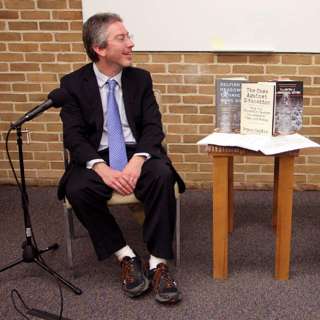
#32 - Bryan Caplan on whether his Case Against Education holds up, totalitarianism, & open borders

#32 - Bryan Caplan on whether his Case Against Education holds up, totalitarianism, & open borders

Bryan Caplan’s claim in *The Case Against Education* is striking: education doesn’t teach people much, we use little of what we learn, and college is mostly about trying to seem smarter than other peo...

22 Maj 20182h 25min
#31 - Allan Dafoe on defusing the political & economic risks posed by existing AI capabilities

#31 - Allan Dafoe on defusing the political & economic risks posed by existing AI capabilities

The debate around the impacts of artificial intelligence often centres on ‘superintelligence’ - a general intellect that is much smarter than the best humans, in practically every field. But according...

18 Maj 201848min
#30 - Eva Vivalt on how little social science findings generalize from one study to another

#30 - Eva Vivalt on how little social science findings generalize from one study to another

If we have a study on the impact of a social program in a particular place and time, how confident can we be that we’ll get a similar result if we study the same program again somewhere else? Dr Eva V...

15 Maj 20182h 1min

Populärt inom Utbildning

historiepodden-se
rss-bara-en-till-om-missbruk-medberoende-2
det-skaver
harrisons-dramatiska-historia
nu-blir-det-historia
roda-vita-rosen
not-fanny-anymore
alska-oss
johannes-hansen-podcast
sektledare
sa-in-i-sjalen
rss-max-tant-med-max-villman
allt-du-velat-veta
rss-viktmedicinpodden
rikatillsammans-om-privatekonomi-rikedom-i-livet
rss-foraldramotet-bring-lagercrantz
i-vantan-pa-katastrofen
rss-sjalsligt-avkladd
rss-basta-livet
sex-pa-riktigt-med-marika-smith