#38 - Yew-Kwang Ng on anticipating effective altruism decades ago & how to make a much happier world

#38 - Yew-Kwang Ng on anticipating effective altruism decades ago & how to make a much happier world

Will people who think carefully about how to maximize welfare eventually converge on the same views?

The effective altruism community has spent a lot of time over the past 10 years debating how best to increase happiness and reduce suffering, and gradually narrowed in on the world’s poorest people, all animals capable of suffering, and future generations.

Yew-Kwang Ng, Professor of Economics at Nanyang Technological University in Singapore, was independently working on this exact question since the 70s. Many of his conclusions have ended up foreshadowing what is now conventional wisdom within effective altruism - though other views he holds remain controversial or little-known.

For instance, he thinks we ought to explore increasing pleasure via direct brain stimulation, and that genetic engineering may be an important tool for increasing happiness in the future.

His work has suggested that the welfare of most wild animals is on balance negative and he thinks that in the future this is a problem humanity might work to solve. Yet he thinks that greatly improved conditions for farm animals could eventually justify eating meat.

He has spent most of his life advocating for the view that happiness, broadly construed, is the only intrinsically valuable thing.

If it’s true that careful researchers will converge as Prof Ng believes, these ideas may prove as prescient as his other, now widely accepted, opinions.

Link to our summary and appreciation of Kwang’s top publications and insights throughout a lifetime of research.

Kwang has led an exceptional life. While in high school he was drawn to physics, mathematics, and philosophy, yet he chose to study economics because of his dream: to establish communism in an independent Malaya.

But events in the Soviet Union and China, in addition to his burgeoning knowledge and academic appreciation of economics, would change his views about the practicability of communism. He would soon complete his journey from young revolutionary to academic economist, and eventually become a columnist writing in support of Deng Xiaoping’s Chinese economic reforms in the 80s.

He got his PhD at Sydney University in 1971, and has since published over 250 refereed papers - covering economics, biology, politics, mathematics, philosophy, psychology, and sociology.

He's most well-known for his work in welfare economics, and proposed ‘welfare biology’ as a new field of study. In 2007, he was made a Distinguished Fellow of the Economic Society of Australia, the highest award that the society bestows.

Links to learn more, summary and full transcript.

In this episode we discuss how he developed some of his most unusual ideas and his fascinating life story, including:

* Why Kwang believes that *’Happiness Is Absolute, Universal, Ultimate, Unidimensional, Cardinally Measurable and Interpersonally Comparable’*
* What are the most pressing questions in economics?
* Did Kwang have to worry about censorship from the Chinese government when promoting market economics, or concern for animal welfare?
* Welfare economics and where Kwang thinks it went wrong

Get this episode by subscribing to our podcast on the world’s most pressing problems and how to solve them: search for '80,000 Hours' in your podcasting app.

The 80,000 Hours Podcast is produced by Keiran Harris.

Avsnitt(324)

#145 Classic episode – Christopher Brown on why slavery abolition wasn't inevitable

#145 Classic episode – Christopher Brown on why slavery abolition wasn't inevitable

In many ways, humanity seems to have become more humane and inclusive over time. While there’s still a lot of progress to be made, campaigns to give people of different genders, races, sexualities, et...

20 Jan 2h 56min
#233 – James Smith on how to prevent a mirror life catastrophe

#233 – James Smith on how to prevent a mirror life catastrophe

When James Smith first heard about mirror bacteria, he was sceptical. But within two weeks, he’d dropped everything to work on it full time, considering it the worst biothreat that he’d seen described...

13 Jan 2h 9min
#144 Classic episode – Athena Aktipis on why cancer is a fundamental universal phenomena

#144 Classic episode – Athena Aktipis on why cancer is a fundamental universal phenomena

What’s the opposite of cancer? If you answered “cure,” “antidote,” or “antivenom” — you’ve obviously been reading the antonym section at www.merriam-webster.com/thesaurus/cancer.But today’s guest Athe...

9 Jan 3h 30min
#142 Classic episode – John McWhorter on why the optimal number of languages might be one, and other provocative claims about language

#142 Classic episode – John McWhorter on why the optimal number of languages might be one, and other provocative claims about language

John McWhorter is a linguistics professor at Columbia University specialising in research on creole languages. He's also a content-producing machine, never afraid to give his frank opinion on anything...

6 Jan 1h 35min
2025 Highlight-o-thon: Oops! All Bests

2025 Highlight-o-thon: Oops! All Bests

It’s that magical time of year once again — highlightapalooza! Stick around for one top bit from each episode we recorded this year, including:Kyle Fish explaining how Anthropic’s AI Claude descends i...

29 Dec 20251h 40min
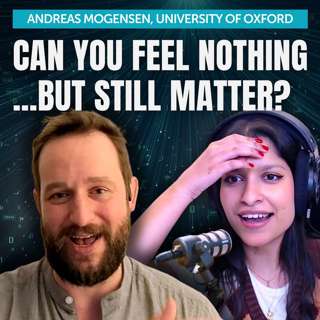
#232 – Andreas Mogensen on what we owe 'philosophical Vulcans' and unconscious beings

#232 – Andreas Mogensen on what we owe 'philosophical Vulcans' and unconscious beings

Most debates about the moral status of AI systems circle the same question: is there something that it feels like to be them? But what if that’s the wrong question to ask? Andreas Mogensen — a senior ...

19 Dec 20252h 37min

#231 – Paul Scharre on how AI-controlled robots will and won't change war

#231 – Paul Scharre on how AI-controlled robots will and won't change war

In 1983, Stanislav Petrov, a Soviet lieutenant colonel, sat in a bunker watching a red screen flash “MISSILE LAUNCH.” Protocol demanded he report it to superiors, which would very likely trigger a ret...

17 Dec 20252h 45min

AI might let a few people control everything — permanently (article by Rose Hadshar)

AI might let a few people control everything — permanently (article by Rose Hadshar)

Power is already concentrated today: over 800 million people live on less than $3 a day, the three richest men in the world are worth over $1 trillion, and almost six billion people live in countries ...

12 Dec 20251h

Populärt inom Utbildning

historiepodden-se
rss-bara-en-till-om-missbruk-medberoende-2
det-skaver
alska-oss
harrisons-dramatiska-historia
nu-blir-det-historia
rss-viktmedicinpodden
sektledare
johannes-hansen-podcast
not-fanny-anymore
allt-du-velat-veta
rss-sjalsligt-avkladd
roda-vita-rosen
i-vantan-pa-katastrofen
rss-max-tant-med-max-villman
sa-in-i-sjalen
rss-om-vi-ska-vara-arliga
rikatillsammans-om-privatekonomi-rikedom-i-livet
polisutbildningspodden
rss-basta-livet