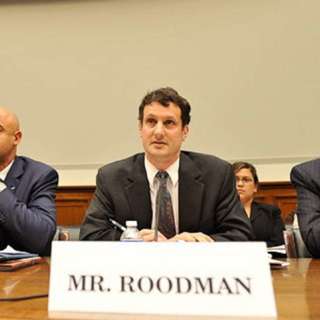

#41 - David Roodman on incarceration, geomagnetic storms, & becoming a world-class researcher

#41 - David Roodman on incarceration, geomagnetic storms, & becoming a world-class researcher

With 698 inmates per 100,000 citizens, the U.S. is by far the leader among large wealthy nations in incarceration. But what effect does imprisonment actually have on crime?

According to David Roodman, Senior Advisor to the Open Philanthropy Project, the marginal effect is zero.

* 80,000 HOURS IMPACT SURVEY - Let me know how this show has helped you with your career.
* ROB'S AUDIOBOOK RECOMMENDATIONS

This stunning rebuke to the American criminal justice system comes from the man Holden Karnofsky’s called "the gold standard for in-depth quantitative research", whose other investigations include the risk of geomagnetic storms, whether deworming improves health and test scores, and the development impacts of microfinance.

Links to learn more, summary and full transcript.

The effects of crime can be split into three categories; before, during, and after.

Does having tougher sentences deter people from committing crime?

After reviewing studies on gun laws and ‘three strikes’ in California, David concluded that the effect of deterrence is zero.

Does imprisoning more people reduce crime by incapacitating potential offenders?

Here he says yes, noting that crimes like motor vehicle theft have gone up in a way that seems pretty clearly connected with recent Californian criminal justice reforms (though the effect on violent crime is far lower).

Finally, do the after-effects of prison make you more or less likely to commit future crimes?

This one is more complicated.

Concerned that he was biased towards a comfortable position against incarceration, David did a cost-benefit analysis using both his favored reading of the evidence and the devil's advocate view; that there is deterrence and that the after-effects are beneficial.

For the devil’s advocate position David used the highest assessment of the harm caused by crime, which suggests a year of prison prevents about $92,000 in crime. But weighed against a lost year of liberty, valued at $50,000, plus the cost of operating prisons, the numbers came out exactly the same.

So even using the least-favorable cost-benefit valuation of the least favorable reading of the evidence -- it just breaks even.

The argument for incarceration melts further when you consider the significant crime that occurs within prisons, de-emphasised because of a lack of data and a perceived lack of compassion for inmates.

In today’s episode we discuss how to conduct such impactful research, and how to proceed having reached strong conclusions.

We also cover:

* How do you become a world class researcher? What kinds of character traits are important?
* Are academics aware of following perverse incentives?
* What’s involved in data replication? How often do papers replicate?
* The politics of large orgs vs. small orgs
* Geomagnetic storms as a potential cause area
* How much does David rely on interviews with experts?
* The effects of deworming on child health and test scores
* Should we have more ‘data vigilantes’?
* What are David’s critiques of effective altruism?
* What are the pros and cons of starting your career in the think tank world?

Get this episode by subscribing to our podcast on the world’s most pressing problems and how to solve them: type 80,000 Hours into your podcasting app. Or read the transcript below.

The 80,000 Hours Podcast is produced by Keiran Harris.

Avsnitt(327)

#115 – David Wallace on the many-worlds theory of quantum mechanics and its implications

#115 – David Wallace on the many-worlds theory of quantum mechanics and its implications

Quantum mechanics — our best theory of atoms, molecules, and the subatomic particles that make them up — underpins most of modern physics. But there are varying interpretations of what it means, all o...

12 Nov 20213h 9min

#114 – Maha Rehman on working with governments to rapidly deliver masks to millions of people

#114 – Maha Rehman on working with governments to rapidly deliver masks to millions of people

It’s hard to believe, but until recently there had never been a large field trial that addressed these simple and obvious questions:1. When ordinary people wear face masks, does it actually reduce the...

22 Okt 20211h 42min

We just put up a new compilation of ten core episodes of the show

We just put up a new compilation of ten core episodes of the show

We recently launched a new podcast feed that might be useful to you and people you know. It's called Effective Altruism: Ten Global Problems, and it's a collection of ten top episodes of this show, se...

20 Okt 20213min

#113 – Varsha Venugopal on using gossip to help vaccinate every child in India

#113 – Varsha Venugopal on using gossip to help vaccinate every child in India

Our failure to make sure all kids globally get all of their basic vaccinations leads to 1.5 million child deaths every year.According to today’s guest, Varsha Venugopal, for the great majority this ha...

18 Okt 20212h 5min

#112 – Carl Shulman on the common-sense case for existential risk work and its practical implications

#112 – Carl Shulman on the common-sense case for existential risk work and its practical implications

Preventing the apocalypse may sound like an idiosyncratic activity, and it sometimes is justified on exotic grounds, such as the potential for humanity to become a galaxy-spanning civilisation.But the...

5 Okt 20213h 48min

#111 – Mushtaq Khan on using institutional economics to predict effective government reforms

#111 – Mushtaq Khan on using institutional economics to predict effective government reforms

If you’re living in the Niger Delta in Nigeria, your best bet at a high-paying career is probably ‘artisanal refining’ — or, in plain language, stealing oil from pipelines. The resulting oil spills da...

10 Sep 20213h 20min

#110 – Holden Karnofsky on building aptitudes and kicking ass

#110 – Holden Karnofsky on building aptitudes and kicking ass

Holden Karnofsky helped create two of the most influential organisations in the effective philanthropy world. So when he outlines a different perspective on career advice than the one we present at 80...

26 Aug 20212h 46min

#109 – Holden Karnofsky on the most important century

#109 – Holden Karnofsky on the most important century

Will the future of humanity be wild, or boring? It's natural to think that if we're trying to be sober and measured, and predict what will really happen rather than spin an exciting story, it's more l...

19 Aug 20212h 19min

Populärt inom Utbildning

historiepodden-se
rss-bara-en-till-om-missbruk-medberoende-2
det-skaver
alska-oss
harrisons-dramatiska-historia
nu-blir-det-historia
johannes-hansen-podcast
rss-foraldramotet-bring-lagercrantz
roda-vita-rosen
rss-viktmedicinpodden
not-fanny-anymore
sektledare
rss-sjalsligt-avkladd
i-vantan-pa-katastrofen
sa-in-i-sjalen
allt-du-velat-veta
rib-podcast
rss-basta-livet
rss-max-tant-med-max-villman
rss-traningsklubben